

OHUB @ohub
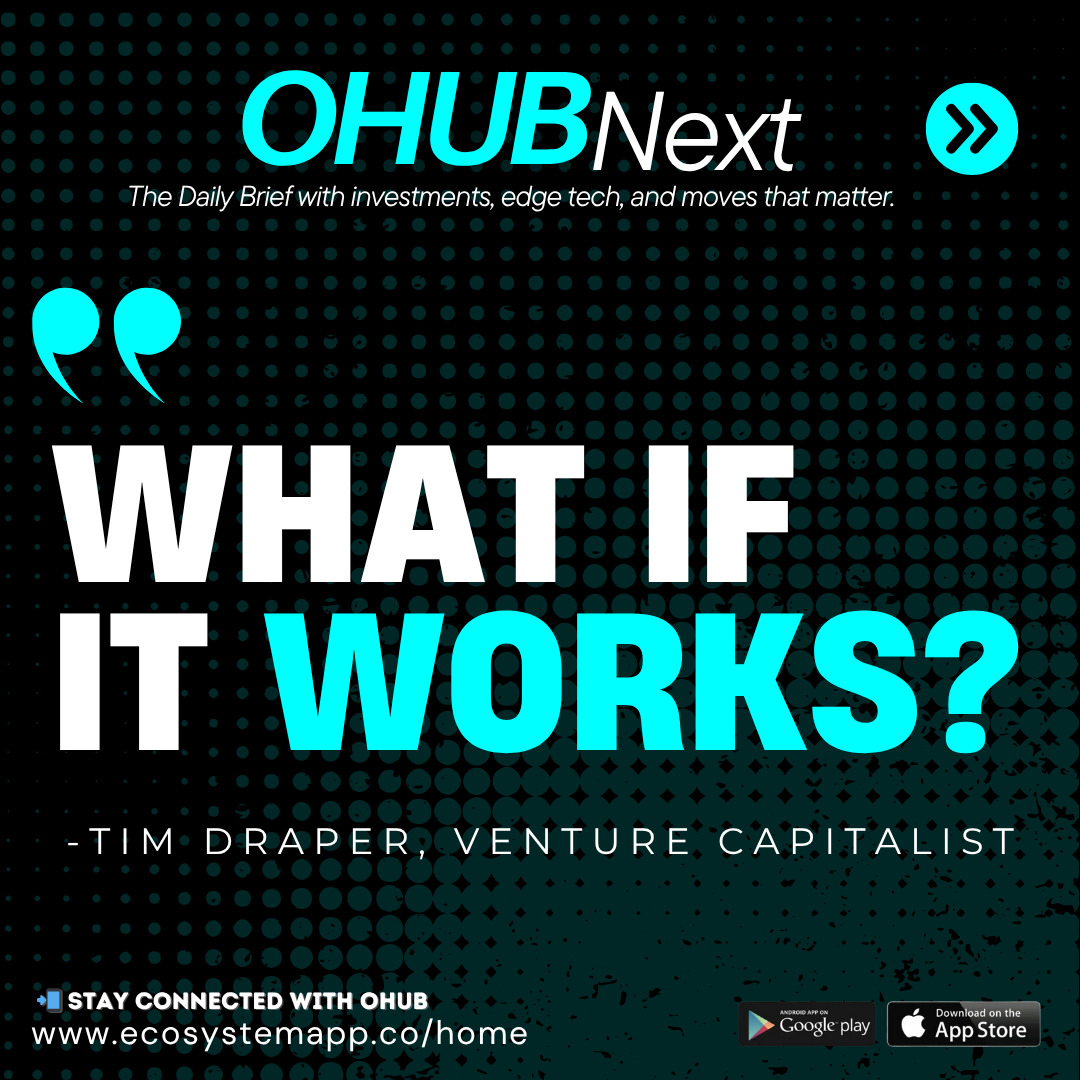
🚨 OHUBNext | Tim Draper’s ‘What If It Works?’ and the Future of Capital
🚨 OHUBNext | Tim Draper’s ‘What If It Works?’ and the Future of Capital
Welcome back, Builders!
Every generation inherits a question. Ours is simple: What if it works?
In 2021, Tim Draper — the Silicon Valley investor behind Tesla, Hotmail, and Bitcoin — posed this challenge to a room of founders. Where most investors obsess over downside risk, Draper flipped the script, and instead of asking “what could go wrong?” he asked “what if it works?”
That mindset created companies that redefined industries. But its true power lies beyond venture capital. What if it works? is bigger than a startup pitch. It’s a test for entire economies — for who gets access to capital, and for whether innovation can be designed to include everyone, not just a handful of favored zip codes.
And we already know which ones dominate the top five: Silicon Valley, New York, Boston, Los Angeles, Washington, D.C. For decades, they have absorbed the lion’s share of investment, talent, and attention.
Moonshots once defined ambition. They took us to space and proved human ingenuity could break gravity. But Draper’s question is wilder than a moonshot. Because it’s not just about technology — it’s about society. It asks us to imagine outcomes bold enough to rewrite who owns the future.
Let's dig in....
⸻
🌌 Beyond the Moonshot
For decades, “moonshot” projects — space travel, biotech breakthroughs, artificial intelligence — have been shorthand for human ambition. But Draper’s challenge is broader. A “what if it works?” moment is not only about technology. It is about society.
▪️What if inclusive innovation closes wealth gaps instead of widening them?
▪️What if underestimated founders secure the capital to build industries, not just startups?
▪️What if emerging regions — from Birmingham to Baton Rouge — become gravitational centers for the next economy?
Those are questions about power, not just progress. They are larger than rockets; they are about rewriting the terms of participation in the innovation economy.
⸻
📊 From Risk to Outcomes
In finance, the default is to count what can be lost — the downside, the dilution, the volatility. Tim Draper’s challenge is to count what can be gained.
Across the U.S., we are seeing proof that when capital flows differently, the returns compound in ways balance sheets alone can’t show. Programs like the State Small Business Credit Initiative are pushing billions into circulation. Local funds and accelerators are backing founders who’ve historically been overlooked. The result isn’t just new companies — it’s jobs, stronger neighborhoods, and tax bases that endure.
The point isn’t that risk disappears. It’s that the surest way to build lasting value is to focus on outcomes that multiply: not only profits for investors, but durable gains for communities. That is how wealth compounds over generations.
⸻
🚀 The Real Risk
The United States faces converging crises- artificial intelligence disrupting jobs, climate volatility, and widening inequality. The instinct is to retreat — to hedge, to wait. But Draper’s question is a reminder that the greater risk is never asking at all.
What if it works?
Because when it does, it will not look like a single company’s success. It will look like ecosystems transformed, families stabilized, and regions long overlooked becoming central to the global economy.
That is wilder than a moonshot. And it is already underway. It’s not a passing headline — it’s a lens, a test, and a charge. What if it works? is the idea we will keep driving home until inclusive innovation isn’t an aspiration, but the architecture of the economy itself.
And that's that!
⸻
💬 We invite readers to share: How are you rethinking risk today? What is your “what if it works?” bet — the way you are rewriting the script for this generation and the next?
⸻
⚡️ OHUBNext Daily Brief — investments, edge tech, and moves that matter.
For more than a decade, OHUB has worked to prove that access plus opportunity equals transformation. Draper’s challenge is a reminder that the extraordinary is not only possible, but inevitable — if we are willing to ask the right question.