
OHUB @ohub
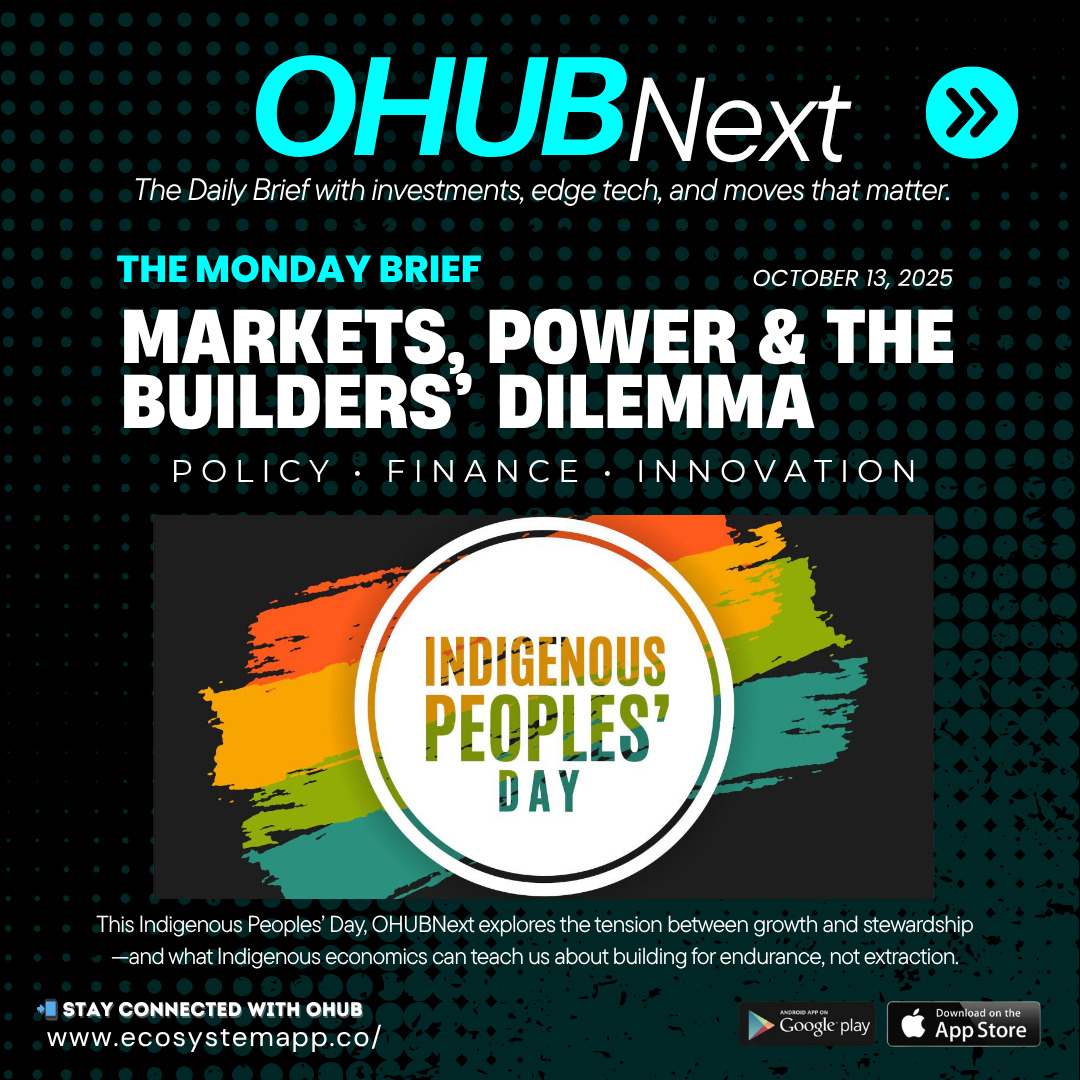
🚨 OHUBNext | On Indigenous Peoples’ Day, a Lesson for the Future
🚨 OHUBNext | On Indigenous Peoples’ Day, a Lesson for the Future
Hey Builders and Happy Indigenous Peoples’ Day!
Every nation has a story it tells about itself. Ours has been one of discovery, conquest, and constant motion — forward, faster, bigger. But today, on Indigenous Peoples’ Day, we pause to remember a quieter story- that true power has always been rooted in balance, not domination.
This holiday began as a correction of history. Now it feels like an invitation to wisdom. Long before the language of markets or monetary policy, Indigenous nations built systems around three simple principles: reciprocity, balance, and continuity.
Long before the language of markets or monetary policy, Indigenous nations across the Americas practiced an economy built on three principles: reciprocity, balance, and continuity.
Those principles feel strikingly relevant now, as leaders, founders, and investors confront the limits of an extractive growth model that’s running on fumes.
So, what can we learn—for the future we’re building?
⸻
🌾 1 | Reciprocity Over Extraction
Indigenous economies were not anti-growth; they were relationship-based.
Wealth flowed in cycles—land nourished people, people restored the land. Modern systems turned those cycles into one-way transactions.
The result is familiar: widening inequality, climate strain, and what economists call diminishing marginal trust.
Reciprocity offers a corrective. It reframes growth as mutual benefit rather than unilateral gain.
“Take only what you need. Give back more than you take.” — An Oglala Lakota principle often cited in community-development literature (Harvard Project on American Indian Economic Development, 2023).
For founders and investors, reciprocity means designing value chains that regenerate the communities and ecosystems that sustain them.
⸻
🌎 2 | Balance as Infrastructure
The Federal Reserve, Congress, and corporate America are all wrestling with imbalance—between inflation and wages, innovation and oversight, risk and regulation. Indigenous governance models approached equilibrium as a design feature, not an afterthought.
Among the Haudenosaunee (Iroquois Confederacy), every major decision considered its impact seven generations ahead (Smithsonian NMAI, 2024).
That temporal discipline contrasts sharply with quarterly earnings cycles and election-year incentives.
Imagine building policy the way we build legacy — with a horizon that spans seven generations instead of seven years. Now that's what you call "future-proofing."
⸻
🔁 3 | Continuity as Strategy
Sustainability has become corporate shorthand, but Indigenous economies practiced continuity—ensuring systems could self-renew.
The Confederated Salish and Kootenai Tribes’ hydroelectric utility in Montana, for instance, reinvests energy revenues into language preservation and ecological restoration (U.S. Department of Energy case study, 2024).
So what's the takeway? Continuity ties innovation to responsibility. It’s the difference between extracting value and extending life. In the end, what we sustain is the only proof that we ever built anything real in the first place.
⸻
🧭 4 | Applying the Lesson
For builders, this day isn’t just remembrance—it’s a challenge.
Founders: build companies where value moves through people, not over them.
Investors: see stability not as a drag on profit, but as its very foundation.
Policymakers: write laws that our grandchildren for generations to come will thank us for.
Stewardship is less about generosity than about governance—the recognition that enduring systems depend on reciprocal care. And, that's the part we cannot afford to forget.
⸻
🔚Closing Reflection
Columbus Day told us to look outward for new worlds. Indigenous Peoples’ Day invites us to look inward at how we care for this one. Lasting prosperity isn’t built on ownership—it’s built on reciprocity. That lesson isn’t from the past; it’s a map for where we’re headed.
⸻
“Through reciprocity the gift is replenished. All of our flourishing is mutual.” — Robin Wall Kimmerer, Braiding Sweetgrass
⸻
⚡ OHUBNext Daily Brief — investments, edge tech & moves that matter
For 12 years, OHUB has built pathways to multigenerational wealth without inherited capital. Through exposure, skills, entrepreneurship, and inclusive capital markets, we’ve helped people create new jobs, new companies, and new wealth.