

OHUB @ohub
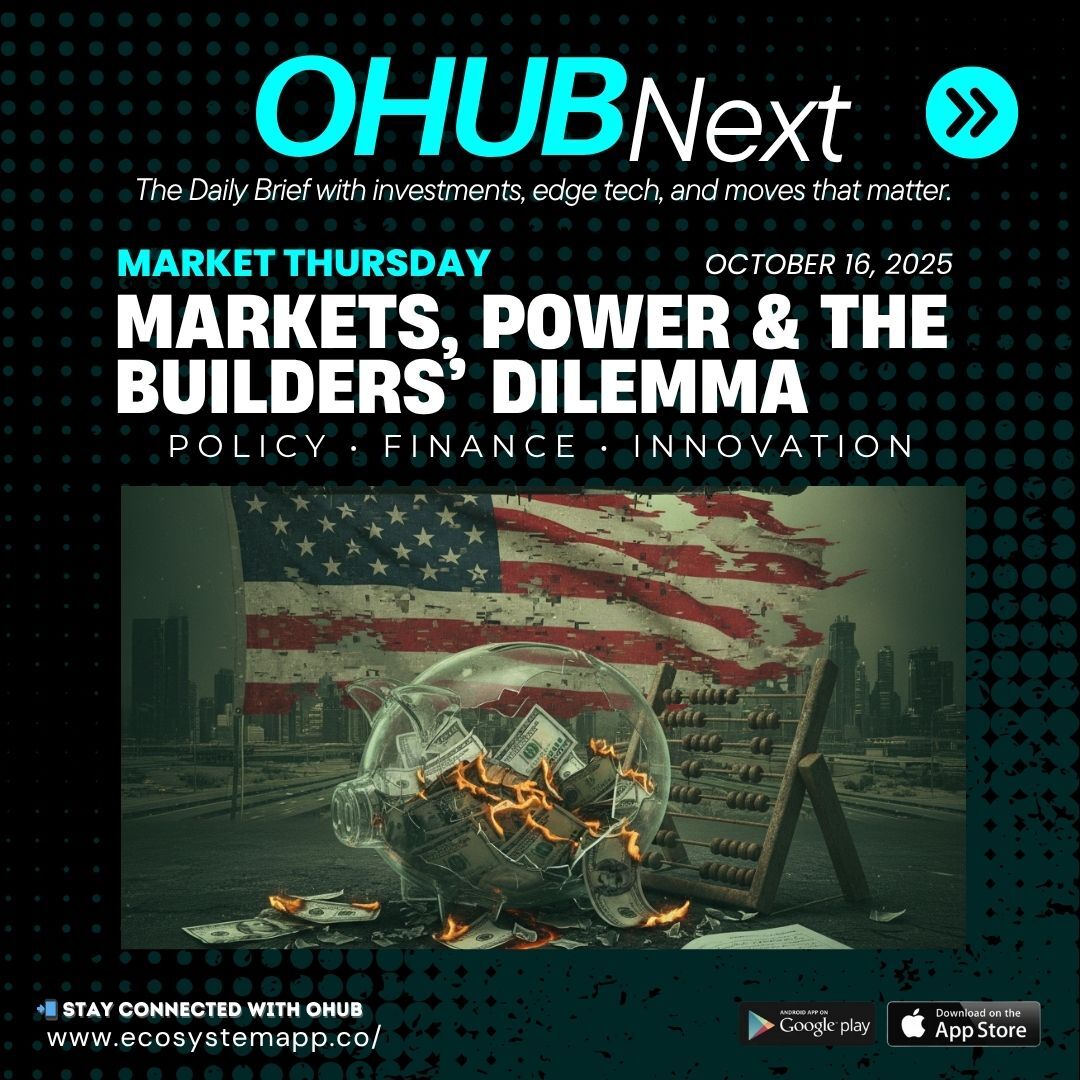
🚨 OHUBNext | The Shutdown Costing America $15 Billion a Week — And Counting!
🚨 OHUBNext | The Shutdown Costing America $15 Billion a Week — And Counting!
📍 As Washington falters, markets find their own tempo — dancing through a downpour of change and unpredictability.
Hey Builders!
Welcome to back to Market Thursday — your weekly pulse on money, policy, and innovation that shape the next economy.
This week’s biggest market mover wasn’t a tech stock, an earnings call, or a rate cut. It was inaction on behalf of Congress.
Treasury Secretary Scott Bessent said the ongoing government shutdown is costing the United States roughly $15 billion per week in lost output — a figure later confirmed by the Treasury Department and the White House’s Council of Economic Advisers (Reuters, Politico).
That number is staggering — roughly the economy of Kansas City, Missouri, erased every seven days. Beyond the headlines, it’s freezing data releases, slowing small-business lending, delaying federal contracts, and eroding global confidence in the U.S. dollar.
Surprisingly, markets aren’t panicking — yet. They’re adapting. Investors are treating the shutdown as another macro variable to trade, instead of fear. But let's not fool ourselves, at $15 billion per week, this level of political paralysis is now a measurable drag on economic growth.
⸻
📰 Top Story — A $15 Billion-a-Week Mistake
The Treasury estimates that every week of gridlock will shave roughly 0.1 percent off quarterly GDP (Reuters, Politico). The Fed’s policy meetings are running on incomplete data; federal payrolls and inflation numbers are delayed. Investors call it “price discovery without information.”
Treasury markets reacted first. Yields rose even after the Fed’s recent quarter-point rate cut — a sign that uncertainty, not optimism, is driving demand. Meanwhile, gold touched a record $4,200 per ounce, its sharpest single-month rally since 2020 (Reuters). Traders are hedging against the government itself.
Bessent defended the administration’s stance, saying the U.S. investment boom remains sustainable — but even he acknowledged that the longer the standoff drags on, the harder it becomes to regain momentum.
The irony? While Washington debates, Wall Street adapts. AI stocks climb, corporate profits hold, and retail traders treat volatility like a game they’ve already mastered.
The economy isn’t collapsing — it’s hacking its own system. In some ways, the U.S. is starting to look less like a nation-state and more like a startup- agile, reactionary, and always fundraising.
⸻
💼 Quick Briefs (Founder Focus)
1️⃣ AI • Chips Keep the Market Alive
Nvidia, TSMC, and Arm continued to lift indexes as AI demand offsets macro gloom.
💡 Takeaway: Infrastructure wins when confidence wavers.
2️⃣ Venture • Funding Defies the Mood
Global venture capital rose 11 percent in Q3, led by applied AI and clean energy.
💡Takeaway: Capital still chases clarity. Tell a believable story.
3️⃣ Policy • Shutdown Becomes a KPI
Every day of gridlock delays data releases and procurement deals.
💡Takeaway: Plan for slower federal decision cycles in Q4.
4️⃣ Capital • Bonds Beat the Drama
Investment-grade issuance stays oversubscribed despite rising yields.
💡Takeaway: Consistency remains currency.
5️⃣ People • Retail Traders Move the Needle
Over 108 million options contracts changed hands in a day — an all-time record.
💡Takeaway: The crowd now trades like institutions.
6️⃣ Ecosystems • Global Markets Stay Resilient
Europe and Asia logged solid Q3 gains; Japan posted double-digit equity growth.
💡Takeaway: Opportunity is regional, not just domestic.
⸻
🧑🏽💻 Builder Insight — Three Rules for Navigating Gridlock
1. Build for the gaps. When policy slows, private innovation accelerates.
2. Treat volatility as signal, not noise. The data drought will reward those who can read indirect indicators.
3. Lead with clarity. In a foggy market, founders who communicate well attract capital first.
⸻
🎬 Closing Thoughts
In the 1980s, R&B crooners New Edition — Ricky, Mike, Ronnie, Ralph, and Johnny — asked a timeless question: “Can you stand the rain?”
Back then, it was a plea for patience and love — a song about weathering hardship together and emerging not just intact, but stronger, a quiet testament to endurance.
In this context, the rain looks quite different — a love affair not between partners, but between a nation and its people, strained by policy gridlock and economic fatigue.
And the heartbreak has taken a new form — $15 billion a week lost to inaction, systemic dysfunction, and markets sprinting ahead of leadership at an unrelenting pace.
Now, we might not have the soothing tone or the smooth choreography New Edition once offered, but we’re still asking the same question —
America, can you stand the rain?
Will you weather this storm?
Only time will tell.....
⸻
🗣️ Quote of the Day
“What matters most is not the shock itself, but how we adapt to it.”
— Jerome Powell, Federal Reserve Chair (FOMC press conference, March 2024)
⸻
⚡️ OHUBNext Daily Brief — investments, edge tech, and moves that matter.
For 12+ years, OHUB has been building pathways and on-ramps to multigenerational wealth — without reliance on pre-existing wealth. Through exposure, skills, entrepreneurship, capital markets, and inclusive ecosystems, we’ve helped people create new jobs, new companies, and new wealth.