

OHUB @ohub
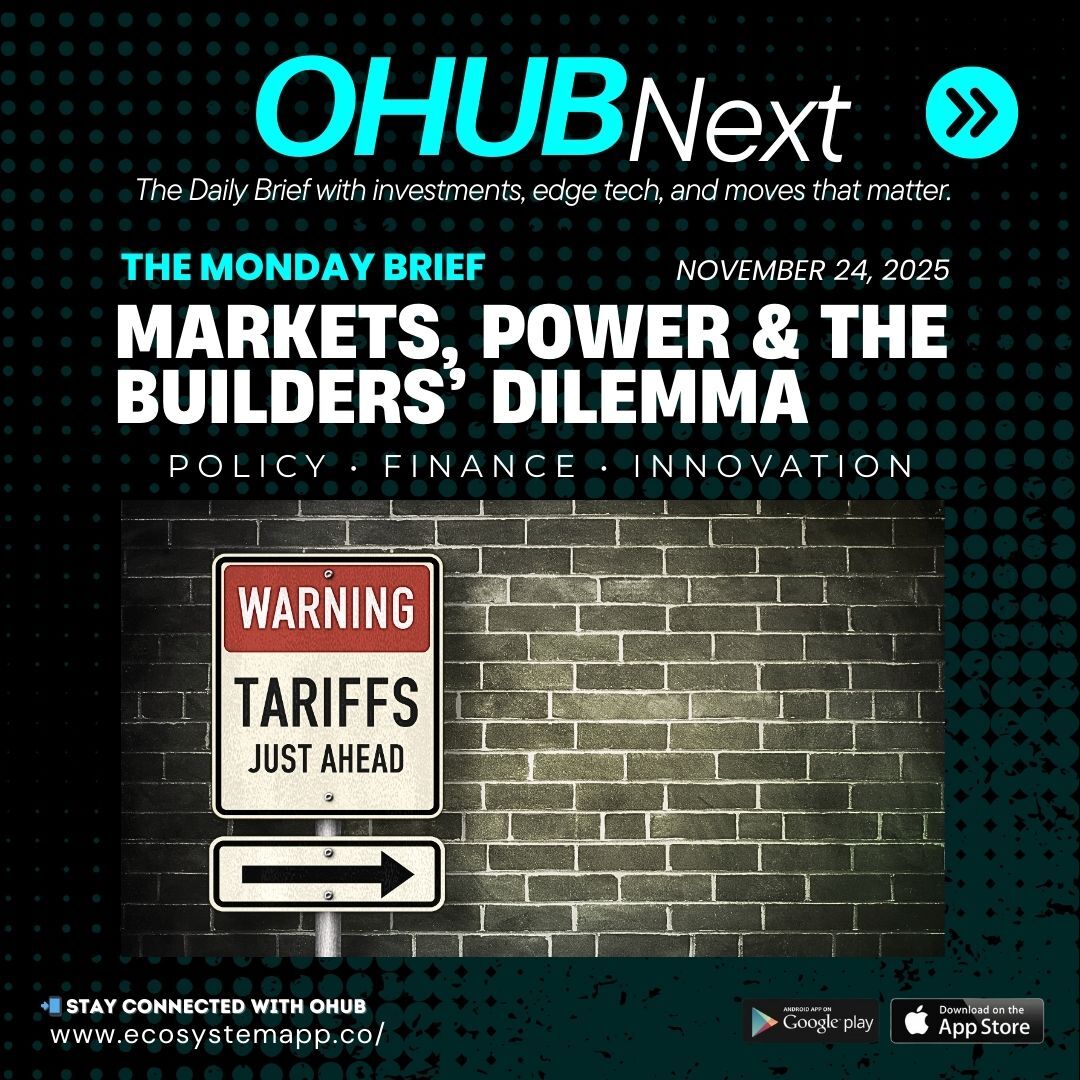
🚨 OHUBNext | The New Tariff-Driven Real Economy
🚨 OHUBNext | The New Tariff-Driven Real Economy
📍 America’s next economy won’t be shaped by markets alone — but by tariffs, leverage, and the return of economic nationalism.
⸻
Hey Builders!
Over the past 72 hours, markets, governments, and multinational corporations have begun bracing for what analysts are calling “the most aggressive American tariff cycle in modern history.”
With the incoming administration signaling steep, wide-ranging tariffs on China, Mexico, and select EU partners, a new reality is taking shape:
The next phase of the U.S. economy will be tariff-driven, not trade-driven.
And that shift won’t only affect governments and Fortune 100s — it will reshape the daily financial lives of households, small businesses, and the builders navigating both the digital and real economies.
This Monday Brief breaks down the signals, the stakes, and the strategic moves for the week ahead.
⸻
🗞 Top Story — A New Trade Reality, A New Economic Operating System
Tariffs aren’t just taxes on imported goods. They are policy tools — levers that reshape power, prices, and production.
What’s emerging now is not a temporary political move.
It’s an operating system rewrite.
Here’s what economists and policy analysts at PIIE, Wharton, and CBO are warning:
1️⃣ Tariffs Are Becoming a Primary Policy Instrument
New proposals include steep duties on manufacturing inputs, electronics, autos, microchips, and select raw materials — a sharp reversal from decades of globalization.
This isn’t protectionism.
It’s economic statecraft.
2️⃣ Corporations Are Rebuilding Their Supply Chains
Multinationals are preparing for higher costs, delayed shipments, and the need for nearshoring (Mexico, Canada, Brazil) or friend-shoring (India, Vietnam).
This will raise costs — and force new investment.
3️⃣ Small Businesses Will Feel It the Most
Most U.S. small businesses depend on imported goods or imported components.
Tariffs don’t hit big corporations first —
they hit wholesalers, e-commerce sellers, hardware stores, startup manufacturers, and local service providers.
4️⃣ Households Will See Rising Prices
Consumer economists warn: tariffs move through the economy like a slow wave — steady, deliberate, and impossible to outrun once the momentum builds.
Within weeks to months, the added costs show up in:
▪️ Appliances
▪️ Furniture
▪️ Electronics
▪️ Vehicles
▪️ Clothing
▪️ Construction materials
▪️ Small business services
This is inflation by another name.
5️⃣ States and Cities Will Have to Rebuild Their Playbooks
Economic development strategies that relied on cheap inputs, foreign suppliers, and long supply chains will have to be rewritten.
Policymakers are bracing for higher infrastructure costs and slower project timelines.
⸻
⚡ Quick Briefs — What to Watch This Week
▪️ Asia markets dipped as tariff expectations triggered modeling of higher export friction (Bloomberg, Reuters).
▪️ European officials warn of retaliation, signaling a possible multi-front tariff battle.
▪️ U.S. manufacturers request exemptions, arguing certain components have no domestic alternatives (Wharton).
▪️ Consumer sentiment softened further, signaling anxiety about future household costs (University of Michigan).
▪️ Nearshoring investment spikes, with Mexico seeing a surge in factory commitments (SIEPR).
⸻
🧱 Builder Insights — What This Means for You
1️⃣ Expect higher prices — plan for them.
Tariffs hit inputs first, consumers second, and businesses hardest in between.
2️⃣ If you manufacture, diversify now.
Single-region supply chains are now liabilities.
3️⃣ If you operate digitally, watch COGS closely.
Everything from servers to devices has global dependencies.
4️⃣ If you’re fundraising, know the macro story.
Investors will ask how tariff-driven costs affect your burn and your runway.
5️⃣ If you serve households or small businesses, prepare for belt-tightening.
Demand will shift — not disappear — but it will skew toward essentials.
⸻
💬 Quote of the Day
“Tariffs don’t change where products come from — they change who pays for them.” — Chad Bown, Senior Fellow, Peterson Institute for International Economics
⸻
🎬 Closing Thought
The tariff-driven real economy isn’t theoretical anymore.
It’s here — and accelerating.
Markets will adjust. Corporations will adapt. Governments will retaliate. But builders have an advantage the legacy systems simply don't.
Agility.
This week, challenge yourself: choose one action that increases your organization’s resilience — refine a supplier relationship, review cost exposures, or run a forward-looking scenario analysis.
Because the age of cheap stability is over —
and the price of unpreparedness is about to get very, very real.
You heard it here first.
⸻
⚡ OHUBNext Daily Brief — investments, edge tech, and moves that matter.
For 12+ years, OHUB has been building pathways to multigenerational wealth through exposure, skills, entrepreneurship, capital markets, and inclusive ecosystems.