

OHUB @ohub
🚨 OHUBNext | The Thanksgiving Economy Is Split — And So Is the Workforce
🚨 OHUBNext | The Thanksgiving Economy Is Split — And So Is the Workforce
📍 Before the country sits down to eat, the labor market delivered the real headline — the K-shaped economy isn’t theoretical anymore. It’s showing up in every major data release.
⸻
Hey Builders!
The day before Thanksgiving usually brings the same narrative — crowded airports, packed grocery aisles, a country preparing to slow down.
This year brings something different: a real-time snapshot of the K-shaped economy that will define American work and wages heading into 2026.
Some households are entering the holiday with record savings and wage gains. Others are carrying rising debt, reduced hours, and the longest job-search stretches since 2021.
The same economy is producing two very different Thanksgivings.
⸻
🗞 Top Story — The K-Shaped Workforce, Exposed
This week’s numbers sharpened the divide:
▪️ Continuing unemployment claims reached their highest level since late 2021 (BLS).
▪️ Wage growth remains strong in AI, healthcare, engineering, and other high-skill sectors — up 5–7% year over year.
▪️ Wage gains for hourly and service workers have flattened or fallen behind inflation (BLS, Atlanta Fed).
▪️ Holiday spending is on pace to break records even as consumer sentiment sits near decade lows (University of Michigan).
▪️ Corporate profits remain solid while household delinquencies rise fastest among lower-income families (New York Fed).
▪️ Remote-capable workers gain flexibility and higher compensation; location-bound workers absorb the full cost of inflation.
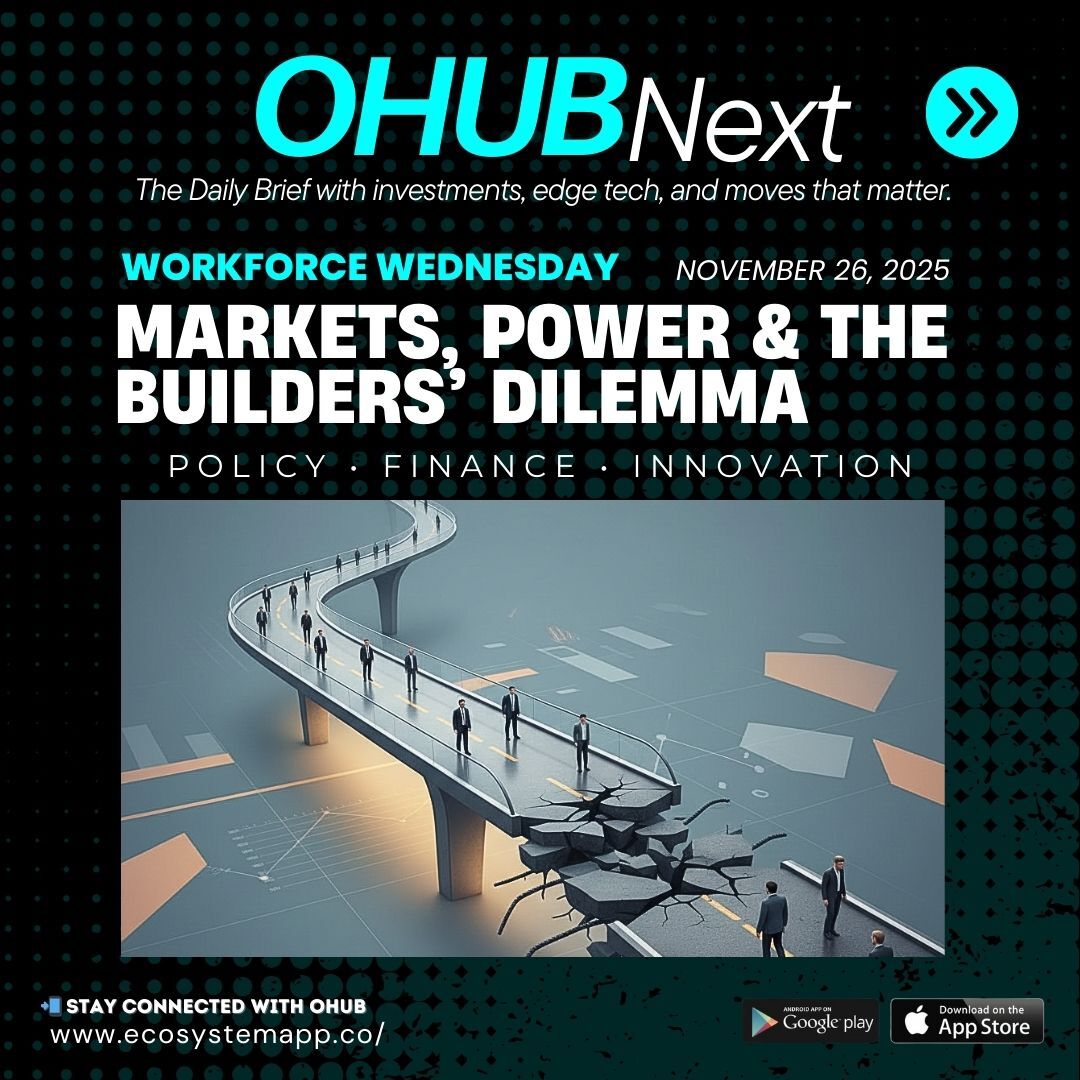
This is the K-shaped economy in motion: one path bending upward, the other bending down.
Thanksgiving just makes the split harder to ignore — some tables full, others stretched thin.
⸻
⚡ Quick Briefs — What’s Moving the Labor Market
▪️ AI-related roles grew more than 40% year over year (Indeed Hiring Lab).
▪️ Retail and logistics hiring remains seasonal but hours have shortened — a sign of cautious demand (BLS).
▪️ Childcare shortages continue to suppress labor force participation, especially for women (U.S. Treasury).
▪️ Skills mismatches widen as AI-literate roles outpace the supply of qualified workers.
▪️ Layoff announcements tick up across real estate, media, and non-tech corporate sectors.
▪️ The restart of student loan payments is straining younger and lower-income households (Department of Education).
⸻
🧱 Builder Insights
1️⃣ Make decisions using sector-specific data, not broad headlines.
2️⃣ Treat AI and data literacy as fundamentals — not differentiators.
3️⃣ For employers, flexible work is a competitive necessity.
4️⃣ Build financial buffers where possible; volatility is uneven but rising.
5️⃣ Align your career or hiring strategy with where momentum truly is — not where it used to be.
⸻
💬 Quote of the Day
“Workers are experiencing two economies at once — one defined by opportunity, one defined by constraint.”
— Lawrence Katz, Harvard Labor Economist
⸻
🎬 Closing Thought
Thanksgiving often reveals the economy in ways the data won’t until months later.
Who feels secure and who feels stretched is the clearest readout of a labor market splitting in two. If your table is full, that reflects your position in an economy rewarding high skills and insulation. If it’s a harder year, that’s not personal failure — it’s structural divergence.
Automation, wage polarization, and uneven inflation are pulling workers onto different tracks. The coming year won’t erase that split, but it will reward those who move deliberately — reskilling, protecting attention, and positioning for upward mobility.
The K-shaped economy isn’t a forecast. It’s the operating reality of 2026. The real risk now is treating structural change like temporary turbulence.
Upward mobility is still on the table — but increasingly for those who move with focus, strategy, and skill in the year ahead.
⸻
⚡ OHUBNext Daily Brief — investments, edge tech, and moves that matter.
For 12+ years, OHUB has been building pathways to multigenerational wealth through exposure, skills, entrepreneurship, capital markets, and inclusive ecosystems.