

OHUB @ohub
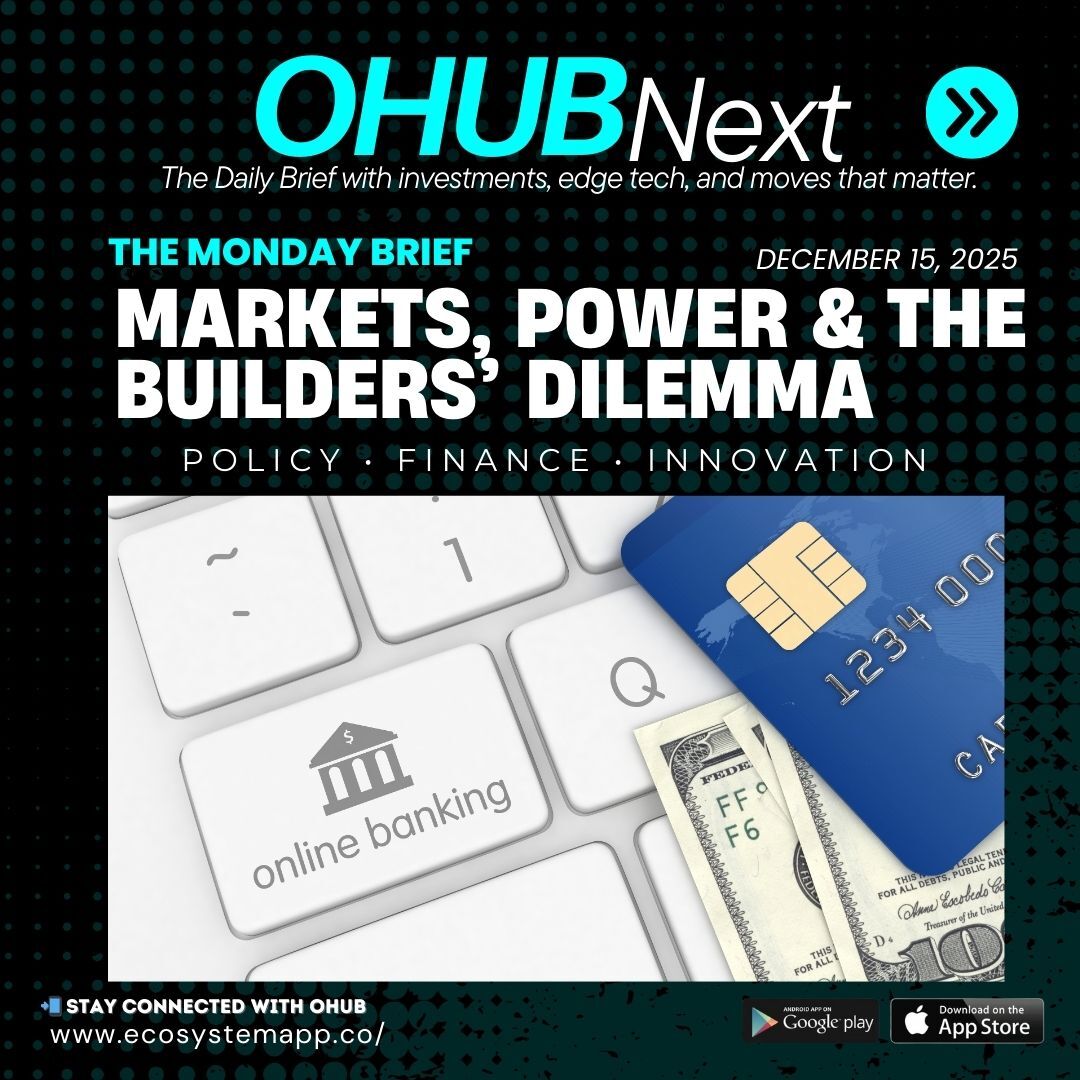
🚨 OHUBNext | The New Bank Is Digital—And It’s Not Who You Think
🚨 OHUBNext | The New Bank Is Digital—And It’s Not Who You Think
📍 PayPal just applied to become a bank.
⸻
Hey Builders!
Heading into the final stretch of 2025, a headline dropped that could reshape the financial landscape far more than any rate-cut speculation or holiday retail data:
PayPal has formally applied to become a bank.
Not a partner bank.
Not a pseudo-bank.
A regulated depository institution operating under newly loosened federal rules (Bloomberg).
This move lands at a moment when traditional banks are pulling back from risk, fintechs are fighting for margin, and regulators are redefining what “banking” even means in a digital economy.
It’s a signal with enormous implications for workers, founders, and cities.
Said differently, financial infrastructure is being rebuilt — and the next generation of institutions may not look like the ones that shaped the last century.
⸻
🗞 Top Story — PayPal’s Banking Play Reveals the New Rules of Financial Power
For years, fintech firms operated in a regulatory gray zone — offering bank-like experiences without the balance-sheet responsibilities or charter authority.
That era is ending.
This week’s move shows that financial power is migrating to institutions that build capability, not those that preserve legacy scale.
1️⃣ Fintechs are moving upstream into regulated finance, not away from it. Owning deposits, payment rails, and compliance infrastructure gives them control that partnerships never could.
2️⃣ Regulators are shifting from restriction to modernization.
The loosening of federal rules signals Washington’s willingness to let tech-native firms compete directly with legacy banks.
3️⃣ The unbundling of banking is reversing — but in tech’s favor.
Fintech once chipped away at bank functions. Now fintech is rebuilding them — with speed, data, and AI capabilities banks can’t match.
4️⃣ The real competition won’t be about checking accounts. It will be based a few different variables- including but not limited to:
▪️ Who controls identity
▪️ Who controls credit
▪️ Who controls real-time payments
▪️ Who controls small-business underwriting
▪️ Who controls transaction-level behavioral data
Put simply, this move signals the emergence of a new financial backbone—one built around digital rails rather than brick-and-mortar institutions.
⸻
⚡ Quick Briefs — What This Means for the Economy
▪️ Deposit flight risk shifts as consumers show willingness to bank with tech companies they trust more than traditional institutions (Reuters).
▪️ Small-business credit could improve through AI-driven underwriting — or worsen if risk models tighten.
▪️ Payment fees are likely to fall as fintech-bank hybrids compete directly with incumbents.
▪️ Regulatory scrutiny will intensify around data use, AI decisioning, and platform-market power (CBO).
▪️ Tech-talent demand in compliance, risk, and AI modeling will accelerate.
This is not a financial story.
It’s a systems redesign story.
⸻
🧱 Builder Insight
The future of financial power won’t be won by whoever has the most branches or the largest marketing budget.
It will be won by whoever controls:
1️⃣ The rails — payments, deposits, identity
2️⃣ The intelligence — AI models trained on real economic behavior
3️⃣ The interface — the point where consumers and businesses actually take action
4️⃣ The trust — speed, transparency, and reliability in an increasingly volatile market
For workers, founders, and policymakers, the takeaway is simple.
Modernization rewards those who build. Defending old terrain is no longer a competitive strategy in a system that’s already shifting beneath it.
⸻
🎬 Closing Thought
PayPal’s bank application is not merely a corporate milestone —
it’s an early indicator that the locus of financial power is migrating.
The gravitational center of the system is shifting away from legacy banks toward institutions that natively operate in data-rich, high-velocity environments and understand consumer behavior at algorithmic scale.
The central question for 2026 is no longer “Which banks will endure?”
It is “Which institutions will become the infrastructural substrate through which economic mobility flows?”
For underestimated founders, workers, and entire communities, the consequences of that shift are profound — because the institutions that control the rails will shape who participates in the next economy and on what terms.
⸻
💬 Quote of the Day
“Banking is necessary. Banks are not.” — Bill Gates
⸻
⚡ OHUBNext Daily Brief — investments, edge tech, and moves that matter.
For 12+ years, OHUB has been building pathways to multigenerational wealth through exposure, skills, entrepreneurship, capital markets, and inclusive ecosystems.