

OHUB @ohub
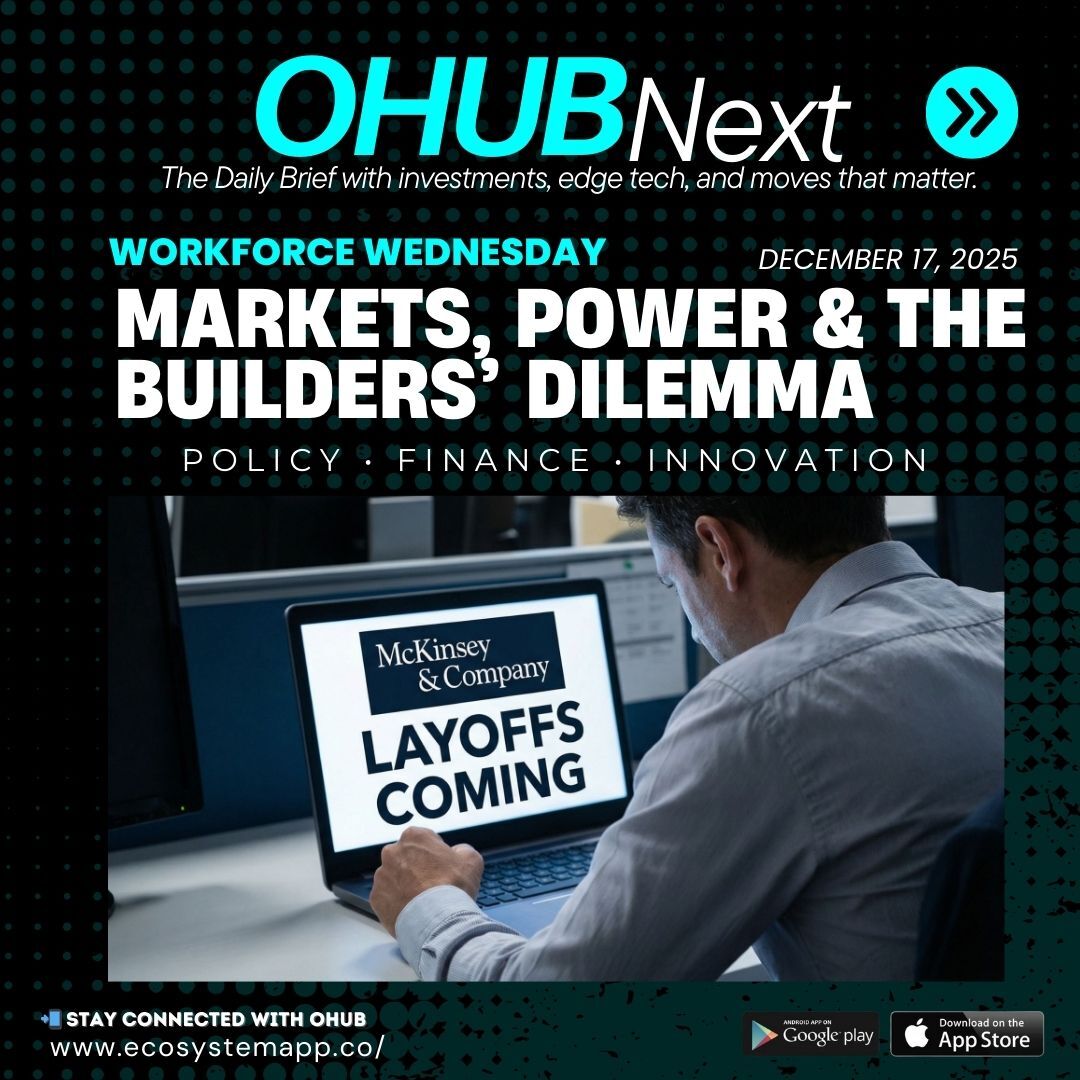
🚨 OHUBNext | When McKinsey Follows Its Own Advice
🚨 OHUBNext | When McKinsey Follows Its Own Advice
📍 The world’s most influential consulting firm is doing what it’s told clients for decades- cut where value thins, protect where it compounds.
⸻
Hey Builders!
This week, McKinsey & Co. said it plans to cut roughly 10% of its non-client-facing workforce—thousands of roles over the next 18 to 24 months—while continuing to hire consultants, underscoring a broader shift in how firms are reallocating talent.
That tension is not accidental.
It is strategic.
After a decade of rapid expansion, McKinsey’s revenue has hovered between $15 billion and $16 billion for nearly five years, forcing a reassessment of where growth still justifies scale.
At the same time, AI has accelerated the automation of research, internal coordination, and operational support—the very layers that once sat between insight and execution.
McKinsey is not shrinking.
It is re-optimizing for a more compressed, outcome-driven economy.
⸻
🗞 Top Story — When the Advisors Apply the Playbook to Themselves
McKinsey’s move mirrors what’s happening across corporate America:
▪️ Support functions are being compressed, automated, or eliminated
▪️ Client-facing and decision-making roles are being protected
▪️ AI is collapsing layers between insight, judgment, and execution
The cuts are concentrated far from revenue, while consultants—the firm’s value engine—remain a hiring priority.
That’s the real signal.
This isn’t about cost cutting for survival.
It’s about repositioning for an economy where capability density matters more than headcount.
McKinsey is quietly acknowledging what many firms are now discovering: scale without leverage is fragile.
⸻
⚡ Quick Briefs — Where the Workforce Pressure Is Concentrating
McKinsey’s reset reflects broader workforce realities:
▪️ AI is replacing coordination faster than expertise.
Internal process roles are being automated first.
▪️ Clients are more cost-conscious than brand-loyal.
Even elite advisors must justify every dollar of value.
▪️ Public-sector consulting demand is tightening.
Government pullbacks are removing a key buffer for large firms.
▪️ Geopolitics is now a workforce variable.
China, Saudi Arabia, and U.S. policy shifts are reshaping where demand shows up.
In short: the market is repricing labor based on proximity to outcomes.
⸻
🧱 Builder Insight — The New Rules of Workforce Resilience
McKinsey’s move surfaces four hard truths:
1️⃣ Distance from value is risk.
The further your role sits from revenue, decisions, or outcomes, the more exposed it becomes.
2️⃣ AI compresses layers, not ambition.
Fewer people will do more—but only those who can orchestrate tools, not just manage processes.
3️⃣ Brand is no longer insulation.
If McKinsey isn’t immune, no logo is.
4️⃣ Capability beats tenure.
The labor market is rewarding what you can do, not how long you’ve been somewhere.
⸻
💬 Quote of the Day
“We’re operating in a moment shaped by rapid advances in AI that are transforming business and society.”
— Bob Sternfels, Global Managing Partner, McKinsey & Co.
⸻
🎬 Closing Thought
McKinsey cutting jobs is not a warning sign. It is a preview of how rational organizations reallocate value under constraint.
In periods of acceleration, strong institutions stop asking how large they can grow and start asking where marginal effort still produces marginal returns. Work that does not directly move outcomes is eventually priced out, regardless of pedigree or brand.
For leaders, founders, and workers alike, the decision frame has shifted.
The question is no longer whether a company is stable.
It is whether an individual is positioned where decisions compound into value, or where they are simply processed.
In an AI-accelerated economy, distance from consequence is not neutral. It is a measurable risk the market now identifies and corrects for far faster than before.
So where does your work actually sit in the value chain—and if it disappeared tomorrow, what outcome would change?
⸻
⚡ OHUBNext Daily Brief — investments, edge tech, and moves that matter.
For 12+ years, OHUB has been building pathways to multigenerational wealth through exposure, skills, entrepreneurship, capital markets, and inclusive ecosystems.