
OHUB @ohub
Honoring Dr. King Beyond the Dream
Honoring Dr. King Beyond the Dream
“We are now faced with the fact that tomorrow is today.”
— Dr. Martin Luther King Jr.
⸻
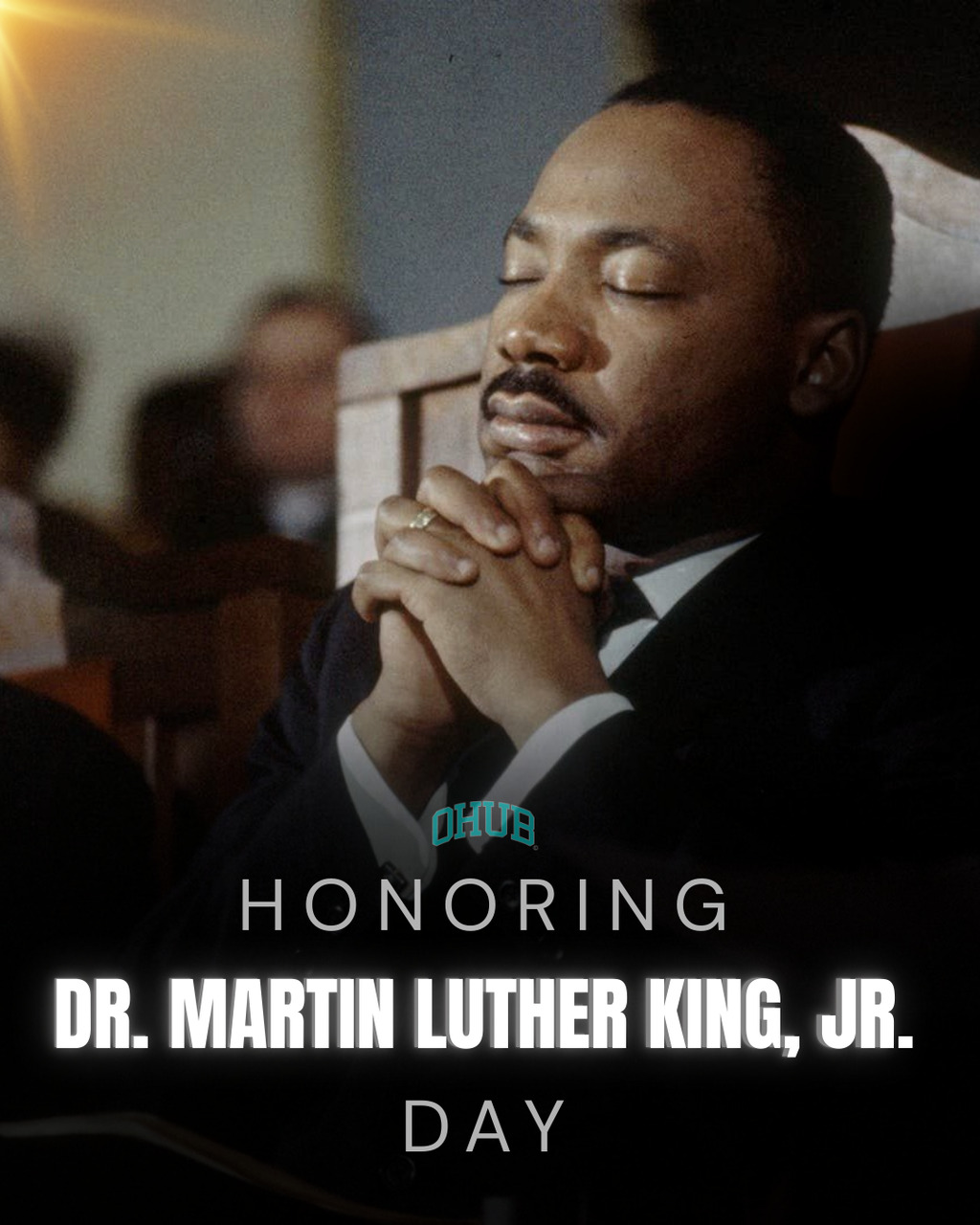
To honor the legacy of Dr. Martin Luther King Jr.
Each year, the nation pauses to honor Martin Luther King Jr., often through language that emphasizes unity and aspiration. What is less frequently acknowledged is that King’s leadership was fundamentally disruptive—directed not at attitudes alone, but at the political and economic systems that made inequality durable and delays for change acceptable.
Dr. King was not simply calling the nation to conscience; he was challenging the structures that governed power, opportunity, and inequality. He understood that injustice was not random or episodic. It was produced—consistently—by interconnected systems of law, labor markets, capital allocation, and state authority. In that context, delay was not neutral. It was a choice.
This is why King rejected gradualism as a governing philosophy. His critique of white moderation was not emotional or rhetorical. It was analytical. Delay functioned as governance—preserving order, protecting incumbency, and redistributing harm downward while maintaining the appearance of reasonableness.
⸻
Why disruption, not consensus, drives real change...
Viewed through an innovation lens, King’s approach appears notably modern. Transformational change rarely emerges through consensus. More often, it arrives through friction.
Disruption unsettles entrenched interests. It exposes inefficiencies disguised as stability. It forces institutions to confront assumptions that persist largely because they feel familiar. King understood that systems optimized for order often resist reform not because reform lacks clarity, but because reform carries consequences.
Stability, in this sense, is not synonymous with justice. More often, it reflects alignment—between institutions, incentives, and power.
⸻
King’s most controversial ideas were the most coherent..
This framework helps explain why King’s later work is so often misunderstood. His opposition to the Vietnam War, his critique of capitalism without moral constraint, and his call for economic redistribution are frequently described as departures from his civil rights agenda.
They were not. They were extensions.
King understood racial justice, economic justice, and peace as interdependent variables within a single system. Treating them as separate issues produced partial solutions while leaving the underlying architecture intact. King refused that fragmentation. He insisted on coherence—even when coherence carried personal, political, and professional cost.
⸻
Resistance was a signal, not a failure...
As King’s analysis became more systemic, his public approval declined. This is often framed as tragedy. It is also instructive.
Resistance, in this context, was not evidence of miscalculation. It was evidence of proximity to power. Work that addresses surface-level symptoms is often tolerated. Work that interrogates system design rarely is.
King’s declining popularity was not incidental. It was diagnostic.
⸻
A framework for ethical leadership, not a finished agenda...
Dr. King did not leave behind a completed program or a closed theory. He left a discipline—a way of thinking about leadership, power, and progress.
Honoring that legacy requires more than remembrance. It requires application.
If King’s work is to be taken seriously today, three principles stand out.
⸻
Three ways to apply King’s discipline today...
1. Treat delay as a design choice.
Time is not neutral. Delay benefits someone. Leaders must ask who gains from postponement—and who bears the cost of patience.
2. Evaluate innovation by moral impact, not efficiency alone.
Growth without ethical constraint accelerates inequality. Progress should be assessed not only by scale or speed, but by who benefits and who is left out.
3. Accept disruption as the cost of ethical leadership.
Leadership that produces no resistance is often preserving stability rather than changing outcomes. Meaningful transformation rarely receives validation in real time.
⸻
In closing...
Dr. King did not leave a finished system.
He left a framework—deliberately unfinished, deliberately demanding.
The measure of his legacy is not how often it is cited, but how often it is practiced. Not whether it inspires reflection, but whether it changes behavior. Not whether it comforts power, but whether it continues to challenge it.
History will not ask whether we admired Dr. King.
It will ask whether we finished any part of the work he made unavoidable.
So, ask yourself—today and going forward.
With freedoms at your fingertips that were unavailable to many generations before you, how are you honoring the sacrifices and living out the legacy of Dr. Martin Luther King Jr.?
Happy Dr. Martin Luther King Jr. Day!
⸻
About OHUB
For 12+ years, OHUB has been building pathways to multigenerational wealth through exposure, skills, entrepreneurship, capital markets, and inclusive ecosystems.