

OHUB @ohub
🚨 OHUBNext | $5T Ownership Shift Reshaping Wealth Access
🚨 OHUBNext | $5T Ownership Shift Reshaping Wealth Access
📍 The biggest ownership transfer in U.S. history is underway — here's what it means for your wealth-building playbook.
⸻
TL;DR
▪️ McKinsey identifies 6 million baby boomer-owned businesses facing ownership transitions by 2035; more than 1 million are viable candidates for sale, representing up to $5 trillion in enterprise value — the largest ownership transition in modern U.S. history.
▪️ Black entrepreneurs currently capture just $87 billion of that transfer at current participation rates — but increasing participation could push that figure above $369 billion.
▪️ A landmark Harvard Business Review study (March 2026) finds AI is cutting 17% of job postings in routine cognitive roles while boosting demand 22% in human-AI collaboration positions.
▪️ Monthly tariff payments for midsize U.S. firms tripled from early 2025 levels, per a February 2026 JPMorgan Chase Institute analysis — squeezing existing owners and accelerating sale timelines.
⸻
Hey Builders!
Six million businesses. Five trillion dollars. And the communities with the most to gain? Most don’t even know the clock is running.
Let that sit for a second.
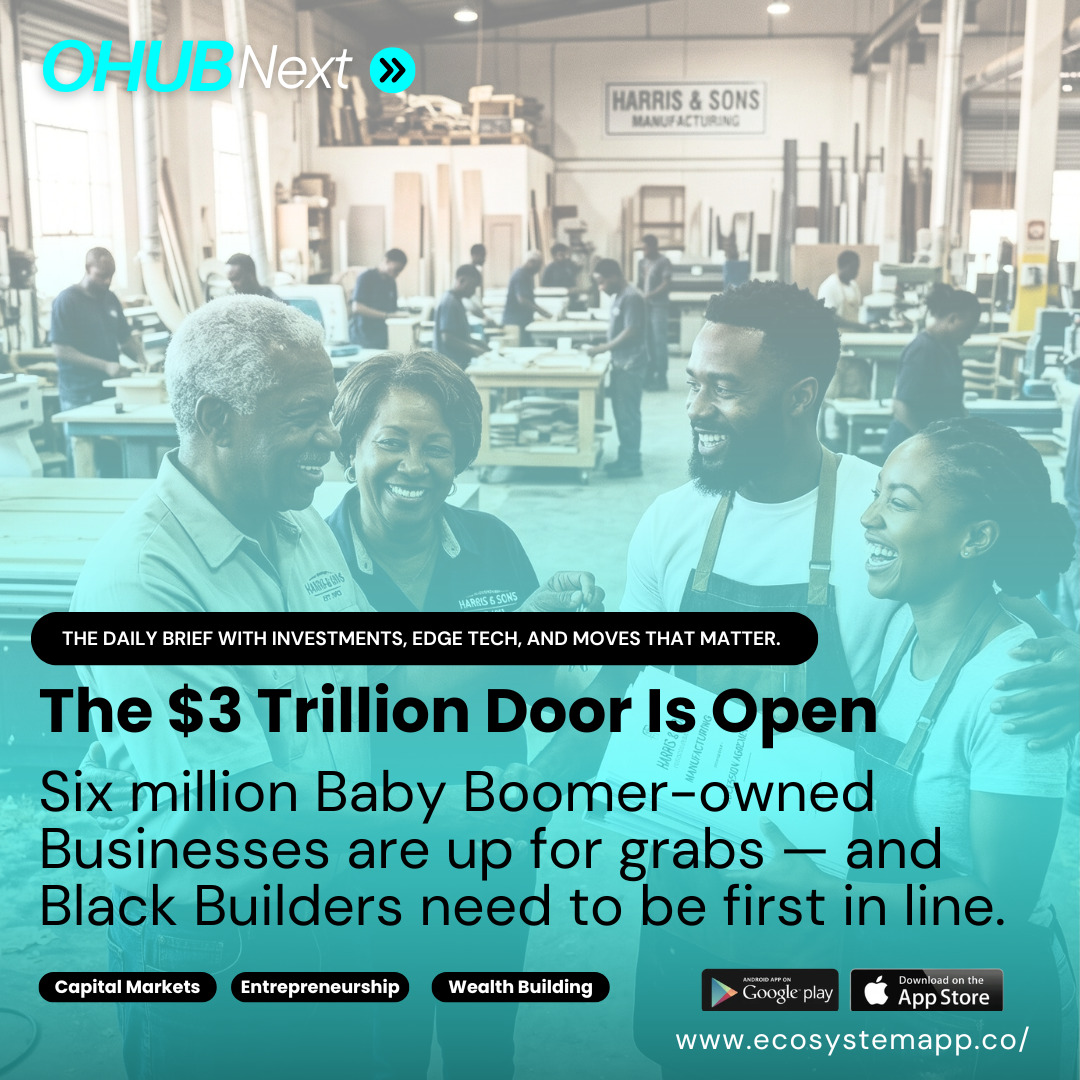
Because the largest ownership transfer in American history isn’t happening on Wall Street. It’s not leading the evening news. It’s unfolding in plain sight — across strip malls and warehouses, service businesses and manufacturing floors, built over decades by Baby Boomers now aging out with no succession plan, no heir, and no buyer waiting in the wings.
6 Million businesses facing ownership transition
$5 Trillion in business wealth at stake
Picture a family business — third generation. The grandfather built it from nothing. The father kept it alive through recessions, tight margins, and long nights that never made it onto any balance sheet. It paid for school. It put food on the table. For decades, it was the family’s gravitational center.
Now it’s the son’s turn.
But his kids are chasing different dreams, different definitions of success. Taking over a business their great-grandfather started is not part of the plan.
So what happens to everything that was built?
The answer is brutal: when there’s no one to take over, businesses don’t transition — they close. More than 92% of small business exits end in closure, not sale.
That’s not a transition. That’s a loss.
A loss of jobs. A loss of the community anchors people drive past every day without thinking about. A loss of generational wealth that took lifetimes to build — and seconds to dissolve.
For Black entrepreneurs, the distance between what’s being captured today and what’s possible isn’t marginal. It’s measured in hundreds of billions of dollars currently walking out the door — into closures, into outside buyers, into anyone but the communities that were always here, always ready, and never given the map.
And that's what we're going to dig into today.
⸻
🗞 Top Story: The Great Ownership Transfer
A new report from the McKinsey Institute for Economic Mobility — "The Great Ownership Transfer" — identifies a structural, once-in-a-generation shift: approximately 6 million baby boomer-owned small and medium-sized businesses will face ownership transitions by 2035 — and more than 1 million of those are viable candidates for sale, representing up to $5 trillion in enterprise value.
For Black entrepreneurs, the math is stark. Today, approximately 3.3% of employer businesses are Black-owned, against 14.4% of the U.S. population. At the current pace, Black entrepreneurs are projected to capture roughly $87 billion of that value. But if participation rates increase?
That number jumps to over $369 billion — and as part of a broader coalition including Latino and women entrepreneurs, the total potential wealth unlock reaches $3 trillion.
The problem isn't the opportunity. It's access — to capital, information, and the deal networks that make acquisitions possible.
🧱 Builder Insight
This is an acquisition story, not just a startup story.
Most wealth-building frameworks for Black founders focus on building from scratch. But buying an existing business — one with cash flow, customers, and operations already in place — is often faster and lower-risk than a ground-up launch. SBA 7(a) loans, seller financing arrangements, and search fund models can make business acquisition more accessible than most people realize. The infrastructure exists. The knowledge gap is what closes doors.
AI and tariffs are creating motivated sellers. A landmark Harvard Business Review study published this month finds that AI is cutting 17% of job postings in structured cognitive-task roles while simultaneously increasing demand by 22% in positions requiring human-AI collaboration.
At the same time, a February 2026 JPMorgan Chase Institute analysis found that monthly tariff payments for midsize U.S. firms tripled compared to early 2025 levels. Owners navigating both technological disruption and rising input costs are more likely to consider an exit — and potentially at more accessible valuations.
The capital gap is real, but it's not the end of the conversation. McKinsey's analysis notes that without systemic changes to connect buyers, sellers, and capital at scale, this historic opportunity could be missed.
Community Development Financial Institutions (CDFIs), Black-led venture and acquisition funds, and new intermediary platforms are actively building that infrastructure now. The window is open — but only for builders who understand how to step through it.
📈 Forward Scenario
Here is the central paradox....
Black Americans hold an estimated $1.98 trillion in annual purchasing power — a figure projected to exceed $2.1 trillion by the end of 2026 — yet that spending is largely cycling out of Black communities rather than building wealth within them. The gap between what Black America earns and what it owns is one of the defining economic fault lines of our time.
Business ownership is the mechanism that closes that gap. McKinsey's analysis finds that effectively capturing the Great Ownership Transfer could protect up to $250 billion in annual local spending power and keep as many as 12 million jobs intact. When Black entrepreneurs become business owners — not just employees or consumers — the economic activity in their communities compounds differently.
Black-owned businesses hire Black workers at higher rates, contract with Black vendors, and reinvest locally in ways that build the kind of circular economic ecosystems that have historically been the engine of group wealth-building.
The question isn't whether this moment is real. It is.
The question is whether Black builders will be resourced, informed, and positioned to take it.
💬 Quote of the Day
"Without systemic changes to connect buyers, sellers, and capital at scale, this historic opportunity could be missed."
— McKinsey Institute for Economic Mobility, The Great Ownership Transfer, February 2026
⸻
🎬 Closing Thought — The Door Is Open. The Clock Is Running.
Three trillion dollars. Six million businesses. One decade.
That's the math of this moment — and it's the most compelling wealth-building equation Black entrepreneurs have ever been handed by circumstances, not charity. The Great Ownership Transfer isn't a program or a policy initiative. It's a structural shift: an entire generation of business owners aging out, with no succession plan and no buyer in sight. That gap is a doorway.
But doorways close. The same AI disruption reshaping the labor market is reshaping these businesses, too. Sellers who feel the combined pressure of rising tariff costs and technological uncertainty are looking for exits — and capital-ready buyers who move now will get better terms, better deals, and better positioning than those who arrive five years late.
This is OHUB's lane. Building pathways to employer-class wealth — not just employment, but ownership, equity, and economic power — is exactly what this community has been training for. Understanding acquisition finance, building deal-sourcing networks, and getting capitalized are no longer optional skills for the next generation of Black wealth-builders.
They're the assignment.
Get informed. Get capitalized. Get in the room.
⸻
⚡️ OHUBNext Daily Brief — investments, edge tech, and moves that matter.
For 12+ years, OHUB has been building pathways and on-ramps to multi-generational wealth — without reliance on pre-existing wealth. Through exposure, skills, entrepreneurship, capital markets, and inclusive ecosystems, we've helped people create new jobs, new companies, and new wealth.