

OHUB @ohub
🚨 OHUBNext | The Cost of the Right Capital
🚨 OHUBNext | The Cost of the Right Capital
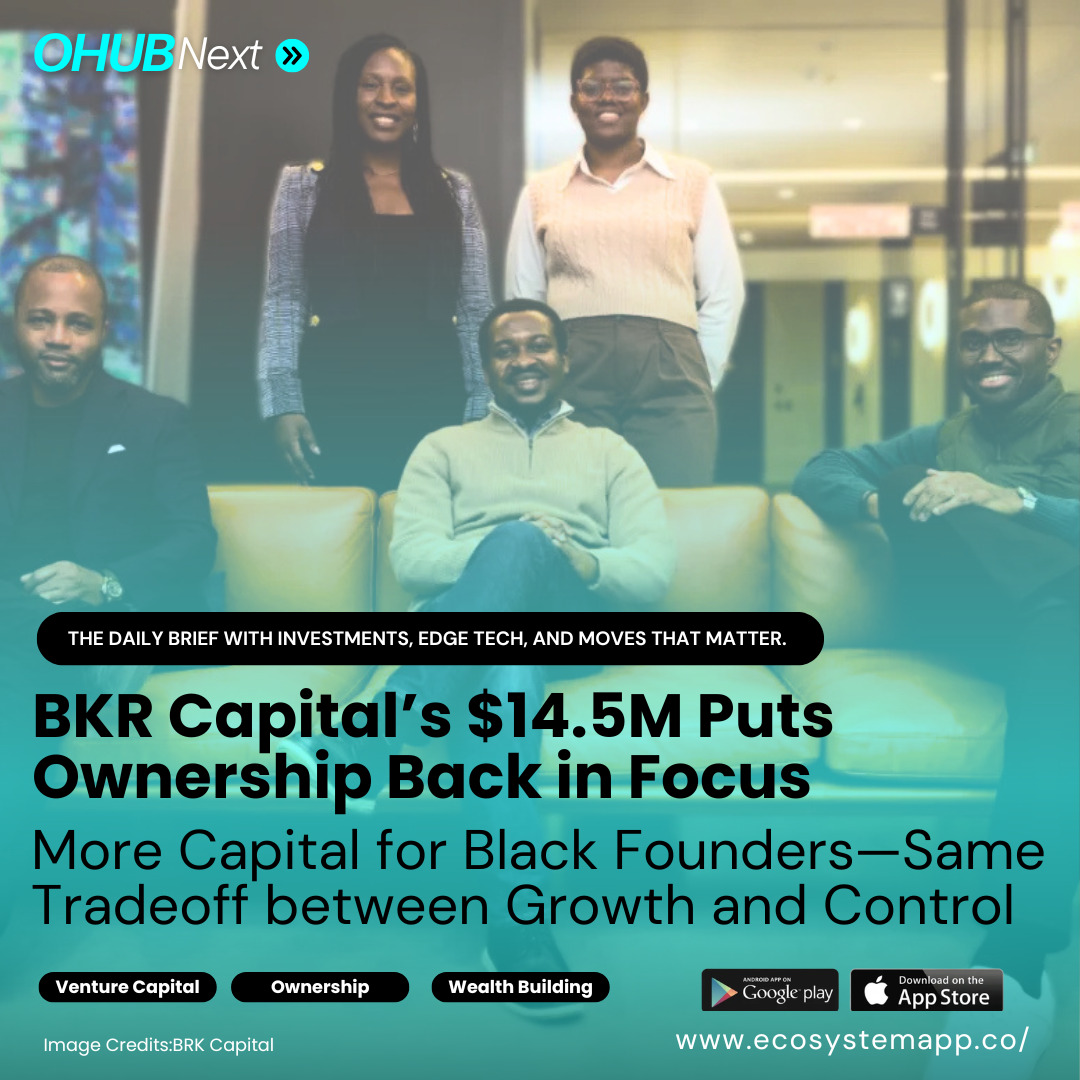
📍 BKR Capital’s $14.5M raise signals progress — and forces a harder question: what does funding really cost?
⸻
TL;DR
▪️ BKR Capital closed $14.5M USD (CA$20M) for Fund II, targeting $50M for Black-led tech companies
▪️ Check sizes range from $250K–$1.5M; Fund I is outperforming 75% of comparable funds
▪️ Black founders still receive <0.5% of U.S. venture capital
▪️ When a Black partner leads a fund, the funding gap narrows by ~50 percentage points
⸻
Hey Builders!
A term sheet doesn’t just fund your company.
It reshapes what you own of it.
Let that sit for a second.
Because the moment most founders are working toward — the check, the validation, the “we believe in you” — is also the moment the math starts to change.
Quietly.
Then permanently.
This week, BKR Capital — a Toronto-based fund led by managing partner Lise Birikundavyi and co-founder Isaac Olowolafe — announced the initial close of its Fund II at CA$20 million (~$14.5M USD), against a CA$50 million target (~$36M USD). The fund is focused on high-growth technology companies led by Black founders building for the future of work, living, and global connectivity.
Fund I raised $22 million and is already performing in the top quartile, outpacing at least 75% of comparable funds from the same vintage. Backers include the Royal Bank of Canada, Boann Social Impact Fund, Cap Finance, BDC, and Export Development Canada — a signal that institutional capital is increasingly aligned with this thesis.
That’s real progress.
And it matters.
Because Black-led capital backing Black founders is one of the most effective structural levers we have. Research from Columbia Business School shows that when a Black partner leads the investment team, the funding gap narrows by nearly 50 percentage points.
That’s not just narrative. It shows up in the data.
But here’s what often gets overlooked.
Progress doesn’t remove the tradeoff.
It makes the decision more consequential.
⸻
♟️ The Tension: Capital vs. Ownership
Every dollar you take has a shadow.
Most founders don’t model the math early enough.
A $10M exit, fully bootstrapped, means you keep close to $10M.
A $10M exit after multiple VC rounds can leave you with $2–$3M.
Different paths. Same company. Same outcome.
A completely different ownership story.
That’s dilution. And it compounds.
But there’s a counterweight, and it’s just as real.
Time is a constraint.
Speed is a weapon.
And capital buys both.
Competitors with funding can outpace you before product-market fit. Markets move before you’re ready. And for Black founders navigating less access to capital, fewer warm introductions, and tighter margins, “just bootstrap” is rarely a neutral strategy.
It’s a constrained one.
So this isn’t a moral question.
It’s a strategic one.
⸻
🧱 Builder Insight
When the check makes sense
Take the check if
▪️ You’ve already found product-market fit and need capital to scale, not to search
▪️ The investor brings real leverage like distribution, access, or expertise you can’t easily build yourself
▪️ The terms protect your upside with reasonable dilution, pro-rata rights, and a track record of real exits
Stay off the cap table if
▪️ You can reach profitability within 12–18 months on revenue alone
▪️ You’re still in discovery mode
▪️ You don’t have a clear exit thesis
Because if you don’t know how the story ends,
you shouldn’t be selling pieces of it.
⸻
💬 Quote of the Day
“Venture capital is not a prize; it’s a fuel that burns your own equity to reach a destination. If you can’t see the destination clearly, you’re just setting your ownership on fire.” — Adapted from 2026 Founder Strategics
⸻
🎬 Closing Thought
Funding is a milestone, but ownership is the outcome, and the two are often mistaken for the same thing when they rarely are.
By the time a company reaches exit, the cap table tells the real story — who owns what, who benefited, and who ultimately captured the value that was created. And for too many founders, that story includes everyone except the person who started it and did the work to bring it to life.
That’s why funds like BKR matter. They can shift who sits at the table, realign incentives, and create a different starting point for founders who have historically been left out. But they don’t change the underlying equation.
Dilution still compounds, and ownership still determines the outcome.
The most expensive mistake a founder can make is taking capital simply because it became available, rather than because the timing and terms actually make sense for the business.
The real question isn’t whether you raised. It’s what you will still own when it’s over.
Because every dollar comes with a cost.
⸻
🗣️ Get More Out of OHUB
Thinking about building your own high-growth company? Subscribe to OHUBNext for just $5.99 a month — less than a cup of coffee — and gain access to the High-Growth Company Building Certificate and our Investment Certificate.
⸻
⚡️ OHUBNext Daily Brief — investments, edge tech, and moves that matter.
For 12+ years, OHUB has been building pathways and on-ramps to multi-generational wealth — without reliance on pre-existing wealth. Through exposure, skills, entrepreneurship, capital markets, and inclusive ecosystems, we’ve helped people create new jobs, new companies, and new wealth.