


OHUB @ohub
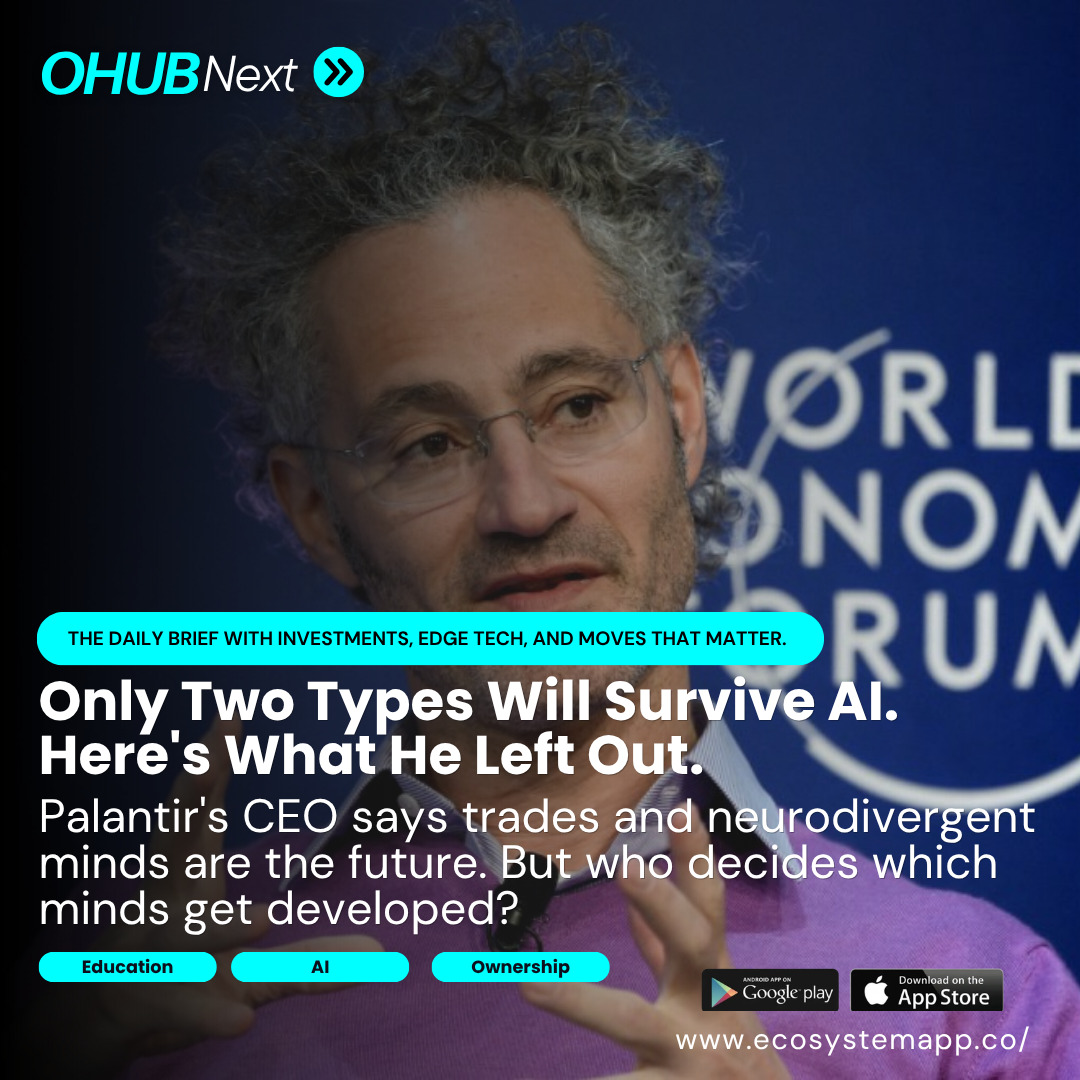
🚨 OHUBNext | Palantir's CEO Says Only Two Types Will Survive AI. Here's What He Got Right — and What He Left Out.
🚨 OHUBNext | Palantir's CEO Says Only Two Types Will Survive AI. Here's What He Got Right — and What He Left Out.
📍 A billionaire with three elite degrees says degrees won't save you. He says vocational workers and neurodivergent thinkers are the only two groups with a future. The take is sharper than most people realize — and the part he left out matters more than the part he said.
─────
Hey Builders!
Last week, Alex Karp told a national audience that only two types of people have a future in the age of AI — people with vocational training and people who are neurodivergent.
Not MBAs.
Not philosophy majors.
Not the credentialed class that has spent decades gatekeeping professional life.
Tradespeople and different thinkers.
Coming from someone with a JD from Stanford University and a PhD from Goethe University Frankfurt, the statement lands differently. He’s not speculating from the outside.
He’s a dyslexic billionaire running a $250B+ defense-tech company, effectively arguing that the very system that validated him may no longer produce advantage.
That alone makes the claim worth a closer look. So we did.
─────
⚠️ The Part Everyone Missed
1️⃣ What Karp Actually Said — and Why It’s Only Partly Right
Karp’s argument rests on two ideas. Skilled trades and neurodivergent thinkers.
The first holds. Electricians, plumbers, HVAC techs, welders — these roles are difficult to automate and increasingly essential as Big Tech scales physical infrastructure. The U.S. is short roughly 500,000 skilled tradespeople, and every AI data center still requires copper, cooling, and concrete. No model installs that.
The second is more nuanced. Neurodivergent thinkers — people with dyslexia, ADHD, autism, and related conditions — often bring pattern-breaking cognition. The ability to approach problems laterally, not linearly. To build what doesn’t yet exist. Palantir Technologies has operationalized this through a Neurodivergent Fellowship with salaries reaching $200,000.
Where he’s right is clear. Hands-on skill and non-linear thinking are both resistant to automation. As AI absorbs routine cognitive work, the premium shifts to what it cannot replicate.
Where he stops short is more telling. He never names who has historically been excluded from both.
2️⃣ The System Already Decided Who Gets to “Survive”
If neurodivergence is the future, the American public education system has spent decades suppressing it.
Black students are identified for special education at higher rates, but receive fewer resources and more discipline once labeled. Black boys with ADHD are nearly three times more likely to be suspended than white peers with the same diagnosis. Dyslexic students in underfunded districts are often undiagnosed until much later, if at all.
The education system optimized for compliance.
Sit still.
Follow instructions.
Memorize.
Repeat.
Students who thought differently weren’t seen as future innovators. They were treated as disruptions. Isolated. Disciplined. Removed. And left with a permanent record that signals to future employers they were a liability, not an asset.
Now a billionaire CEO argues those same cognitive traits define future advantage. The contradiction is hard to ignore.
The traits that command $200,000 salaries in one context have historically triggered exclusion in another.
So the real question is not whether neurodivergence matters. It’s which version gets recognized, supported, and capitalized.
3️⃣ The Upside and the Blind Spot
There is real upside in this framing.
If markets begin rewarding non-linear thinking, risk tolerance, and creative problem solving over credentials, that creates an opening. Many of the strongest builders have never fit neatly inside traditional systems. That divergence has always been signal, not deficiency.
But the blind spot is just as real.
Positioning neurodivergence as an advantage without acknowledging the systems that penalize it is incomplete. It romanticizes the outcome while ignoring the conditions.
A dyslexic child diagnosed early, resourced, and supported follows a fundamentally different path than one who is misdiagnosed, underfunded, or never evaluated at all.
The same applies to trades. Demand is rising, but access to high-quality training, apprenticeships, and union pathways remains uneven. Entire communities were historically excluded from the very systems that built middle-class stability.
4️⃣ Let's Do the Math
The U.S. civilian labor force is about 168 million people.
Skilled trades account for roughly 15 to 17 million.
Neurodivergent adults are estimated at 30 to 40 million.
Even combined, and allowing for overlap, that reaches perhaps 45 to 50 million people. Less than a third of the workforce.
That leaves over 100 million people implicitly categorized as at risk.
Now layer in access.
Black workers represent about 22 million of the workforce. Of those, only a small fraction are in skilled trades due to historical barriers in unions and apprenticeships. Neurodivergent Black adults are also underdiagnosed and under-supported relative to their peers.
So even within Karp’s framework, the constraint is not capability. It boils down to access.
The implication is straightforward. If you accept the premise, the response cannot stop at individual advice.
It has to address the system that determines who gets trained, who gets identified, who gets supported, and who gets left out.
─────
🔧 Three Moves to Make
1️⃣ Reframe neurodivergence as a strategic asset — not a diagnosis to manage
If you're neurodivergent, or if you're building teams, stop treating ADHD, dyslexia, or autism spectrum traits as things to "work around." Start treating them as cognitive edges — and build environments where those edges are sharpened, not dulled. Palantir is hiring for it. Your company should be too.
2️⃣ Audit what "education" actually means in your stack
If your last formal learning experience was a degree program built around memorization and compliance, your education is already obsolete by Karp's own standard. The OHUBAI Competency Program is built for builders who learn by doing — not by sitting still. Enroll in something that forces you to ship, not just study.
3️⃣ Run your own survival math
Take 30 minutes this week. Write down: What can I do that AI cannot? What do I own? What is my income if my current role disappears in 90 days? If the answers make you uncomfortable, that discomfort is the signal. Move toward it.
─────
💬 Quote of the Day
"The measure of intelligence is the ability to change." — Albert Einstein
─────
🏁 Build New Skills With OHUB
The OHUBAI Competency Program is a four-week intensive, hands-on training program designed to help you build real AI capability fast — whether you're a founder, a working professional, or a career-switcher ready to future-proof your skill set.
New cohorts open every four weeks. By the end of Week 1, you'll have built your first AI agent.
For $399, here's what you walk away with:
▪️ 4 weeks of live, instructor-led curriculum — not pre-recorded, not self-paced, real instruction with real accountability
▪️ Up to 1 year of access to the Mindstone Dashboard
▪️ Up to 1 year of updated education content
▪️ A seat in one of the fastest-growing AI communities globally
Financing available through Affirm or Klarna — get started for as low as $37/mo.
🚀 Visit opportunityhub.co/ai to learn more.
─────
🎬 Closing Thought
When a billionaire CEO with three elite degrees tells the world that degrees won't save you — and that the future belongs to tradespeople and neurodivergent thinkers — believe the signal, but interrogate the source. He's right that compliance-based careers are being compressed by AI. He's right that different thinking has a premium. But he's speaking from inside a system that spent decades punishing the very minds he now calls essential — especially when those minds were Black, Brown, underfunded, and undiagnosed.
The answer isn't to accept his two categories. It's to build a third- the owners. People who don't just survive AI — they direct it, deploy it, and profit from it. People who build the companies, own the equity, and write the rules.
That’s what OHUB is for, and that’s why this community exists. Not to wait for permission or inherit opportunity—but to create it, own it, and define what comes next.
What are your thoughts on this?
─────
⚡️ OHUBNext Daily Brief — investments, edge tech, and moves that matter.
For 12+ years, OHUB has been building pathways and on-ramps to multi-generational wealth — without reliance on pre-existing wealth. Through exposure, skills, entrepreneurship, capital markets, and inclusive ecosystems, we've helped people create new jobs, new companies, and new wealth.

OHUBAI Competency Program
Visit the post for more.
opportunityhub.co