


OHUB @ohub
🚨 OHUBNext | AI Jobs Surge As Workers Fall Behind
🚨 OHUBNext | AI Jobs Surge As Workers Fall Behind
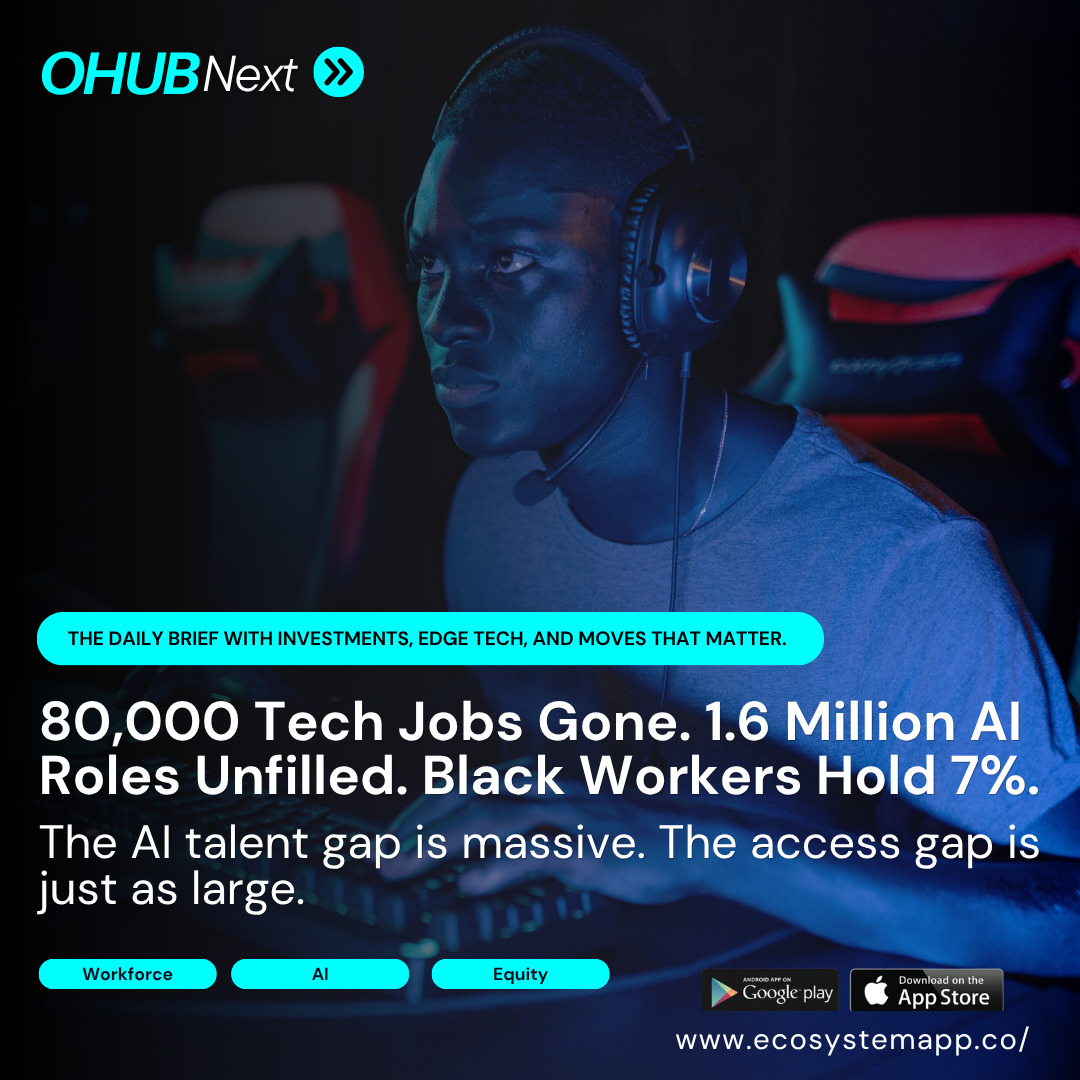
📍 The tech industry cut 80,000 jobs in Q1 2026 — nearly half blamed on AI. At the same time, CompTIA's just-released State of the Tech Workforce report shows 9.8 million tech jobs projected for this year, a $2.27 trillion economic footprint, and 1.6 million AI roles sitting empty because companies can't find qualified people. The opportunity is massive. The access gap is just as large.
─────
Hey Builders!
Two reports landed this week that tell the same story from opposite ends. CompTIA's 2026 State of the Tech Workforce report (comptia.org/...) projects a tech sector growing to 9.8 million workers — with AI-adjacent roles (data science, ML, cybersecurity) growing at 2-3x the national rate.
Meanwhile, Q1 2026 closed with 80,000 tech workers laid off, nearly half of those jobs explicitly eliminated because of AI automation. Goldman Sachs put a sharper point on it this week: AI is cutting 16,000 U.S. jobs every single month — and Gen Z is absorbing most of the hit.
But here's the number that doesn't get enough airtime: the median tech wage is $112,805. That's 126% higher than the median wage across all U.S. occupations. The wealth isn't leaving tech — it's concentrating inside it, toward the people who hold the right skills. And today, fewer than 1 in 5 employers posting AI jobs can find qualified candidates to fill them.
This is the split screen that defines the moment. On one side: disruption, displacement, and a federal government scrambling to respond with $224 million in new AI workforce funding. On the other side: the single largest skills-driven wealth creation window of the last two decades — and it is wide open. The question isn't whether AI is a threat or an opportunity. It's whether you're positioned on the right side of that line.
─────
📰 Top Stories
Here's what's moving — and what it means for you.
1️⃣ CompTIA's 2026 Tech Workforce Report: The $2.27 Trillion Split Screen
CompTIA's just-released State of the Tech Workforce 2026 projects net tech employment growing to 9.8 million workers this year — a 1.9% rebound after 2025 saw a rare contraction of 33,624 jobs. The industry still accounts for an estimated $2.27 trillion in direct U.S. economic value, or 8.7% of the entire national economy. AI-related occupations are the standout growth story: dedicated AI hiring is up 81% year-over-year, and January 2026 alone saw 275,000+ active AI job postings in the market. Data scientists and analysts are projected to grow at 420% above the national rate over the next decade.
The report also reveals a geography story. Austin leads all U.S. metros in net tech employment gains. Nevada, Wyoming, and Utah lead states in projected tech occupation growth through 2036 — not California or New York. The center of gravity is shifting south and inland, and the cities with the lowest cost of living are posting the highest tech wage premiums relative to local wages.
This isn't just a jobs report — it's a capital allocation map. If you're building a tech-enabled business and hiring, the report shows the highest ROI talent pools are in secondary markets with a 1st-quartile cost-of-living rank: Alabama, Arkansas, and Nevada all rank in the top tier for tech wage premium relative to prevailing local wages. You can recruit exceptional talent at competitive wages without a San Francisco salary war. More importantly: data science/ML and cybersecurity roles are the fastest growing — if you're not building these capabilities into your team today, you're betting against the decade.
─────
2️⃣ Goldman Sachs: AI Is Cutting 16,000 U.S. Jobs a Month — Gen Z Takes the Brunt
A Fortune report published April 6th cites Goldman Sachs research showing AI displacement is now eliminating approximately 16,000 U.S. jobs per month — with younger, earlier-career workers disproportionately absorbing the shock. Tech industry layoffs in Q1 2026 hit 80,000 workers, with nearly 50% of those cuts explicitly attributed to AI and automation replacing human roles in content creation, basic coding, customer support, and data entry. That's a dramatic jump from 2025, when AI was cited as a factor in fewer than 8% of layoff announcements.
Block CEO Jack Dorsey announced the elimination of 4,000 jobs — roughly 40% of the company's global workforce — citing "the growing capability of AI tools to perform a wider range of tasks." Oracle executed a sweeping reduction of an estimated 20,000 to 30,000 employees. AI is being credited — and blamed — simultaneously for both the job losses and the hiring surge happening in parallel.
This is the displacement paradox you need to understand before it catches you off guard. Entry-level and generalist roles are the most exposed — inside your company and in your own career. The roles that are growing? AI engineers, MLOps specialists, AI governance and ethics specialists, forward-deployed engineers. If you're a founder, this means two things: one, your overhead for certain functions just dropped significantly because AI tools can now absorb them. Two, if you're hiring right now, skip the generalists and go straight for the skill sets that compound — the ones that command premium wages precisely because AI makes them harder to replicate.
─────
3️⃣ $224 Million in Federal AI Workforce Funding — and a 30% Training Tax Credit on the Table
The Department of Labor and the National Science Foundation have formalized a joint partnership to launch a national AI workforce development initiative — with up to $224 million earmarked to fund up to 56 state and territory coordination hubs designed to expand AI skills access and economic readiness. The initiative is designed explicitly to reach workers in communities that have been structurally excluded from prior technology boom cycles.
Simultaneously, House lawmakers have proposed the AI Workforce Training Act, which would create a 30% tax credit for employer-sponsored AI training and certification programs. A $500,000 company training investment could yield $150,000 in direct tax relief. The legislation is in early stages, but signals serious Congressional appetite for using the tax code to accelerate reskilling.
This is capital, and you should be chasing it. If you run a company with employees — or you're building an edtech, workforce development, or training platform — the window to position yourself for federal dollars is open now. The DOL/NSF hub structure is being built at the state level, which means community organizations, training providers, and workforce intermediaries have a direct path to that $224 million. OHUB's AI Competency Program is already built for exactly this moment — and if you're an employer looking to train your team, that incoming 30% tax credit should sharpen your pencil on what you invest this year.
─────
4️⃣ Tariffs + Tech: The Hiring Headwind Nobody's Talking About
The Trump administration's tariff regime is beginning to register in the tech sector's hiring math. A 25% tariff on specific chip categories took effect in January 2026, and the broader tariff package now represents an average household tax increase of approximately $1,500 per year — the largest U.S. tariff burden as a share of GDP since 1993. CIOs are reporting delayed projects and frozen hiring as companies protect margins. One analysis notes that when companies finance major AI infrastructure investments on credit, labor becomes the most immediately adjustable cost — and discretionary tech hiring is the first line to cut.
The Computerworld tech jobs report shows tech hiring slowing and unemployment ticking upward even as AI job postings remain elevated. The bifurcation is becoming structural: companies are spending heavily on AI infrastructure while simultaneously pulling back on human headcount — particularly in roles that don't require advanced technical specialization.
If you're building a hardware-adjacent product, a device, or anything in the supply chain for physical tech — your cost structure just got repriced. Run the math on your component costs and your product margin now, before you commit to a next round or a pricing strategy. On the hiring side: the market is soft for generalist tech roles, which is actually a window. If you need engineers, analysts, or cybersecurity professionals who would have been priced out of your budget last year, reach back out. The competitive landscape for great talent at fair compensation has opened up in ways it hasn't in three years.
─────
5️⃣ The 7% Problem: A $2.27 Trillion Industry and Black Workers Hold 7% of the Seats
CompTIA's 2026 report doesn't lead with this data, but it's buried in the demographic appendix — and it matters: Black Americans are 13% of the U.S. population and hold approximately 7% of computing workforce positions. In an industry worth $2.27 trillion with a median wage of $112,805 — more than double the national median — that's a structural wealth exclusion hiding in plain sight. The gap isn't about talent. The pipeline is being built in real time.
FuelAL's HBCU Innovation Internship Program just launched its Spring 2026 cohort, placing 20 students from five Alabama HBCUs with 12 employers in paid, 12-week tech internships. Microsoft has expanded its HBCU Founders Initiative pre-accelerator to 15 campuses. Apple's Propel Center partnership continues placing HBCU students into curriculum development and internship pipelines. At the same time, CompTIA's data shows that the top five metro areas where tech job postings specify less than a four-year degree requirement are: New York, Washington DC, Dallas, San Francisco, and Chicago — a direct signal that the credential wall is lowering exactly where opportunity concentrates.
The most underutilized competitive advantage in building a high-growth tech company right now is tapping HBCU and community college pipelines before your competitors wake up. Companies like Google and Microsoft have already done the math — the talent is there, it's credentialed, and it's going to build the companies that define the next decade. If you're hiring for AI skills, data science, or cybersecurity — the three fastest-growing occupation categories in CompTIA's data — and you're not actively recruiting from HBCU programs, you're leaving the best candidates in the pool. The OHUB network is one of the fastest paths in.
─────
🔧 Three moves to make this week
1️⃣ Run your AI skills audit — before someone else runs it for you
Goldman Sachs says AI is eliminating 16,000 jobs a month. CompTIA shows 275,000+ active AI job postings. The gap is not a paradox — it's a skills mismatch. Pull up your LinkedIn, your resume, or your team's capacity map and ask one question: which of the skills listed in CompTIA's top occupation categories (data science/ML, cybersecurity, AI development) does your current profile include? If the answer is none, that's your action item. CompTIA certifications in AI Essentials, Data+, and Security+ are direct on-ramps. OHUB's AI Competency Program is a four-week path to your first AI agent. The people who act on this in April don't worry about it in Q3.
2️⃣ Get in front of the federal AI workforce money — now
The DOL/NSF partnership is building 56 state-level AI workforce hubs with $224 million in federal funding. If you run a training organization, an employer with a workforce, or a community institution — this money is designed for you. Find your state's workforce development board, identify the regional point of contact for the NSF AI Ready Workforce program, and submit a letter of interest before the cohort structure gets locked in. Early positioning in federal grant cycles almost always wins over late, polished applications. Move this week.
3️⃣ Call one HBCU career center before Friday
The 7% figure is your business opportunity. Five Alabama HBCUs just placed 20 students in tech internships in 12 weeks. If that kind of speed and quality of talent is coming out of a state-level program, imagine what a direct recruiting relationship looks like. Pick one HBCU with a tech or computer science program — Howard, Morehouse, FAMU, North Carolina A&T, Jackson State — find the career services director on LinkedIn, and send a message before end of week. Not a form. A message. This is how the best hires happen.
─────
💬 Quote of the Day
"The function of education is to teach one to think intensively and to think critically. Intelligence plus character — that is the goal of true education." — Dr. Martin Luther King Jr.
─────
🏁 Build New Skills With OHUB
The OHUBAI Competency Program is a four-week intensive, hands-on training program designed to help you build real AI capability fast — whether you're a founder, a working professional, or a career-switcher ready to future-proof your skill set.
New cohorts open every four weeks. By the end of Week 1, you'll have built your first AI agent.
For builders, here's what you walk away with:
▪️ 4 weeks of live, instructor-led curriculum — not pre-recorded, not self-paced, real instruction with real accountability
▪️ Up to 1 year of access to the Mindstone Dashboard
▪️ Up to 1 year of updated education content
▪️ A seat in one of the fastest-growing AI communities globally
Financing available through Affirm or Klarna — get started for as low as $0/mo.
🚀 Visit opportunityhub.co/ai to learn more.
─────
🎬 Closing Thought
When 80,000 tech workers are laid off in 90 days while 1.6 million AI roles sit empty — that is not a story about job loss. That is a story about who holds the skills. When the federal government deploys $224 million to build workforce hubs across 56 states while simultaneously proposing a 30% training tax credit, that is not policy noise — that is capital moving toward the same moment CompTIA's data has been pointing to all year. And when Black workers hold just 7% of the seats in a $2.27 trillion industry that pays double the national median, that is not a diversity talking point — that is the single largest unaddressed wealth gap in the American economy.
The tech industry is not contracting. It is filtering. It is separating the people who own AI capability from the people who watched it happen. The data scientists CompTIA projects will grow 420% aren't going to come from the same talent pools that filled these roles in 2015. They're going to come from the communities that move fastest — the ones with access to real training, real networks, and real capital pathways.
That's why OHUB exists. Not to watch the shift happen. To make sure our people own the next economy — not just work in it.
─────
⚡️ OHUBNext Daily Brief — investments, edge tech, and moves that matter. For 12+ years, OHUB has been building pathways and on-ramps to multi-generational wealth — without reliance on pre-existing wealth. Through exposure, skills, entrepreneurship, capital markets, and inclusive ecosystems, we've helped people create new jobs, new companies, and new wealth.

Tech Job Trends, Job Growth, and Future Opportunities | CompTIA Blog
Discover 2026 tech hiring trends, salaries, AI hiring, and tech jobs by state in CompTIA’s State of the Tech Workforce report.
www.comptia.org