

OHUB @ohub
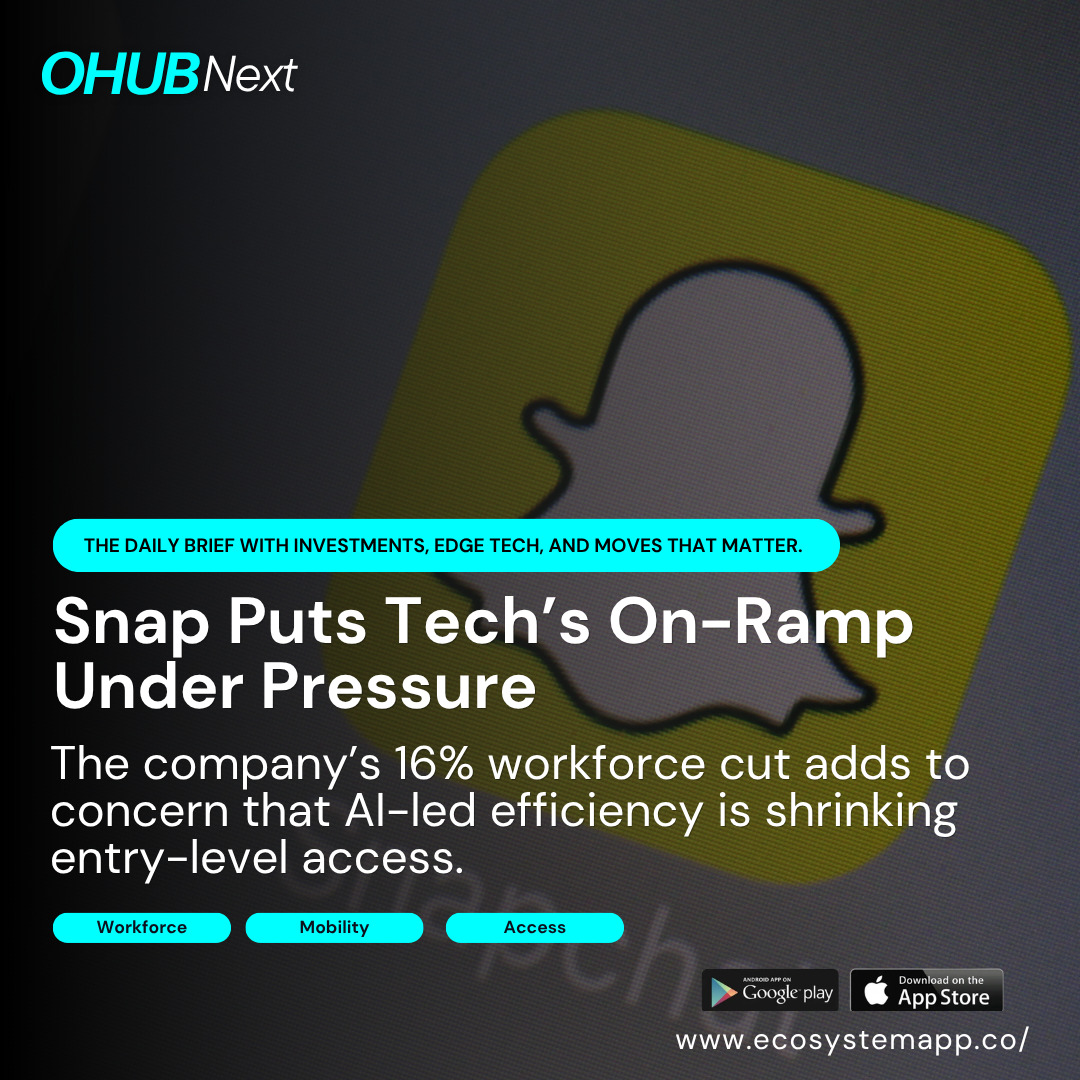
🚨 OHUBNext | Snap’s Layoffs Raise New Workforce Concerns
🚨 OHUBNext | Snap’s Layoffs Raise New Workforce Concerns
📍 Snap's restructuring is a fresh signal that AI efficiency is changing how tech companies hire, train, and scale.
⸻
TL;DR
▪️ Snap said on April 15 it would cut about 1,000 employees, or 16% of full-time staff, and close more than 300 open roles.
▪️ The company said the restructuring should reduce its annualized cost base by more than $500 million by the second half of 2026.
▪️ Snap had 5,261 full-time employees as of December 31, 2025, according to AP's report citing the company's annual filing.
▪️ On April 20, Snap announced a CFO transition and said the company now has a clearer path to net-income profitability.
⸻
Hey Builders!
For years, tech layoffs were usually framed as a response to weaker demand, ad-market shocks, or overexpansion. Snap's April cuts land differently. This time, the company did not just talk about cost control. It explicitly tied its restructuring to AI's ability to reduce repetitive work, increase velocity, and support smaller teams.
That is what makes this worth watching. Snap's decision is not merely a company-specific reset. It is a useful case study in how firms may start redesigning their labor models when AI moves from experimental tool to operating assumption.
For workers, founders, and investors, the issue is no longer whether AI changes productivity. It is how that productivity gets translated into hiring, training, and profitability decisions.
⸻
🗞 Top Story
Snap CEO Evan Spiegel told employees on April 15 that the company would eliminate roughly 16% of its full-time workforce and close more than 300 open roles. In the same memo, he said Snap expects to reduce its annualized cost base by more than $500 million by the second half of 2026 and argued that advances in AI are already helping teams reduce repetitive work and move faster. Five days later, on April 20, Spiegel announced a CFO transition and said the company had created a clearer path to net-income profitability.
Taken together, those announcements amount to more than a layoff headline. They outline a new corporate playbook: use AI to compress workflows, simplify teams, and improve financial performance faster. In that framework, the workforce is not just being reduced. It is being redesigned.
⸻
🧱 Builder Insight
1️⃣ The first loss is not only jobs. It is training.
When companies cut workers and close open roles at the same time, they do more than reduce payroll. They narrow the number of entry points into the business. That matters in tech because a significant share of training has always happened on the job: in ad operations, partnerships, customer success, product ops, junior engineering, analytics, and growth. If AI allows companies to run those workflows with fewer people, the talent pipeline can tighten even if overall productivity rises.
2️⃣ Efficiency changes what firms value in labor.
The clearest lesson from Snap is that AI adoption is starting to affect labor demand at the task level. Companies are likely to place a higher premium on employees who can manage systems, automate processes, and oversee higher-leverage workflows, while reducing reliance on roles built around repeatable execution. That does not eliminate human work. It changes the mix of human work companies are willing to pay for.
3️⃣ The career response has to shift from access to ownership.
This does not mean jobs stop mattering. It means relying only on traditional hiring pipelines is becoming riskier. For professionals and founders, the more resilient response may be to build skills and business models that benefit from leaner operating environments: AI-enabled services, productized expertise, workflow automation, and niche software tools. If large companies expand headcount more slowly, more value may shift toward people who can operate independently and produce with smaller teams.
⸻
📈 Forward Scenario
Expect more companies to speak this way in 2026. The language will sound measured: streamlined operations, faster execution, profitable growth, AI leverage. Investors may reward some of it, especially where cost savings are clear. But policymakers, workforce leaders, and founders should also watch what happens to entry-level hiring, internal training, and the availability of mid-skill roles. If the next phase of tech is built around smaller teams and higher output per employee, labor-market access may become more constrained even as firms become more efficient.
⸻
💬 Quote of the Day
"Rapid advancements in artificial intelligence enable our teams to reduce repetitive work, increase velocity, and better support our community, partners, and advertisers." — Evan Spiegel, CEO of Snap
⸻
🎬 Closing Thought — Efficiency for Whom?
Every executive wants a clearer path to profitability. Every investor wants better margins. And every company wants to believe AI can deliver both without meaningful tradeoffs. Snap's restructuring is a reminder that those tradeoffs are already arriving in the workforce.
The central question now is not whether companies will use AI to get leaner.
They will.
The question is whether the broader economy will create enough new pathways for workers and builders as traditional pathways narrow. That makes this more than a Snap story. It is an early indicator of how the AI economy may reprice labor, restructure training, and redefine what counts as valuable work.
By Kieran Blanks, MBA, Head of Product and New Ventures, OHUB
⸻
⚡️ OHUBNext Daily Brief — investments, edge tech, and moves that matter.
For 12+ years, OHUB has been building pathways and on-ramps to multi-generational wealth — without reliance on pre-existing wealth. Through exposure, skills, entrepreneurship, capital markets, and inclusive ecosystems, we've helped people create new jobs, new companies, and new wealth.