

OHUB @ohub
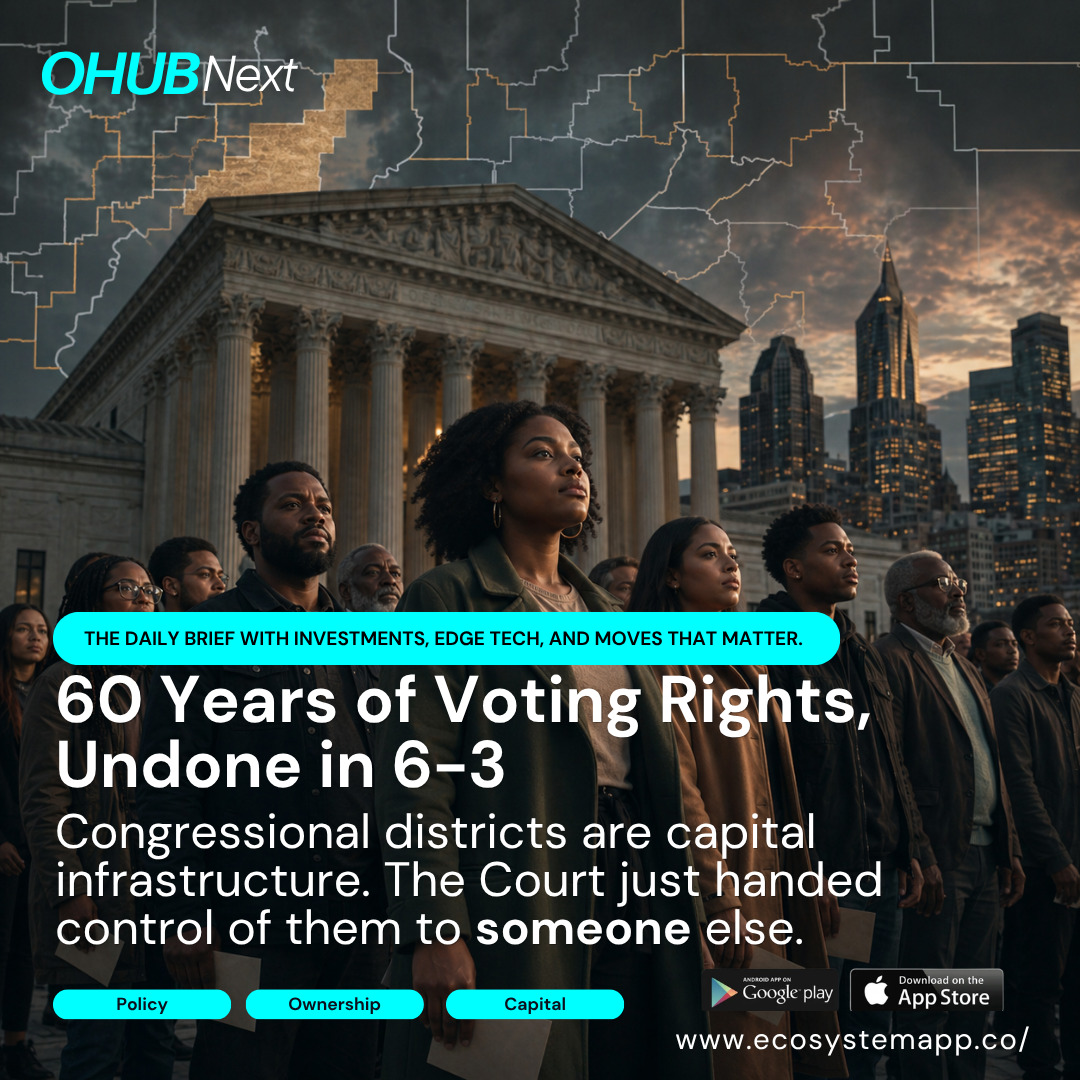
🚨 OHUBNext | 60 Years of Voting Rights — Gutted
🚨 OHUBNext | 60 Years of Voting Rights — Gutted
📍 The Supreme Court's 6-3 ruling in Louisiana v. Callais didn't just redraw maps — it redrew who controls the districts where the next generation of federal infrastructure spending, AI investment, and economic growth is landing. At least 15 majority-Black congressional districts are now at risk of elimination. Within 60 minutes of the decision, Florida passed a gerrymander flipping 4 House seats. This isn't a civics story. It's a capital story.
─────
Hey Builders!
Most people are reading yesterday's Supreme Court ruling as a voting rights story. They're not wrong — but they're looking at the frame, not the painting.
Here's what's actually at stake: congressional districts are economic geography. The representatives who sit in those seats write the appropriations bills that direct billions in federal infrastructure investment, AI research grants, CDFI capital, Opportunity Zone designations, SBA contracting set-asides, and clean energy dollars.
They chair the committees that decide which industries get regulatory protection and which get exposed. They control the earmarks that fund HBCUs, community health centers, and minority business development agencies. When you redraw the maps and remove Black representation from those seats — and experts are now projecting the largest-ever decline in Black congressional representation in U.S. history — you don't just lose a vote. You lose the hand on the lever that directs capital investment into your community.
The South, where most of the 15 at-risk districts sit, is also where the next decade of growth is happening. Data centers, EV manufacturing, semiconductor fabs, port expansion, logistics corridors — the capital is already moving there. The question is who gets to be in the room when that investment gets allocated. Yesterday's ruling just made it significantly harder for Black communities and Black founders in those regions to have a seat at that table.
That's the through-line across today's stories. Every piece of infrastructure being mobilized right now — legal, financial, technological, community — is a response to the same underlying equation: representation equals access to capital. The builders who understand that will know exactly what to build next.
─────
📰 Top Stories
Here's what's moving — and what it means for you.
1️⃣ SCOTUS Guts the Voting Rights Act — The "Intent Test" Changes Everything
On April 29, 2026, the U.S. Supreme Court handed down a 6-3 ruling in Louisiana v. Callais that fundamentally rewrites how Section 2 of the Voting Rights Act of 1965 can be enforced. Writing for the majority, Justice Samuel Alito ruled that Section 2 must now focus exclusively on proving intentional racial discrimination — not simply on whether a voting map produces discriminatory results. That "results test" had been the enforcement standard for over four decades, and it just died.
The court struck down Louisiana's second majority-Black congressional district, which had been drawn specifically to remedy documented racial vote dilution. Congressional Black Caucus Chair Rep. Yvette Clarke called it "the opening of a coordinated attack on Black voters across this country." NPR's analysis identifies at least 15 House districts, from Louisiana eastward through North Carolina, now at risk of elimination in states with Republican-controlled legislatures.
The full redistricting wave hits hardest in 2028 — but state legislatures aren't waiting. Florida moved within the hour. Experts are projecting the largest-ever drop in Black representation in the history of the U.S. Congress.
🧱For Founders
Understand what a congressional district actually is: it's a catchment zone for federal capital. The representative who holds that seat controls committee assignments, earmark requests, federal agency relationships, and the political will to direct investment into specific geographies. The 15 majority-Black districts now at risk span the exact corridor — Louisiana through North Carolina — where data centers, port expansions, EV supply chains, and semiconductor manufacturing are accelerating. If those districts flip, the capital access dynamics for Black-owned businesses, CDFIs, HBCUs, and community health centers in those regions shift with them. Start mapping your business's exposure to that geography now — and start building relationships with the successor power structures before the maps are finalized.
─────
2️⃣ Florida Moves in 60 Minutes: The Gerrymander Speed-Run
An hour after the Supreme Court ruling dropped, the Republican-controlled Florida House approved an aggressively redrawn congressional map designed to flip 4 additional House seats to Republicans. Under the new map, Florida's delegation would shift from a 20-to-8 Republican majority to a 24-to-4 split — the most lopsided in Florida's modern history. Governor Ron DeSantis had called a special session specifically in anticipation of the ruling.
The map dismantles existing majority-Black districts by dispersing Black voters across multiple districts where they become a minority in each — a classic packing-and-cracking strategy now supercharged by the court's removal of Section 2's results standard. Florida's state constitution technically prohibits explicitly partisan redistricting, so legal challenges are already being prepared, but the burden of proof just got exponentially harder.
The speed of Florida's response is the tell. This wasn't improvised — it was pre-loaded. DeSantis called the special session weeks ago. The map was drafted and ready. The playbook was built around the assumption that SCOTUS would rule exactly this way.
🧱For Founders
When policy changes this fast, the organizations that already had contingency plans activate first. This is a lesson in scenario planning. If you're building in regulated industries — health, fintech, housing, education, civic tech — you need a pre-built "if this ruling happens" playbook, not a "let's figure it out" meeting. The builders who move in the first 60 minutes shape the next 60 months.
─────
3️⃣ $50M in Grassroots Capital — And Black Civic Infrastructure Is Mobilizing Now
The NAACP Legal Defense Fund launched its Voting Rights 2026 emergency campaign immediately following the ruling, with a direct fundraising push to finance litigation against new discriminatory maps. LDF's initial legal response focuses on challenging redistricting changes that cannot meet even the higher intentional-discrimination bar — a narrower but still viable legal lane. The NAACP has separately condemned the ruling and is mobilizing its multi-million dollar Building Community Voice Fund toward voter registration and protection ahead of the 2026 midterms.
Black Voters Matter — which has invested over $50 million in grassroots power and engaged more than 10 million voters across 25+ states over the past decade — is already activating its voter registration and protection networks. Networks including Higher Heights, Win with Black Women, Black Church Freedom Fund, and Faith in Action are deploying decentralized mobilization strategies specifically designed to be harder to suppress. Black churches are implementing "check your registration" Sundays, early voting pushes, and rapid-response legal partnerships with election protection coalitions.
The mobilization architecture being deployed right now is explicitly designed for a post-VRA environment — decentralized, faith-based, tech-augmented, and legally resourced at the local level.
🧱For Founders
There is serious capital moving into civic infrastructure right now — and it needs operational support. Founders building in compliance tech, voter registration software, nonprofit CRM tools, legal case management, or mobile-first civic engagement platforms have a direct market. LDF, Black Voters Matter, and the NAACP are deploying funds now. If your product solves a problem in their operational stack, this is the moment to get in front of their leadership. The movement is also the market.
─────
4️⃣ Vote Smart Launches "Civic Sage" — An AI Chatbot Built to Fight Misinformation
On April 28, 2026 — one day before the SCOTUS ruling — Vote Smart launched Civic Sage, a nonpartisan AI chatbot designed to give every American instant, verified access to facts about candidates and issues. Unlike general-purpose AI tools that draw from the open internet, Civic Sage operates exclusively within Vote Smart's curated, 34-year database of independent political research. It doesn't generate opinions, doesn't speculate, and doesn't produce persuasive content — just sourced, verifiable facts.
The timing couldn't be more significant. As redistricting reshapes congressional maps, voter confusion about who represents them, who's running, and what districts they live in will spike dramatically. Misinformation about voting eligibility and procedures surged after the last round of redistricting, and with 52% of Southeast Asian respondents (per a 2026 survey) now saying they view the U.S. as unstable — and only 8% of Californians confident in their ability to detect AI-generated content — the misinformation risk is structurally elevated. Civic Sage is live at votesmart.org/civic-sage.
The product is nonpartisan by design — but the need it fills is asymmetric. Disinformation campaigns targeting minority voters consistently outperform factual corrections. A credible, AI-powered, verifiable fact source is infrastructure, not just a product.
🧱For Founders
Civic Sage is a case study in narrow-data AI done right. The competitive moat isn't the model — it's the 34 years of curated, trusted data that no one else has. If you're building AI products, the question to ask isn't "what model am I using?" — it's "what proprietary data do I have access to that no one else can train on?" That's where the durable advantage lives. The founders who understand this will build defensible AI products. The ones chasing model performance will be commodity vendors in 18 months.
─────
5️⃣ Maryland Signed a State VRA One Day Before SCOTUS Ruled — and It Might Hold
In what may prove to be the most consequential piece of state-level legislative timing in years, Maryland Governor Wes Moore signed SB 255 — the Maryland Voting Rights Act of 2026 — into law on April 28, 2026, one day before the Supreme Court gutted the federal VRA. The Maryland law prohibits any method of electing county or municipal governing bodies that creates polarized voting or dilutes the votes of a protected class — a results-based standard that mirrors the old federal language, but grounded in state constitutional authority.
Maryland Democrats acknowledge the state law now operates in legal uncertainty — the Supreme Court's ruling in Louisiana v. Callais will likely be used to challenge state VRAs built on similar logic. Maryland's Attorney General is actively reviewing the decision's implications. Senate President Bill Ferguson called the SCOTUS ruling "a tragic step backward and reflective of ongoing judicial extremism." But the law is in effect — and as a state law, it operates on different constitutional ground than its federal counterpart.
At least one other state — California — is evaluating how its own state-level voting protections interact with the federal ruling. The model of state-level VRA legislation as a backstop to federal court erosion is now the most viable legislative infrastructure play in the country.
🧱For Founders
Governor Moore just demonstrated something every founder needs to study: anticipatory infrastructure. He didn't react to the ruling — he pre-empted it. The lesson isn't partisan — it's strategic. Build the structure before you need it. Pass the policy before the court acts. Raise the capital before the downturn. The founders who operate 12 months ahead of the market don't scramble when conditions change. They're already positioned.
─────
🔧 Three moves to make this week
1️⃣ Map your business exposure to congressional redistricting
If your revenue touches federal contracting, MWBE certifications, HUD programs, SBA loans, CDFI capital, or any appropriations-dependent funding — you have redistricting exposure. Pull the list of the 15 at-risk majority-Black congressional districts identified by NPR. Check which ones currently cover your markets or your capital sources. Start building relationships with the successor power structures now, not after the maps are redrawn.
2️⃣ Pitch your product to the civic infrastructure organizations mobilizing right now
LDF, Black Voters Matter, NAACP, Higher Heights, and Faith in Action are all deploying capital and building operational capacity in response to today's ruling. If you build in compliance, CRM, mobile engagement, legal tech, or voter data tools, this is your moment. These organizations are actively looking for operational solutions. Don't wait for an RFP — get in the room.
3️⃣ Audit your AI product's data moat — not its model
After studying Vote Smart's Civic Sage launch: take 30 minutes this week to list every proprietary dataset you have access to that a competitor couldn't easily replicate. If that list is short or empty, that's your product roadmap problem. The most defensible AI products in the next 3 years will be the ones sitting on top of unique, curated, trusted data — not the ones with the best prompt engineering. Audit your moat.
─────
💬 Quote of the Day
"A man's rights rest in three boxes: the ballot box, the jury box, and the cartridge box." — Frederick Douglass
─────
🏁 Build New Skills With OHUB
The OHUBAI Competency Program is a four-week intensive, hands-on training program designed to help you build real AI capability fast — whether you're a founder, a working professional, or a career-switcher ready to future-proof your skill set.
New cohorts open every four weeks. By the end of Week 1, you'll have built your first AI agent.
For builders, here's what you walk away with:
▪️ 4 weeks of live, instructor-led curriculum — not pre-recorded, not self-paced, real instruction with real accountability
▪️ Up to 1 year of access to the Mindstone Dashboard
▪️ Up to 1 year of updated education content
▪️ A seat in one of the fastest-growing AI communities globally
Financing available through Affirm or Klarna — get started for as low as $/mo.
🚀 Visit opportunityhub.co/ai to learn more.
─────
🎬 Closing Thought
Here is what gets missed when this story gets filed under "voting rights": the districts being erased aren't abstract political units. They are the geographic containers through which federal capital flows into communities. Data center corridors. Port expansion zones. EV manufacturing hubs. Semiconductor fab sites. The next decade of American economic growth is concentrated in the South — and the South is precisely where the 15 at-risk majority-Black districts sit. Redraw those maps, remove Black representation from those seats, and you don't just change who votes. You change who gets the contract, who gets the grant, who gets the zoning variance, who gets the CDFI loan, who gets the call from the federal agency with $2 billion to deploy.
The organizations moving fastest right now — LDF filing litigation, Black Voters Matter activating its 25-state network, Governor Moore signing state-level VRA protection the day before the ruling dropped — understand this. They're not fighting about maps. They're fighting about access to the capital that will define the next generation of Black wealth.
The ballot box has always been contested terrain. But now that the fight is also about who controls the zip codes where the economy is being built — the builders who treat representation as a capital strategy won't just survive this moment. They'll be positioned to own what comes next.
─────
⚡️ OHUBNext Daily Brief — investments, edge tech, and moves that matter. For 12+ years, OHUB has been building pathways and on-ramps to multi-generational wealth — without reliance on pre-existing wealth. Through exposure, skills, entrepreneurship, capital markets, and inclusive ecosystems, we've helped people create new jobs, new companies, and new wealth.
votesmart.org