

OHUB @ohub
🚨 OHUBNext | Japan Airlines Just Replaced Workers with Robots — And $242B Went to AI While Black Founders Got 0.4%
🚨 OHUBNext | Japan Airlines Just Replaced Workers with Robots — And $242B Went to AI While Black Founders Got 0.4%
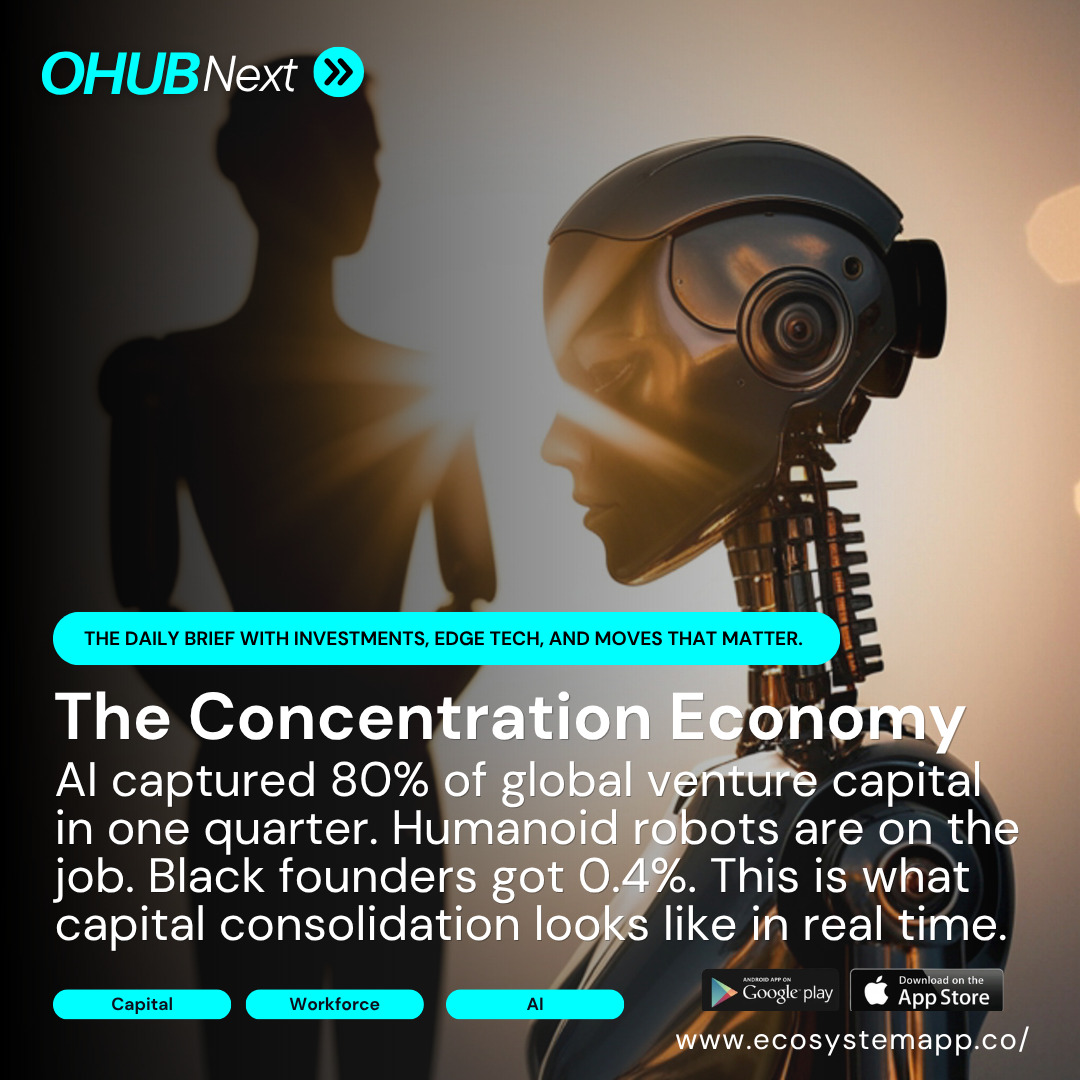
📍 On May 1st — International Workers Day — Japan Airlines began humanoid robot trials at Tokyo's Haneda Airport, deploying Chinese-made Unitree robots for baggage transport and cabin cleaning alongside human staff. Meanwhile, AI absorbed $242 billion in Q1 venture funding — 80% of all global VC — while Black founders captured just 0.4% of all U.S. startup capital in 2024, the lowest share on record. The workforce is being rebuilt. The question is who gets to own the machines.
─────
Hey Builders!
The irony writes itself. On International Workers Day 2026, Japan Airlines announced it's testing humanoid robots at one of the world's busiest airports — partnering with GMO AI & Robotics to deploy Chinese-made Unitree robots on the tarmac at Haneda, which serves more than 60 million passengers annually. The framing from the airline is careful: robots filling labor gaps, not replacing workers. But the direction of travel is unmistakable.
At the same time, the capital funding all of this is flowing to an extraordinarily narrow set of hands. Q1 2026 saw $242 billion go into AI — 80% of all global venture capital — with the four largest private rounds in history closing in a single quarter. OpenAI alone pulled $122 billion. A handful of frontier labs captured more capital in 90 days than most industries see in a decade.
And then there's the number that doesn't make headlines: 0.4%. That's the share of all U.S. startup funding that went to Black founders in 2024 — down from 1.3% in 2021, the lowest share on record. The machines are being funded at historic scale. The founders who could build the next generation of them are being systematically priced out. That tension is the story of this week.
─────
📰 Top Stories
Here's what's moving — and what it means for you.
1️⃣ Japan Airlines Deploys Humanoid Robots at Haneda — Baggage, Tarmac, and the Labor Shortage Playbook
Japan Airlines began humanoid robot trials at Tokyo's Haneda Airport in May 2026, partnering with GMO AI & Robotics Corporation. The robots — Chinese-made Unitree humanoids — are tasked with transporting containers and operating the levers that secure them on the tarmac, as well as cabin cleaning. The initiative is framed around Japan's chronic labor shortage: more than 7 million visitors arrived in just the first two months of 2026, following a record 42.7 million inbound visitors the prior year. The trial is expected to run for two years. UBS forecasts approximately 30,000 humanoid robot shipments globally in 2026 — up from 18,600 units in 2025 — with the major scaling wave projected for 2027–28.
🧱 FOR FOUNDERS
This isn't just a Japan story — it's the playbook every major employer in aviation, logistics, hospitality, and manufacturing will run over the next three years. "Filling gaps where human workers don't exist" is the narrative template, and it will precede every major humanoid deployment you're about to see. You don't have to build the robot to win here. The services stack sitting on top of this physical AI layer — operator software, motion program optimization, compliance tooling, workforce transition infrastructure — is still wide open. That's where your wedge is.
─────
2️⃣ $242 Billion to AI in One Quarter — The Four Largest Private Rounds in History Closed Simultaneously
Four of the five largest venture rounds ever recorded closed in Q1 2026: OpenAI ($122B at an $852B valuation), Anthropic ($30B at a $380B valuation), xAI ($20B at a $230B valuation), and Waymo ($16B). OpenAI's round — confirmed by Bloomberg, CNBC, and OpenAI's own press release — is the single largest private financing deal in history, with Amazon ($50B), Nvidia ($30B), and SoftBank ($30B) as lead investors. OpenAI is generating $2 billion in revenue per month with over 900 million weekly active users. Anthropic's Series G was led by GIC and co-led by D.E. Shaw Ventures, Dragoneer, and Founders Fund; Anthropic's run-rate revenue stands at $14 billion, growing more than 10x annually for three consecutive years.
🧱 FOR FOUNDERS
When 80% of all global VC concentrates into one sector and the top four deals represent the majority of that capital, you are not competing for the same checks — and you shouldn't try to. The frontier model layer is closed. What's open is the vertical application layer: industry-specific tools built on top of OpenAI, Anthropic, and xAI infrastructure, serving buyers who already have budget and urgency. That's where your pitch lives right now. Get there before the category becomes obvious.
─────
3️⃣ Black Founders Captured 0.4% of All Startup Funding in 2024 — The Lowest Share on Record
Black-founded startups raised approximately $730 million in 2024 — just 0.4% of all U.S. startup capital, the lowest share on record per Crunchbase, and down from 1.3% in 2021. Not one U.S. AI startup that raised $100 million or more in 2024 was Black-founded. The slide is accelerating against a backdrop of retreating DEI commitments across institutional LPs and GPs. The structural remedy identified by research is not more founder support programs — it's fund formation: when a Black investor leads the investment team, the funding gap narrows by nearly 50 percentage points. Programs like Black Flag (writing $100K–$2M checks into aerospace, biology, energy, and robotics) and Google for Startups' Black Founders Fund (over $40 million deployed since 2020) remain active, but they are working against a structural headwind that is currently widening, not narrowing.
🧱 FOR FOUNDERS
This isn't a pipeline problem and it isn't going to be solved by the same VCs who created the gap. The path through runs through alternative capital structures — and the infrastructure for them is growing faster than the traditional channel. Investment crowdfunding raised $447.4 million in H1 2025 alone, up 60% year over year. Revenue-based financing, community SPVs, and Reg A+ raises are not consolation prizes right now. In a market where 0.4% is the number, they are the primary path. Build your fundraising strategy around that reality, not around hoping the traditional pipeline opens up.
─────
4️⃣ Edge AI Chips Are a Projected $80B Market — And Most Founders Haven't Built for It Yet
As AI inference shifts from centralized cloud to on-device computation, the edge AI chip market is projected to surpass $80 billion by 2036, covering an estimated 15 billion enterprise-connected devices by 2030, per IDTechEx. Arduino launched the Ventuno Q edge AI development board in Q1 2026 — powered by Qualcomm Dragonwing processors, targeting robotics, vision systems, and autonomous edge applications, with availability expected in Q2 2026. NVIDIA's Jetson Thor platform is already deployed by Amazon Robotics, Boston Dynamics, Figure, and Caterpillar. In the vehicle edge AI segment, recent rounds include Wayve at $1.2B and Nuro at $203M.
🧱 FOR FOUNDERS
Three forcing functions are driving this shift — latency, cost, and data privacy — and they're not going away. If your product depends on real-time data from a physical environment: a factory floor, a retail space, a vehicle, a medical device — your cloud-dependent architecture is a future liability that your competitors are already pricing into their roadmaps. You don't need to build chips to play here. You need to build applications that run efficiently at the edge, and you need to start designing for that constraint now, before your architecture hardens around assumptions that will cost you to unwind later.
─────
5️⃣ Investment Crowdfunding Hit $447M in H1 2025 — Up 60% Year Over Year
Regulated investment crowdfunding — Reg CF and Reg A+ combined — raised $447.4 million in the first half of 2025, the strongest performance since the 2021 market peak, per Kingscrowd's H1 2025 Investment Crowdfunding Report. The 60% overall growth was driven significantly by Reg A+ activity, which surged 157% — though that figure was heavily influenced by a small number of large campaigns. Reg CF, the more broadly accessible channel with a $5 million annual raise cap, grew a more modest 9%. The global crowdfunding market is projected to grow from $1.45 billion in 2024 to $5.43 billion by 2033, per Fortune Business Insights.
🧱 FOR FOUNDERS
Read the 60% headline carefully — it's real, but it's not uniformly distributed. Reg A+ is being moved by large, high-profile campaigns. Reg CF is steadier and more accessible but growing more slowly. The question you need to answer before pursuing this channel isn't "can I raise this way?" — it's "does my company have a community-legible story?" Existing customers who love the product. A mission with a natural constituency. A brand that inspires co-ownership. If you can say yes to any of those, a Reg CF raise can generate capital and a built-in customer base that no VC term sheet provides. Know which instrument fits your stage and story before you assume crowdfunding is a fallback.
─────
🔧 Three moves to make this week
1️⃣ Audit your product's cloud dependency against the edge AI timeline
The JAL and edge chip stories share the same infrastructure thesis: AI compute is moving off centralized servers and onto physical devices. Spend two hours this week mapping which parts of your product could run on-device rather than in the cloud. Latency, cost, and privacy are the three forcing functions — if any apply to your product, your cloud dependency is a future liability that is already being priced into competitor roadmaps. Get ahead of it before your architecture hardens.
2️⃣ Run the alternative capital math before your next raise
With Black founder VC funding at 0.4% in 2024 and investment crowdfunding up 60% in H1 2025, the math on traditional fundraising has shifted for a lot of you. Model a Reg CF raise in parallel with your VC outreach — not instead of it. Count how many of your existing users, customers, or community members would invest $500–$2,500 if given the option. If the number exceeds 200, the economics start working in your favor before you send a single pitch deck.
3️⃣ Define your vertical AI wedge — the window is shorter than you think
With OpenAI at an $852B valuation and Anthropic at $380B, the foundation model layer is closed to new entrants. The next funding wave flows to vertical applications built on top of that infrastructure.
This week: identify one specific workflow in your industry that frontier AI can now automate end-to-end. Scope a product that does exactly that — nothing more. The founders who lock in their wedge in the next 90 days will have meaningful distribution before the category gets obvious to everyone else.
─────
💬 Quote of the Day
"We must use time creatively, in the knowledge that the time is always ripe to do right." — Martin Luther King Jr.
─────
🏁 Build New Skills With OHUB
The OHUBAI Competency Program is a four-week intensive, hands-on training program designed to help you build real AI capability fast — whether you're a founder, a working professional, or a career-switcher ready to future-proof your skill set.
New cohorts open every four weeks. By the end of Week 1, you'll have built your first AI agent.
For founders, here's what you walk away with:
▪️ 4 weeks of live, instructor-led curriculum — not pre-recorded, not self-paced, real instruction with real accountability
▪️ Up to 1 year of access to the Mindstone Dashboard
▪️ Up to 1 year of updated education content
▪️ A seat in one of the fastest-growing AI communities globally
Financing available through Affirm or Klarna — get started for as low as $97/mo.
🚀 Visit opportunityhub.co/ai to learn more.
─────
🎬 Closing Thought
When Japan Airlines deploys humanoid robots on International Workers Day, when $242 billion concentrates into four AI companies in a single quarter, and when Black founders capture 0.4% of all startup capital — these aren't three separate news stories. They're one story about who gets to own the infrastructure of the next economy.
The machines are being funded. The physical labor layer is being automated. Capital is concentrating at a velocity that makes every prior tech cycle look measured. And if you understand all three of those forces simultaneously — not just one — you have a clearer view of where the surface area for new companies actually exists right now.
The ownership gap doesn't close by waiting for the system to correct itself. It closes when you move faster, read the signals clearer, and position on the right side of the capital flows before everyone else catches up. The founders who do that won't just survive the concentration. They'll own a piece of what replaces it.
─────
⚡️ OHUBNext Daily Brief — investments, edge tech, and moves that matter. For 12+ years, OHUB has been building pathways and on-ramps to multi-generational wealth — without reliance on pre-existing wealth. Through exposure, skills, entrepreneurship, capital markets, and inclusive ecosystems, we've helped people create new jobs, new companies, and new wealth.

OHUBAI Competency Program
Visit the post for more.
opportunityhub.co