


OHUB @ohub
🚨 OHUBNext | The War on Your Income
🚨 OHUBNext | The War on Your Income
📍 AI is cutting 16,000 U.S. jobs a month — and the people with the least cushion are absorbing the most impact.
⸻
TL;DR
▪️ AI eliminated an estimated 16,000 U.S. jobs per month in early 2026, with Gen Z and entry-level workers hit hardest — a 13% employment drop among workers aged 22–25 in AI-exposed fields (Stanford University / Dallas Fed, 2026; Goldman Sachs / Fortune, April 2026)
▪️ Trump-era tariffs now represent the largest U.S. tax increase as a share of GDP since 1993 — costing households up to $1,300 this year, depending on which tariffs remain in effect after recent court rulings (Tax Foundation, 2026)
▪️ More than 260,000 federal workers have been confirmed departed since January 2025 — with total workforce departures estimated as high as 385,000 — with ripple effects hitting contractors, nonprofits, hospitals, and local economies (OPM / Fortune, 2026)
▪️ 86% of the 6.1 million workers facing both high AI exposure AND low adaptive capacity are women — the most vulnerable intersection in the labor market right now (Brookings Institution, 2026)
⸻
Hey Builders!
You start a Monday by checking your phone and the news feels like it's happening "to" someone else. But this week, the data says it's happening to "all of us" — Black workers, first-gen professionals, and founders who built careers in the exact fields now being automated, defunded, or taxed into oblivion. The question isn't whether the storm is real. It's whether you have a map.
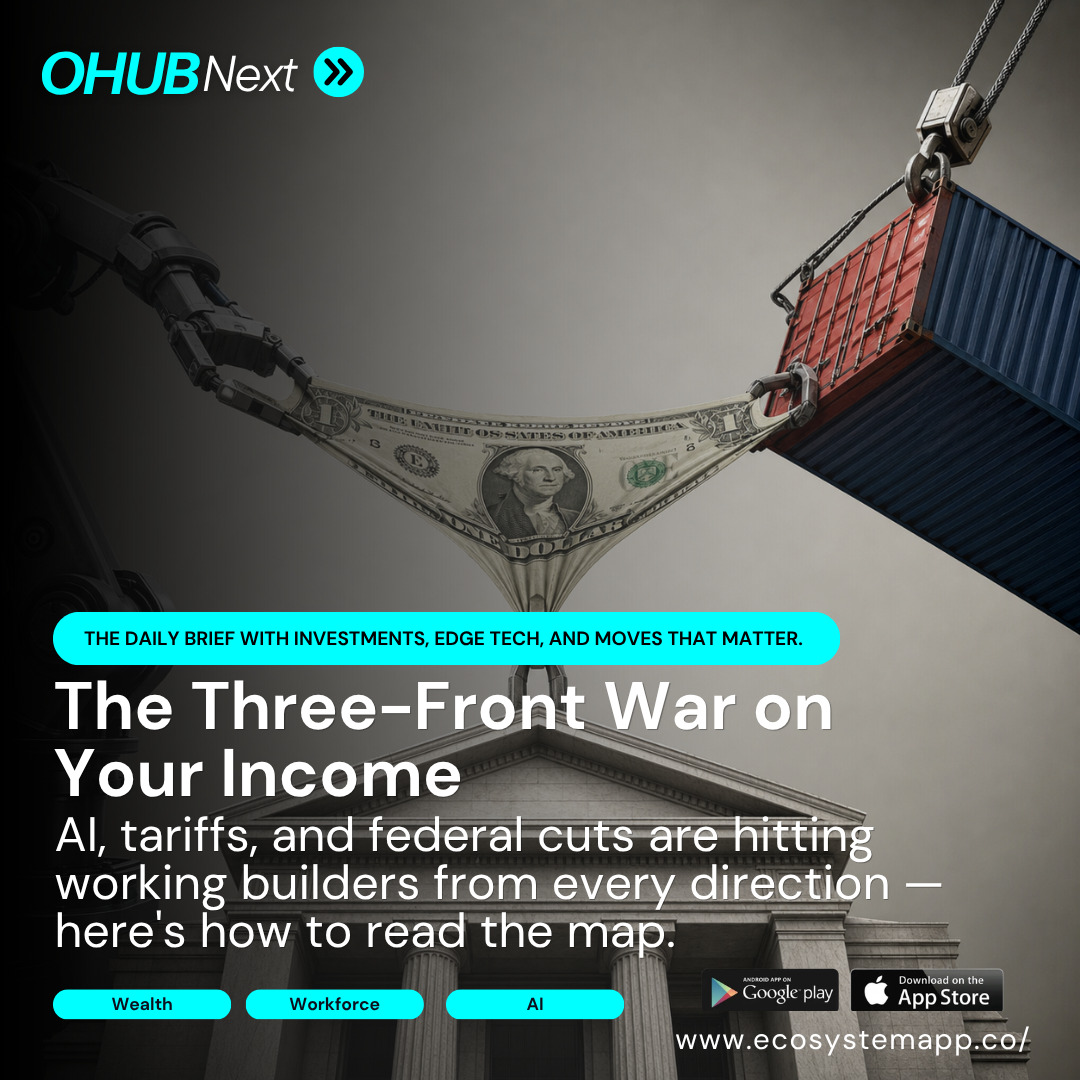
Three converging forces are reshaping the labor market and small business landscape in real time.
They're not unrelated.
They're compounding.
⸻
🗞 Top Story: The Triple Squeeze
The U.S. economy is in the middle of a three-front restructuring that no single headline is capturing in full.
▪️Front 1 — AI displacement is no longer theoretical. Goldman Sachs reported in April 2026 that AI is eliminating roughly 16,000 U.S. jobs per month, with the brunt landing on Gen Z and entry-level workers in knowledge and administrative roles. That's the internship pipeline. That's the first-job pipeline. That's the rung that used to let people climb. Brookings found that 6.1 million workers face both high AI exposure and low capacity to adapt — and 86% of them are women. These aren't abstract projections. This is happening now, and our community is concentrated in exactly those roles.
▪️Front 2 — Tariffs are a tax increase in disguise. The Tax Foundation confirmed that Trump's tariff regime is the largest U.S. tax increase as a share of GDP since 1993 — translating to up to $1,300 per household in 2026, depending on which tariffs remain in force after recent court rulings. For small business owners sourcing goods or materials, it's worse: supply chain disruptions, higher input costs, and compressed margins. A U.S.-China 90-day tariff pause was recently announced, but with effective rates on Chinese imports still near 30%, and a February Supreme Court ruling complicating enforcement, the instability itself is a cost. Uncertainty is expensive.
▪️Front 3 — Federal cuts are draining local economies. More than 260,000 federal workers have been confirmed departed since January 2025, with OPM tracking total workforce departures as high as 385,000. But the damage isn't just to federal employees — it's to every contractor, nonprofit, research institution, and small business in their orbit. In Northern Virginia, 80% of business leaders said DOGE cuts threatened their regional economy. In majority-Black metro areas that historically leaned on federal employment as a stable, wealth-building career path, that foundation has been cracked.
⸻
🧱 Builder Insight
1️⃣ The entry point has moved. If AI is collapsing the entry-level job market, the new entry point is skills-forward, not credential-forward. Builders who can demonstrate AI fluency — not just use tools, but deploy them strategically — are building leverage. Everyone else is competing in a shrinking pool.
2️⃣ Price everything for the new normal. If you run a product-based business or source any goods internationally, your 2024 cost model is broken. Rebuild your pricing and margin assumptions around the current tariff environment, not the one you hoped would go away. It's not going away fast enough.
3️⃣ Diversify your revenue's geography. The communities most hurt by federal workforce cuts are often the same ones with the most concentrated economic exposure. If your customer base is primarily federal workers or federal contractors, you need a second revenue stream — now. This is a structural vulnerability, not a temporary dip.
⸻
📈 Forward Scenario
Run the numbers and the opportunity becomes concrete. PwC's Global AI Jobs Barometer found that workers with genuine AI skills now earn a 56% wage premium over colleagues in the same role without them — up from 25% just one year earlier. That's not a rounding error. That's the difference between a $60,000 job and a $94,000 job. On the supply chain side, small businesses that diversified sourcing away from China saw tariff cost reductions of 40–80%, according to a Netstock April 2026 analysis of SMB tariff strategies — while businesses that did nothing are now absorbing an average of $11,400 per month in tariff-related costs, nearly triple what they paid in early 2024.
The builders who thrive in this cycle will be those who see the three fronts as connected — not three separate problems to solve, but one systemic shift requiring a unified response. That response looks like: AI skills as a competitive moat, supply chain flexibility as a business imperative, and revenue diversification as wealth protection.
The next 18 months will reward people who made moves now while others waited to see if things would stabilize.
They won't — they'll just shift again.
Do with that information what you will.
⸻
💬 Quote of the Day
"Society would have to rethink the social safety net to ensure that the gains from unprecedented economic growth are shared rather than concentrated among a small group of capital holders and AI superstars." — Fed Governor Michael Barr, Federal Reserve Speech on AI and the Labor Market, February 17, 2026
⸻
🎬 Closing Thought — The Map Is the Advantage
Here's what the headlines are missing: these three forces — AI displacement, tariff costs, and federal workforce cuts — aren't random. They're part of a broader economic restructuring that disproportionately impacts people without existing wealth buffers. That's not pessimism. That's the map.
And maps are only useful if you're willing to read them clearly. The Great Wealth Transfer is real — an estimated $3 trillion in small business ownership is expected to change hands as Baby Boomers retire, with McKinsey and CNBC both flagging the opportunity for Black and underrepresented entrepreneurs to capture a meaningful share. But capturing that opportunity requires capital access, operational readiness, and community infrastructure — none of which appear by accident.
The builders in this community didn't get to where they are by waiting for conditions to improve. They built leverage in constrained environments. That skill — that *capacity* — is exactly what this moment demands. Know the forces. Work the map. Don't wait for the storm to pass before you start building.
By Kieran Blanks, MBA, Head of Product and New Ventures, OHUB
⸻
⚡️ OHUBNext Daily Brief — investments, edge tech, and moves that matter.
For 12+ years, OHUB has been building pathways and on-ramps to multi-generational wealth — without reliance on pre-existing wealth. Through exposure, skills, entrepreneurship, capital markets, and inclusive ecosystems, we've helped people create new jobs, new companies, and new wealth.