


OHUB @ohub
🚨 OHUBNext | Daily Brief
🚨 OHUBNext | Daily Brief
📍 The AI productivity story is now a jobs, skills, and ownership story.
⸻
TL;DR
▪️ Coinbase said on May 5, 2026 that it will cut about 700 jobs, roughly 14% of its workforce.
▪️ CEO Brian Armstrong cited two pressures: a volatile crypto market and AI changing how work gets done.
▪️ The most recent BLS report showed U.S. payrolls rose 178,000 in March while unemployment stood at 4.3%.
▪️ This week's labor-market debate is about whether AI is replacing workers, pressuring companies to shrink teams, or changing which workers get leverage.
⸻
Hey Builders!
You can feel the shift before it shows up cleanly in the data. Teams are smaller, expectations are higher, and the person who knows how to use AI well is starting to look like a whole department. For builders trying to protect income, raise capital, or move into the next version of work, today's question is not whether AI matters. It is whether you are positioned as the person using it, or the person being measured against it.
⸻
🗞 Top Story
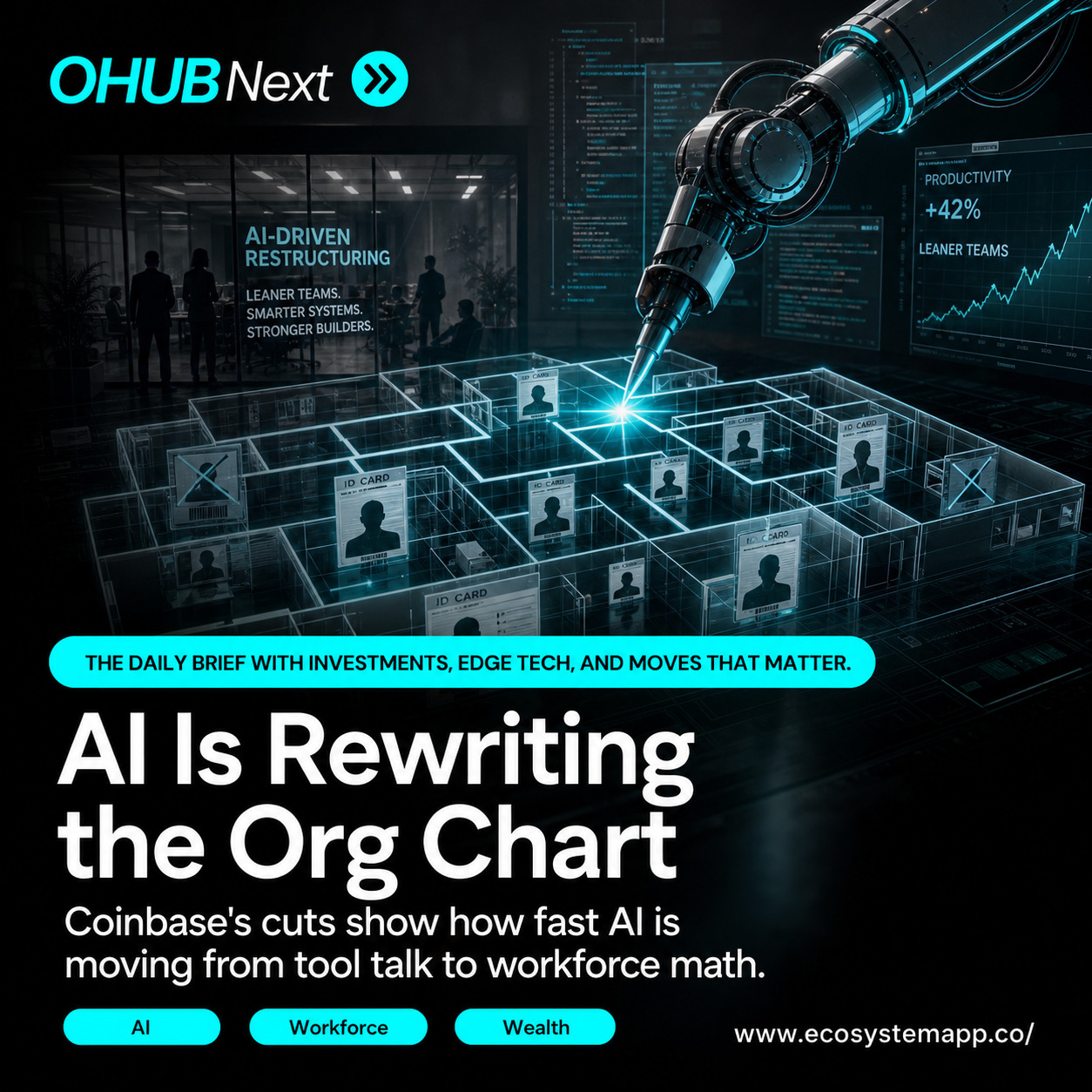
Coinbase became today's clearest signal. The crypto exchange said it will reduce its workforce by about 700 employees, or roughly 14%, as part of a restructuring tied to market volatility and a more AI-native operating model. The company is also flattening management layers, concentrating remaining teams around AI skills, and pushing leaders to operate less like pure managers and more like hands-on builders.
That matters beyond crypto. Coinbase is a highly visible company in a sector built around financial infrastructure, digital assets, and speculative cycles. When a company like that cuts staff while saying AI lets small teams do more, the message travels. Investors hear efficiency. Workers hear risk. Founders hear a new benchmark for how lean they are expected to be.
The broader labor backdrop is mixed. The Bureau of Labor Statistics reported that nonfarm payroll employment increased by 178,000 in March, with unemployment at 4.3%. That sounds steady on the surface. But the next jobs report is now a pressure test for the Federal Reserve and for households trying to read whether income opportunities are expanding or narrowing.
⸻
🧱 Builder Insight
1️⃣ AI is becoming an operating model, not a software category.
The first wave of AI adoption was about tools: chatbots, copilots, automations, content workflows. The second wave is about structure. Companies are asking whether one person with agents can do what used to require three people, a manager, and a weekly status meeting. That changes hiring, promotion, and vendor decisions.
2️⃣ The danger is not only job loss. It is leverage loss.
For underrepresented builders, the risk is that AI becomes another gatekeeping layer. If companies decide that entry-level roles can shrink, then the first rung of the ladder gets weaker. If capital markets reward smaller teams without asking who gets trained, mentored, and promoted, the productivity gains can widen the same wealth gaps OHUB exists to close.
3️⃣ The response is ownership of workflow.
The builders with the edge will not be the ones who simply "know AI." They will be the ones who can redesign a workflow, document the outcome, measure the time saved, and turn that into a stronger job case, client offer, or company model. AI skill has to become economic proof.
⸻
📈 Forward Scenario
Expect more companies to frame restructuring around AI, even when the full story includes slower demand, investor pressure, or capital discipline. That means workers and founders should listen carefully to the language. When a CEO says small teams can now ship faster, the practical question is: which roles become more valuable inside those smaller teams?
For the OHUB's ecosystem, the answer cannot be passive adaptation. Builders need to learn the tools, but they also need to claim the systems layer- product strategy, data judgment, customer trust, compliance, sales motion, and community context. Those are the places where automation alone does not lend itself to multigenerational wealth building
⸻
💬 Quote of the Day
"AI is changing how we work." — Brian Armstrong, Coinbase CEO
⸻
🎬 Closing Thought — Productivity Needs a Ladder
The market loves a clean efficiency story. Fewer layers. Smaller teams. Faster output. Better margins. But communities do not build wealth from efficiency alone. They build wealth when productivity creates new access points and on-ramps to better jobs, stronger businesses, more ownership, and clearer paths into the marketing defining industries that are setting the rules.
That is the standard we should use to read AI news. Not just whether a company can cut costs, but whether the new operating model creates room for more people to participate in the upside. If AI makes every team smaller, then training, apprenticeship, and entrepreneurship have to get more intentional.
Today's move isn't panic. It's preparation.
Audit your workflow. Find one process you repeat every week — then use AI to make it faster, clearer, or more valuable. Document the before and after.
In this economy, proof of leverage is its own form of capital.
The question isn't whether AI can help you.
It's which task you're still doing manually that Claude, Gemini, or Perplexity could handle by tomorrow.
⸻
By Kieran Blanks, MBA, Head of Product and New Ventures, OHUB
⚡️ OHUBNext Daily Brief — investments, edge tech, and moves that matter.
For 12+ years, OHUB has been building pathways and on-ramps to multi-generational wealth — without reliance on pre-existing wealth. Through exposure, skills, entrepreneurship, capital markets, and inclusive ecosystems, we've helped people create new jobs, new companies, and new wealth.