

OHUB @ohub
🚨 OHUBNext | Opportunity Alert
🚨 OHUBNext | Opportunity Alert
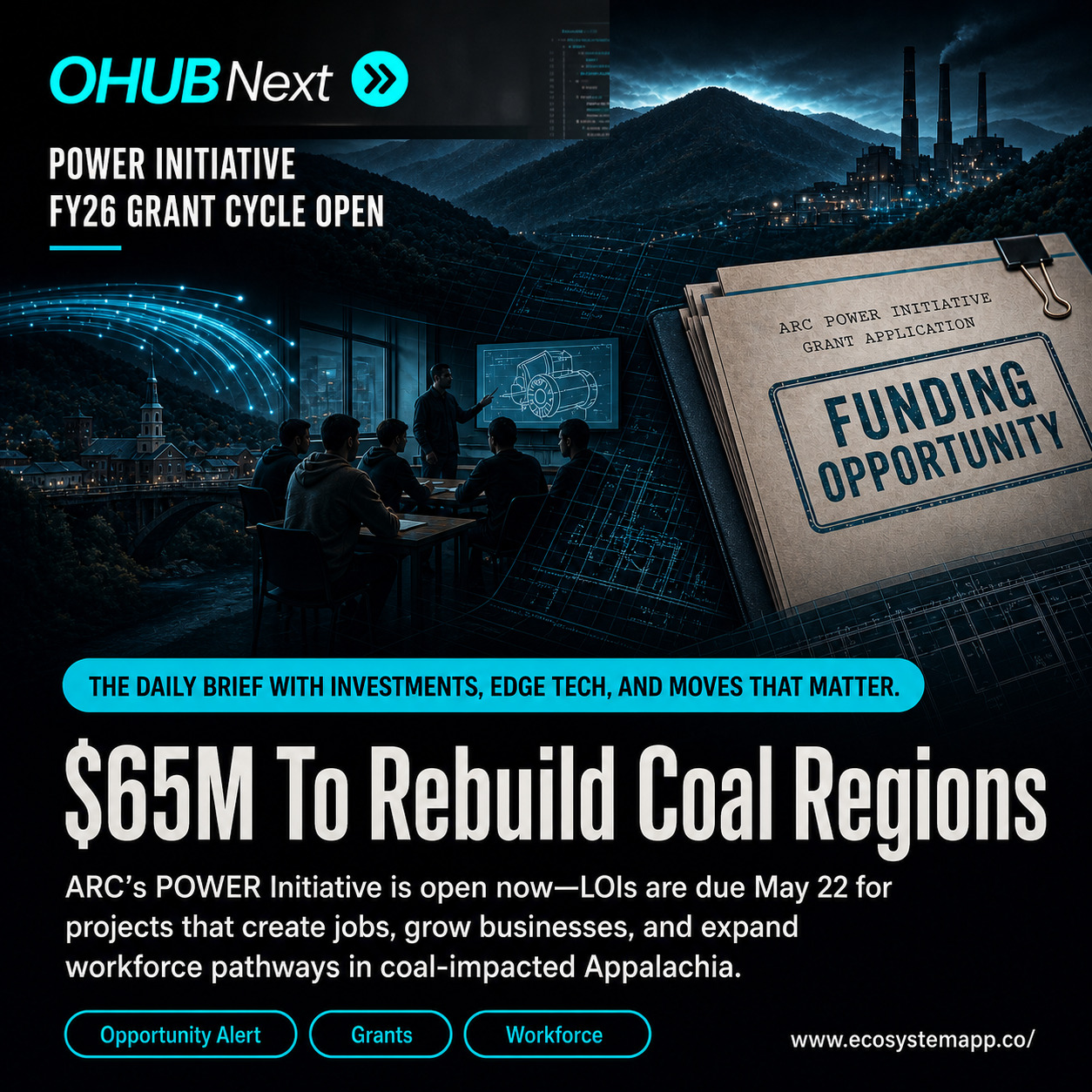
📍 Letters of intent due May 22 (5 p.m. ET) for ARC’s POWER Initiative.
⸻
TL;DR
▪️ ARC opened its FY 2026 POWER Initiative funding cycle on May 5, 2026.
▪️ LOIs are due May 22, 2026 (5:00 p.m. ET) and full applications are due July 8, 2026 (5:00 p.m. ET).
▪️ARC says up to $65M is available, with awards ranging from $100K planning grants to $2M+ implementation awards (including broadband up to $2.5M).
▪️Eligible applicants include nonprofits, local/state government entities, tribes, local development districts, and higher-ed—not individuals or for-profit companies.
⸻
Hey Builders!
There’s a specific kind of pressure that hits places built around one industry: when the work shifts, the whole local economy shifts with it. If you’ve ever tried to build in a region where opportunity feels like it has a short shelf life, today’s alert is for you.
The Appalachian Regional Commission (ARC) just opened its FY 2026 POWER Initiative—federal grant funding aimed at turning coal-impacted communities into new engines for jobs, entrepreneurship, and workforce mobility.
⸻
🧾 What it is
POWER (Partnerships for Opportunity and Workforce and Economic Revitalization) funds projects in Appalachian communities hit by coal-related job losses—coal mining, coal power plants, and coal supply chains—with a focus on diversification that turns into paid work, business growth, and durable capacity.
⸻
🎯 What’s included (and what’s fundable)
ARC’s FY 2026 notice says up to $65 million is available. Awards range from up to $100,000 for planning to $400,000–$2 million for implementation (up to $2.5 million for broadband implementation). Projects can include workforce training (including paid work-based learning), entrepreneurship support, and enabling infrastructure like broadband.
⸻
✅ Who it’s for (eligibility reality check)
POWER isn’t a “solo founder” grant you apply for as an individual. The eligible applicants ARC lists include:
- Public or private nonprofit organizations (including faith-based organizations)
- States, counties, cities, or other political subdivisions (and certain consortia)
- Local development districts (LDDs)
- Indian tribes (or a consortium of tribes)
- Institutions of higher education (or consortia)
ARC also explicitly says it does not award grants to individuals or for-profit entities. Translation: if you’re a founder or operator, you’ll likely lead the idea while a nonprofit, local government, tribe, LDD, or college applies.
⸻
🗓 Key dates (don’t miss the funnel)
✓May 15, 2026: register for Pathways (ARC’s grants system) to ensure access to the application portal
✓May 22, 2026 (5:00 p.m. ET): required letter of intent (LOI) due
✓July 8, 2026 (5:00 p.m. ET): full application due
✓Winter 2027: awards announced (selected projects begin February 1, 2027)
The LOI is the moment to move: lock in the partner, scope, and outcomes now, then use June to build the full application.
⸻
🧠 Builder playbook (how to position a POWER-worthy idea)
Federal grants can be bureaucratic, but they’re one of the few capital sources that can underwrite ecosystem work the market ignores. Anchor your idea to three questions:
1️⃣ What job pathway are you building, and for whom?
Name the industry, credential, and wage ladder—then show who gets access.
2️⃣ What’s the business or supplier outcome?
Pair training with small-business growth, procurement pathways, and an access-to-capital plan that keeps value local.
3️⃣ What becomes permanent after the grant?
An apprenticeship model, a lab, a broadband corridor, a standing coalition—something that still works when the grant period ends.
⸻
🔗 Official link
Apply/learn more here: arc.gov/...
(The FY 2026 NOSA PDF is linked on that page and includes full eligibility, match requirements, and scoring criteria.)
⸻
🧩 Bonus window
If you build in supply chains, SBA is also taking public comments on supply chain gaps and entrepreneur assistance—comments close May 18, 2026. It’s not a check, but it can shape what programs get built next.
⸻
💬 Quote of the Day
“Appalachia’s coal communities have long been a driving force in our region’s economic development,” said ARC Federal Co-Chair Gayle Manchin. “Through ARC’s POWER initiative, our intent is to strengthen the communities’ ability to push forward into the next era of prosperity, while empowering the residents to be able to chart the course of their futures.”
⸻
🎬 Closing Thought — Build The Next Base
The goal isn’t to bring the old jobs back. The goal is to build a new economic base that can’t be extracted and exported so easily.
That’s why POWER matters for Black and underrepresented builders: transitions rewrite the rules of who gets trained, contracted, financed, and positioned to own the upside. If we don’t show up early with projects designed for equitable participation, the benefits will follow the same old map.
Treat this as a leverage moment. If you’re in Appalachia—or you partner with coal-impacted counties—use the LOI deadline to assemble the right coalition (applicant org + employer + training partner + capital partner) and put your outcomes in writing. May 22 comes fast.
By Kieran Blanks, MBA, Head of Product and New Ventures, OHUB
⸻
OHUBNext Daily Brief ⚡️ - investments, edge tech, and moves that matter.
For 12+ years, OHUB has been building pathways and on-ramps to multi-generational wealth - without reliance on pre-existing wealth. Through exposure, skills, entrepreneurship, capital markets, and inclusive ecosystems, we've helped people create new jobs, new companies, and new wealth.

Partnerships for Opportunity and Workforce and Economic Revitalization Initiative - Appalachian Regional Commission
ARC’s POWER Initiative targets federal resources to projects that help coal communities expand local and regional economies.
www.arc.gov