

OHUB @ohub
🚨OHUBNext | Allen Takes the BuzzFeed Wheel
🚨OHUBNext | Allen Takes the BuzzFeed Wheel
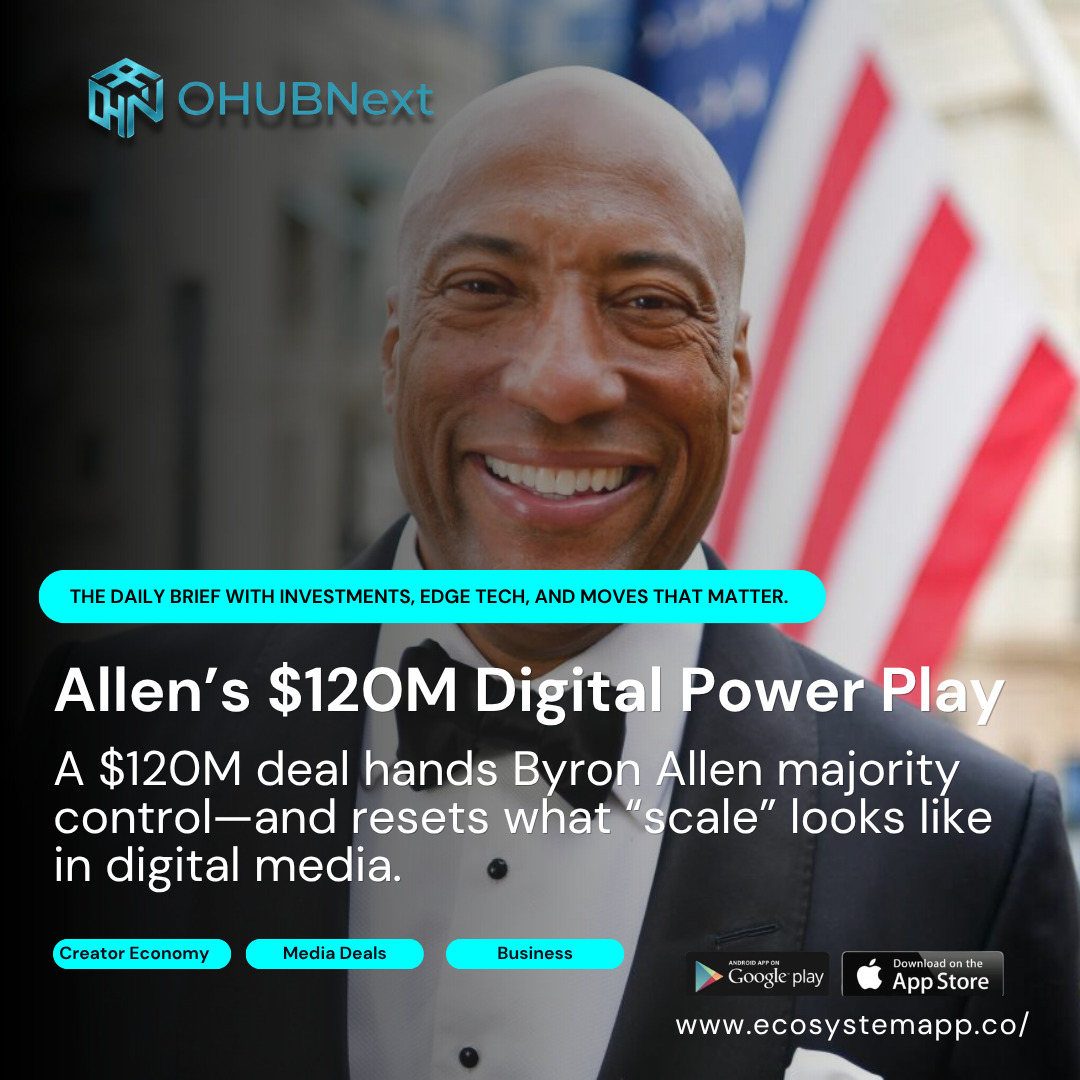
📍 Byron Allen takes control of BuzzFeed—$120M in exchange for governance and a new playbook for distribution
─────
TL;DR
▪️ Byron Allen’s family office is putting $120M into BuzzFeed for 40M shares at $3.00/share, targeting about 52% ownership after closing.
▪️ The $120M is structured as $20M cash at closing plus a $100M secured promissory note (5% interest, five-year maturity).
▪️ The company says the deal is expected to close on or around May 26, 2026 (subject to customary conditions).
▪️ Governance shifts with control: Allen is slated to become Chairman + CEO at close; Jonah Peretti transitions to President of BuzzFeed AI.
─────
Hey Builders!
There’s a particular jolt in watching a culturally consequential brand get priced—publicly, in real time. It forces an uncomfortable question: what is a decade of influence worth when the business model underneath it is under pressure?
But the headline isn’t sentiment. It’s control. This is capital paired with governance at a moment when attention is plentiful, but distribution is increasingly pay-to-play.
─────
🗞️ Top Story
BuzzFeed says it has signed a transaction agreement with Allen Family Digital, LLC (an affiliate of Byron Allen’s family office) for a majority investment. The structure is unusually plain—and that’s what makes it legible:
▪️ 40,000,000 new Class A shares at $3.00 per share (a $120M headline number).
▪️ Funded with $20M cash at closing and a $100M promissory note that bears 5% interest and matures five years after the close.
▪️ BuzzFeed indicates proceeds are intended to partially repay existing indebtedness.
▪️ After a conversion of Jonah Peretti’s Class B shares, Allen Family Digital is expected to hold about 52% of the company’s outstanding Class A common stock.
💡What This Means: this is a capital injection, but it’s also a steering wheel transfer. The 8‑K lays out board expansion and director appointment rights that turn “investment” into “control.”
If you’re building anything that depends on platforms, it’s a reminder that governance is a growth strategy—not paperwork.
Let that sink in.
─────
🧱Builder's Insight: Three Moves This Deal Makes Visible
1️⃣ Control is the product now
In 2026, the scarce asset in media isn’t content volume. It’s repeatable distribution and the capacity to finance audience acquisition without living at the mercy of the feed. A majority stake turns BuzzFeed from a brand with reach into an asset that can be repositioned—especially if the next chapter is free streaming video and creator-first formats.
2️⃣ Liquidity buys optionality—and time
The deal’s financing matters. A 5% note is not a gift; it is a price for time. But compared with trying to survive on volatile CPMs alone, time can be the most valuable input. For builders, the lesson is simple: if your model runs through someone else’s marketplace (ad platforms, app stores, social distribution), your balance sheet becomes a core part of your product strategy.
3️⃣ AI isn’t just a tool; it’s a re-org
Peretti’s new title—President of BuzzFeed AI—signals that the edge is shifting from pure creative to operating system: personalization, packaging, commerce conversion, and disciplined experimentation. The winners won’t be the loudest storytellers; they’ll be the builders who can ship, test, and monetize at a cadence the market can’t easily imitate.
─────
⏭️ Forward Scenario: What This Could Mean for the Next 12 Months
If Allen’s stated goal is to push BuzzFeed toward free-streaming video and creator formats, expect the “media company” category to keep collapsing into “distribution + adtech + creator supply chain.”
That has two ripple effects worth watching:
▪️ More control transactions (not just partnerships) in digital media—especially for assets with recognizable brands but shaky balance sheets.
▪️ A sharper split between publishers who can finance experimentation and those forced into permanent austerity.
For Black and underrepresented builders, the opportunity is not to wait for the industry to “come back.” It’s to build businesses that own a channel: direct audience, membership, commerce loops, and repeatable content systems—so your revenue does not vanish the moment a platform reprices your reach.
─────
💬 Quote of the Day
“BuzzFeed is officially chasing YouTube…” - Byron Allen, incoming Chairman and CEO of BuzzFeed, Inc.
─────
🎬 Closing Thought - Own the Channel
Culture can create demand at global scale. But ownership determines who converts that demand into durable wealth.
If you’re building in media, community, or commerce, treat distribution like infrastructure—not marketing. Own the list. Own the customer relationship. Own the conversion path. Build revenue streams that can survive a platform reset: when algorithms tighten, reach gets repriced, and the feed goes silent.
A significant portion of the wealth gap is really a distribution gap disguised as culture—who controls the audience, the data, the inventory, and the terms of monetization as products evolve.
So don’t just become the face, the voice, or the personality. Structure your position for long-term upside: equity, rights, ownership, and real control.
That’s how you build multigenerational wealth 🔑.
─────
⚡️ OHUBNext Daily Brief - investments, edge tech, and moves that matter.
For 12+ years, OHUB has been building pathways and on-ramps to multi-generational wealth - without reliance on pre-existing wealth. Through exposure, skills, entrepreneurship, capital markets, and inclusive ecosystems, we've helped people create new jobs, new companies, and new wealth.