


OHUB @ohub
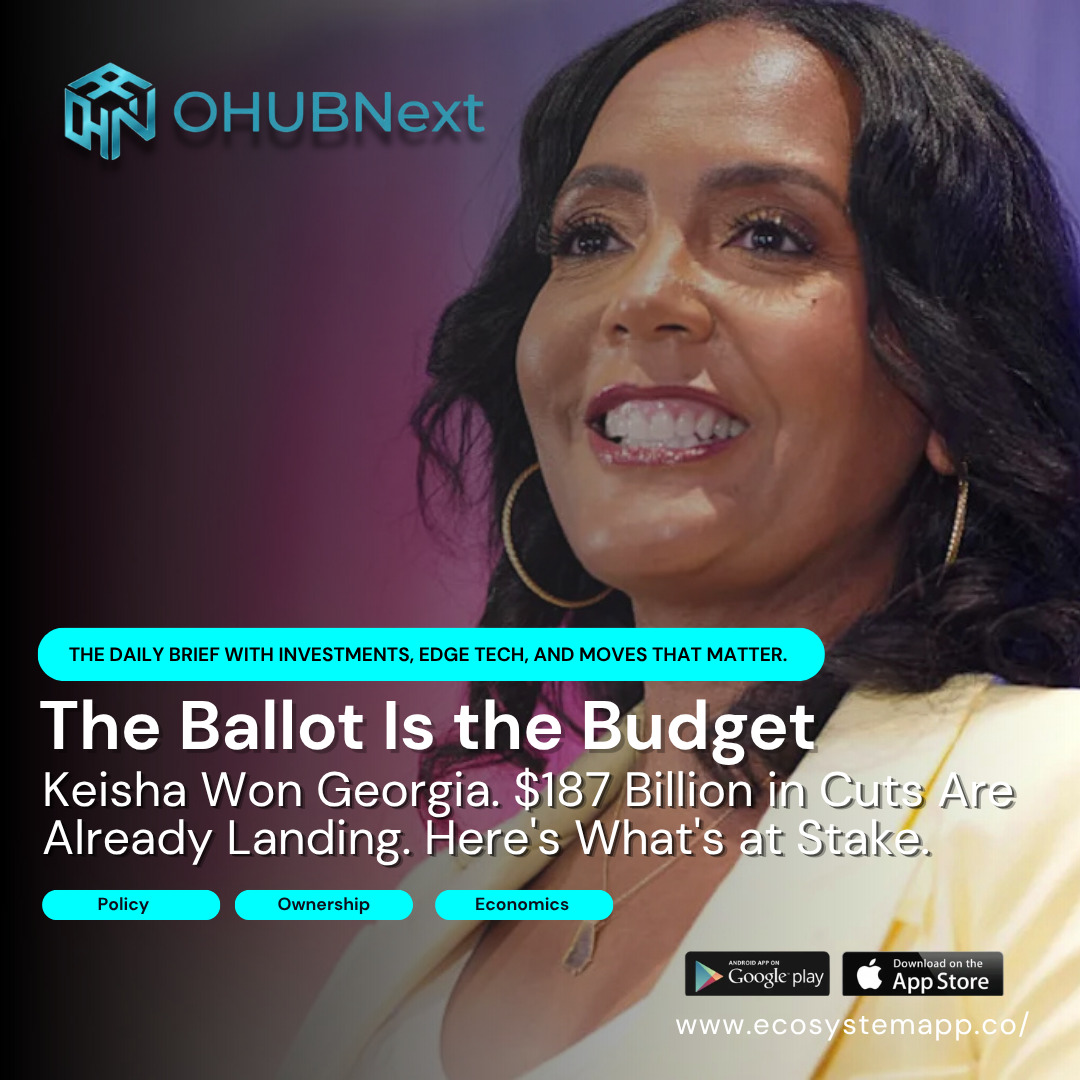
Keisha Won Georgia. $187 Billion in Cuts Are Already Landing. Here's What's at Stake.
Keisha Won Georgia. $187 Billion in Cuts Are Already Landing. Here's What's at Stake.
🚨 OHUBNext | Keisha Won Georgia. $187B in SNAP Cuts Are Landing. The Ballot and the Budget Are the Same Fight.
📍 Keisha Lance Bottoms won the Georgia Democratic gubernatorial primary Tuesday with 56% of the vote — no runoff, no contest. If she wins in November, she becomes the first Black woman governor in American history. Meanwhile, the One Big Beautiful Bill — signed July 4, 2025 — is already cutting $187 billion from SNAP over 10 years, stripping health coverage from an estimated 10 to 11.8 million people, and choking off the federal contracting pipeline that Black-owned businesses depend on. Political power and economic survival are running on the same clock.
─────
Hey Builders!
Tuesday night, Keisha Lance Bottoms did something no Democrat has done cleanly in a crowded Georgia gubernatorial primary in a long time — she cleared 50% and walked out without a runoff. She took 56% of the vote across a seven-candidate field. That matters tactically. It matters symbolically. And it matters economically in ways most political coverage won't touch.
Georgia is not a backdrop. Georgia is infrastructure. It is the state with the third-highest uninsured rate in the country — 13.7% — with 1.4 million residents uninsured and 36% of those in the coverage gap being Black. It controls Medicaid policy for hundreds of thousands of people currently being denied coverage under a work-requirement waiver that has enrolled fewer than 20,000 people in two years. It controls housing policy in one of the fastest-gentrifying metro markets in the country. What happens in Georgia in November doesn't just determine who holds the title. It determines who holds the resources.
And while that race is being run, the federal policy environment is actively dismantling the infrastructure Black families depend on. The One Big Beautiful Bill — signed July 4, 2025 — is now cutting. SNAP, Medicaid, federal contracting access, 1.3 million jobs across healthcare and adjacent sectors. The numbers are not projections. They are arriving. The window between now and November is the window where both things are true simultaneously: the most consequential Black political candidacy in American history is live, and the economic floor under Black communities is being pulled out from under it.
That is today's brief. Not separately. Together.
─────
📰 Top Stories
Here's what's moving --- and what it means for you.
1️⃣ Keisha Lance Bottoms Wins Georgia — And the Stakes Are Bigger Than the Headline
Bottoms won the Democratic nomination for Georgia governor on Tuesday, May 19, taking 56.22% of the vote — 606,983 votes — across a seven-candidate field. Her nearest challenger, former state Sen. Jason Esteves, finished at 18.7%. She won outright, no runoff. She is now the Democratic nominee and faces either Rick Jackson or Burt Jones — two Republicans currently headed to a June 16 runoff — in the November 3 general election.
If she wins, she becomes the first Black woman elected governor in the United States. Not just in Georgia. Anywhere. Ever.
Her platform hits the exact pressure points Black communities are facing right now: full Medicaid expansion for Georgia's 1.4 million uninsured residents, an end to state income tax for teachers, direct action against corporate landlords driving up rents, and expanded small business support. A recent Supreme Court ruling greenlit Southern states to redraw majority-Black districts — it has become a central pillar of her campaign, connecting voting rights to economic rights in the same argument.
💡 For Founders
Georgia is the 9th largest economy in the United States — roughly $800 billion in annual GDP. Who controls the governor's mansion controls Medicaid reimbursement rates for health startups, small business contracting priorities, housing development incentives, and rural infrastructure spending. If you are building in health, fintech, workforce, or real estate anywhere in the Southeast, this race is your regulatory environment for the next four years. Map the policy platforms now. Don't wait for November.
─────
2️⃣ The Big Beautiful Bill's Cuts Are Landing — and the Math Is Corrected
The One Big Beautiful Bill Act was signed July 4, 2025. The CBO scored its SNAP provisions at $187 billion in cuts over 10 years — roughly a 20% reduction to the program, the largest single cut in SNAP's history. Black Americans make up approximately 26% of SNAP participants — about 10.2 million people — meaning this cut lands disproportionately on Black households by raw numbers.
On health coverage: the CBO estimated the bill's Medicaid and ACA provisions will result in 10 to 11.8 million people losing health coverage by 2034. That range reflects varying assumptions on provision interactions — but both ends of it represent a healthcare access crisis. The Commonwealth Fund projected 1.3 million jobs lost across healthcare and adjacent sectors — not 500,000 as widely cited — with an $8.8 billion hit to state and local tax revenues as a downstream consequence.
In Georgia specifically, 36% of residents in the Medicaid coverage gap are Black. The state's work-requirement Medicaid waiver — Pathways to Coverage — enrolled just 18,301 people in two years, against a coverage gap of 359,000. The gap is not closing. It is widening. And the federal cuts are making state-level expansion both more urgent and, financially, harder to execute.
💡 For Founders
1.3 million healthcare and adjacent jobs disappearing and 10-plus million people losing coverage is not a political story. It is a market signal. The founders building food access infrastructure, alternative healthcare delivery, community finance tools, and workforce transition programs are addressing the largest unmet need in the country right now. That is not mission work. That is the most defensible demand signal in the American economy.
─────
3️⃣ Black Federal Contractors Are Being Frozen Out — Here Are the Verified Numbers
In fiscal year 2025, the SBA admitted just 65 new firms into the 8(a) Business Development Program — the primary federal contracting access vehicle for small disadvantaged businesses. In the four years of the Biden administration, more than 2,100 firms were admitted. The year before, FY2024, 753 firms were admitted. The drop from 753 to 65 in a single year is a 91% collapse in program access.
In January 2026, the SBA suspended more than 1,000 existing 8(a) firms for documentation non-compliance following the program's first comprehensive audit in decades. The new SBA guidance issued that same month redefines "social and economic disadvantage" to require documented, demonstrable harm — and explicitly directs staff to consider whether an applicant has been adversely affected by DEI or affirmative action policies. The practical effect: the bar has been raised to a level that will exclude the vast majority of applicants.
📌Context
Black-owned businesses currently receive approximately 1.7% of total federal contract dollars, against a Black population share of 13.4% and a business ownership share of roughly 2%. This was already a disparity. The new standards make it structurally worse.
💡 For Founders
This is not abstract. Federal contracting is one of the most reliable paths to scale for early-stage companies — predictable revenue, long contract cycles, stable payment terms. If you are in or near the 8(a) program, audit your documentation immediately and get legal counsel on the new evidentiary standards. If you are not yet in the program, the state and municipal contracting pipeline — particularly in states like Georgia where Bottoms has pledged expansion — is your parallel track. Build it now, not after federal access closes completely.
─────
4️⃣ The Ambition Is There. The Access Isn't. New Data Shows the Gap Is Getting Worse.
A new 2026 study titled "Ambition Without Access" found that young Black and Hispanic Americans aspire to homeownership, entrepreneurship, and generational wealth at rates equal to or higher than white peers — and achieve those goals far less often, not because of lack of drive but because of structural barriers to credit, capital, and financial products.
The updated numbers are sharper than the headline suggests. Black homeownership slipped to 43.9% in mid-2025 — down from 45.3% a year earlier — while the white rate held near 74%. That 30-point gap is wider than it was before the Fair Housing Act of 1968. Among millennials, 32% of Black households own versus 66.6% of white millennials. Among Gen Z, the gap is even starker: 14.2% of young Black Americans own versus 31.6% of young white Americans.
🏦 On wealth
For every $100 held by white households, Black households hold $15. Homes in majority-Black neighborhoods are undervalued by an average of $48,000. Black homebuyers are twice as likely to have mortgage applications rejected as white applicants. Black women are the fastest-growing group of entrepreneurs in the country — and still face the steepest capital access gap at every funding stage.
💡 For Founders
The "Ambition Without Access" framing is your pitch. Stop framing work in underserved communities as DEI and start framing it as structural market access — because that is factually what it is. For every $100 in white household wealth, Black households have $15. That is not a cultural story. That is an addressable infrastructure gap worth trillions of dollars. The founders who build the access layer — alternative credit products, community investment vehicles, ownership-building tools — are not doing social impact work. They are building for the most capital-efficient market opportunity in America.
─────
5️⃣ Georgia Is the Main Character of 2026 — and the Script Has More Than One Author
The 19th News this week declared Georgia "the main character of 2026." They are not wrong, but the story is larger than one race. Georgia also has a Senate contest, an active Supreme Court redistricting battle reshaping majority-Black legislative districts, and one of the most intense voter suppression legal fights in the country — all running simultaneously with the governor's race.
The midterm backdrop: Democrats are contesting House and Senate majorities in a political environment where Black voter turnout is simultaneously the most essential variable and the most targeted one. The redistricting ruling has upended which candidates can win, which communities are represented, and which policy agendas can be enacted. Bottoms has made the connection explicit — voting rights and economic rights are the same argument.
One additional data point worth naming: the broader primary results this week also showed Black candidates advancing in competitive congressional districts in Texas, where redistricting created a new 18th district with a 45% Black voting-age population. The political map is being redrawn in real time.
💡 For Founders
Political infrastructure is economic infrastructure. Redistricting maps determine which legislators control committee assignments, budget allocations, and contracting priorities in your state. If you are building in the Southeast and ignoring the redistricting fight, you are missing half the operating environment that governs your market. The communities that build civic participation infrastructure — voter education, civic tech, community organizing platforms — are building the foundational layer everything else runs on.
─────
🔧 Three moves to make this week
1️⃣ Map Bottoms' policy platform against your business model
Pull her specific commitments — Medicaid expansion, corporate landlord regulation, small business support — and pressure-test your current model against each scenario. If she wins, what changes in your market? If she loses, what's your contingency? Build both versions of the next 12 months before November, not after.
2️⃣ Audit your federal revenue exposure right now
If any portion of your revenue, contracts, or grant funding touches federal programs — 8(a), SBIR, federal procurement, SNAP-adjacent services — run a stress test today. 1,000 firms were suspended from 8(a) in a single sweep. Know exactly what your documentation looks like and whether you meet the new evidentiary standard. Then identify your state and municipal contracting alternatives and start building that pipeline in parallel.
3️⃣ Reframe your pitch around the "Ambition Without Access" thesis
If you are building for underserved communities, ditch the DEI framing and lead with the market gap. For every $100 in white household wealth, Black households hold $15. Black homeownership is at 43.9% and falling. 10-plus million people are losing health coverage. The demand is structural and massive. Write the version of your pitch that leads with that market size — not with mission language — this week.
─────
💬 Quote of the Day
"We are not fighting for the right to be like white Americans. We are fighting for the right to be ourselves and make what we can of what we have." --- Fannie Lou Hamer
─────
🏁 Build New Skills With OHUB
The OHUBAI Competency Program is a four-week intensive, hands-on training program designed to help you build real AI capability fast --- whether you're a founder, a working professional, or a career-switcher ready to future-proof your skill set.
New cohorts open every four weeks. By the end of Week 1, you'll have built your first AI agent.
For builders, here's what you walk away with:
▪️ 4 weeks of live, instructor-led curriculum --- not pre-recorded, not self-paced, real instruction with real accountability
▪️ Up to 1 year of access to the Mindstone Dashboard
▪️ Up to 1 year of updated education content
▪️ A seat in one of the fastest-growing AI communities globally
Financing available through Affirm or Klarna --- get started for as low as $97/mo.
🚀 Visit opportunityhub.co/ai to learn more.
─────
🎬 Closing Thought
Consider what happened in the same week. A Black woman won the Democratic nomination for governor of Georgia with 56% of the vote. The federal government admitted 65 firms — total — into the contracting program that is supposed to give small disadvantaged businesses a path to federal dollars, down from 2,100 over the previous four years. And a law already signed is cutting $187 billion from the food assistance program that feeds 10.2 million Black Americans. Those three facts did not make the same front page. They should have.
This is how structural disinvestment works — not in a single dramatic act, but in the simultaneous tightening of every available lever. Cut the contracting access. Cut the health coverage. Cut the food assistance. Redraw the districts. Do it all at once, in the same fiscal year, so no single headline captures the cumulative weight. The CBO scored the Medicaid cuts at 10 to 11.8 million people losing coverage. The Commonwealth Fund put the job losses at 1.3 million. Black homeownership is at 43.9% and falling — lower, right now, than it was the year the Fair Housing Act was signed. These numbers belong in the same sentence because they are the same sentence.
The November election in Georgia is not a referendum on symbolism. It is a referendum on whether Medicaid gets expanded for 359,000 people currently in the coverage gap — 36% of them Black. Whether corporate landlords get regulated in one of the fastest-gentrifying cities in America. Whether a state controlling $800 billion in annual GDP deploys that power toward the communities building the next economy or away from them. Winning the primary was the easy part. The founders and operators in this community who treat that distinction as a business variable — not a political opinion — are the ones who will be positioned on the right side of whatever comes next. The window is open. It will not stay that way.
─────
⚡️ OHUBNext Daily Brief --- investments, edge tech, and moves that matter.
For 12+ years, OHUB has been building pathways and on-ramps to multi-generational wealth --- without reliance on pre-existing wealth. Through exposure, skills, entrepreneurship, capital markets, and inclusive ecosystems, we've helped people create new jobs, new companies, and new wealth.

OHUBAI Competency Program
Visit the post for more.
opportunityhub.co