


OHUB @ohub
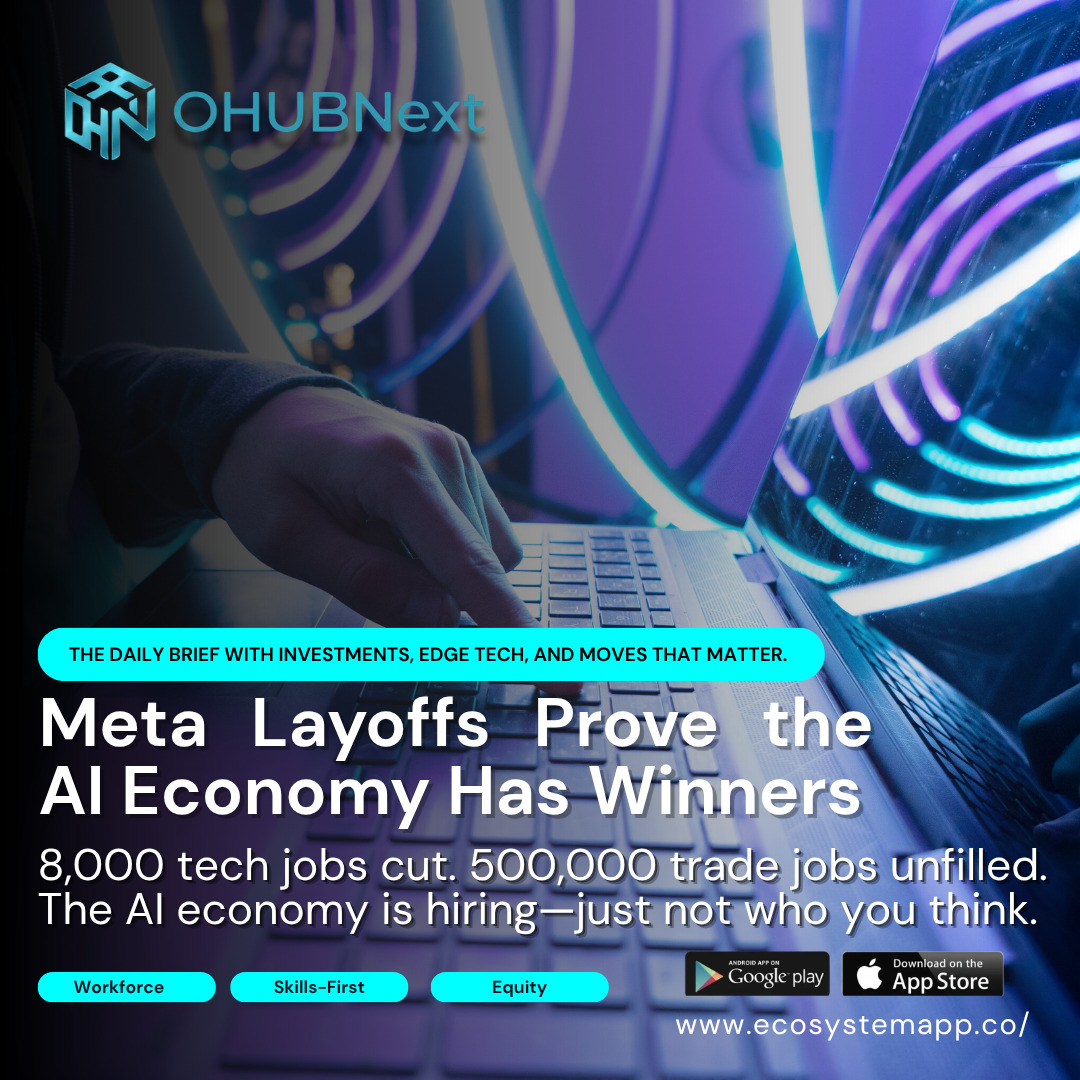
🚨 OHUBNext | Meta Layoffs Prove the AI Economy Has Winners.
🚨 OHUBNext | Meta Layoffs Prove the AI Economy Has Winners.
📍 Meta cut 8,000 jobs and blamed AI. The next day, California made worker equity state policy. Meanwhile, 499,000 trade jobs sit unfilled — paying 30% more than they did four years ago. The AI economy is not eliminating work. It is rerouting it. The question is whether you are on the right side of that reroute.
─────
Hey Builders!
The same week a tech giant cut 8,000 jobs and blamed AI, the governor of the largest state economy in the country signed an order putting worker equity on the same policy table as unemployment insurance. Nobody put those two stories next to each other. They belong there.
Meta cut 8,000 jobs — designers, engineers, content moderators, cybersecurity teams. Not performance cuts. Structural cuts. AI absorbed the work. The same week, companies announced nearly 50,000 AI-linked job cuts in 2026 alone. Employment among early-career workers in AI-exposed occupations has dropped 16% since ChatGPT launched, per Stanford research. The white-collar pipeline is narrowing faster than any recession in living memory.
One day later, California Governor Gavin Newsom signed an executive order directing the state to explore worker ownership models, equity stakes for displaced workers, and universal basic capital as structural responses to AI displacement. Not charity. Policy. The first of its kind in American history.
The third data point that ties it together: demand for skilled trade workers is growing 3x faster than professional roles. Trade wages are up 30%. BlackRock just deployed $100 million to train 50,000 electricians and HVAC technicians because the U.S. could run out of electricians before it can build the data centers the AI economy requires.
The AI economy does not need fewer workers. It needs different ones — and it is paying more for them than the white-collar economy ever did.
─────
📰 Top Stories
Here's what's moving --- and what it means for you.
1️⃣ Meta Cuts 8,000 Jobs and Calls It AI. Every Other Company Is Watching.
Meta announced cuts to 10% of its global workforce — 8,000 employees plus 6,000 canceled open roles, a total reduction of 14,000 positions. The cuts hit product design, engineering, content moderation, and cybersecurity. The company's own statement was blunt: these are structural, not performance-based. AI absorbed the work.
Meta is spending $115–135 billion on AI infrastructure this year and redirecting 7,000 employees into AI-focused divisions. The company is not shrinking — it is restructuring around fewer, more specialized, AI-augmented roles. What Meta is doing, every major tech company will attempt in the next 24 months. AI now accounts for 26% of all corporate job cuts in 2026, per Challenger, Gray & Christmas. The entry-level white-collar market is not recovering. It is being redesigned.
💡 For Founders
If your hiring plan assumes the talent market works the way it did in 2022, rebuild that assumption now. Displaced white-collar workers are entering the market at volume — motivated, skilled, and often at lower price points. The founders who move fastest to build lean, AI-augmented teams with these operators will have a structural cost advantage over competitors still hiring at pre-2025 salary bands.
─────
2️⃣ California Just Put Worker Equity on the Policy Table.
Governor Newsom signed an executive order directing California's Labor and Workforce Development Agency to study severance tied to stock and equity awards, expanded worker ownership models, and universal basic capital — all as responses to AI-driven displacement. The order mandates a public dashboard tracking AI's impact on hiring within 90 days, and a full safety-net policy review within 180 days.
This is a diagnostic mandate, not an enforceable law. But the framing matters. A sitting U.S. governor has officially characterized AI displacement as a wealth distribution problem — not just an unemployment problem. Worker equity stakes are now on the same policy menu as unemployment insurance. ESOPs have existed since 1974 but have never been treated as a mainstream economic stabilization tool. That framing just changed.
💡 For Founders
The Newsom order is a 12–18 month early signal. If it moves toward legislation — mandatory equity severance, expanded ESOP incentives, state-backed worker ownership funds — it reshapes the competitive landscape for every company in California and sets a national template. Founders building in workforce tech, alternative ownership structures, or AI transition infrastructure are operating in a market that just got official policy recognition. That changes the fundraising conversation.
─────
3️⃣ The AI Economy Needs 500,000 Trade Workers It Does Not Have.
BlackRock launched a $100 million initiative in March 2026 to train 50,000 skilled trade workers over five years — electricians, HVAC technicians, plumbers, ironworkers. The reason: BlackRock's own analysis found the U.S. data center buildout faces a projected shortfall of 499,000 workers in 2026. Robotic technician vacancies are up 107% since 2022. HVAC engineer openings up 67%. Trade wages up 30% over four years.
A journeyman electrician earns $59.50 an hour — over $120,000 annually — with senior roles approaching $200,000. Data center construction workers earn 32% more than workers on standard builds. Randstad's analysis of 50 million job postings confirms it: demand for skilled trades is growing 3x faster than demand for professional roles. Apprenticeship applications are up 70% since 2022.
Black and Latino workers represent roughly 6% of the construction trades workforce against a 13% population share. The highest-demand labor market in the American economy has an access gap. That gap is the opportunity.
💡 For Founders
BlackRock's $100 million is a capital signal. It points directly at where the gap is and who will pay to close it. If you are building workforce training platforms, apprenticeship pipelines, or trade placement infrastructure — you are in the most defensible demand environment in the labor market right now. The scarcest resource in the AI economy is not compute. It is the human who builds and maintains the infrastructure the compute runs on.
─────
🔧 Three moves to make this week
1️⃣ Map your AI exposure before the next round of cuts lands
Pull up your job descriptions. Identify every function that is primarily information processing, content production, or routine analysis — that is your AI exposure surface. Ask honestly: is AI augmenting this role or replacing it? The founders who answer that question now and restructure proactively will have leaner, more defensible operations when the next wave forces everyone else to catch up.
2️⃣ Find the data center corridor nearest to you
Go to datacenterfrontier.com and search your metro. Look at what is being built within 100 miles and what certifications those projects are hiring for. If you are in workforce development or community economic development, this is your market intelligence briefing. The organizations that understand the specific skills the buildout needs will be first to the funding and first to the contracts.
3️⃣ Read the Newsom executive order
Go to gov.ca.gov and read it — three pages. Set a reminder for November 2026 when the 180-day policy recommendations are due. The founders who understand the policy landscape before it becomes law are the ones who build well-positioned businesses when it does.
─────
💬 Quote of the Day
"Opportunity is missed by most people because it is dressed in overalls and looks like work." — Thomas Edison
─────
🏁 Build New Skills With OHUB
The OHUBAI Competency Program is a four-week intensive, hands-on training program designed to help you build real AI capability fast --- whether you're a founder, a working professional, or a career-switcher ready to future-proof your skill set.
New cohorts open every four weeks. By the end of Week 1, you'll have built your first AI agent.
For builders, here's what you walk away with:
▪️ 4 weeks of live, instructor-led curriculum --- not pre-recorded, not self-paced, real instruction with real accountability
▪️ Up to 1 year of access to the Mindstone Dashboard
▪️ Up to 1 year of updated education content
▪️ A seat in one of the fastest-growing AI communities globally
Financing available through Affirm or Klarna --- get started for as low as $97/mo.
🚀 Visit opportunityhub.co/ai to learn more.
─────
🎬 Closing Thought
Meta cut 8,000 jobs and called it AI. California responded by putting worker equity on the policy table. Those two events did not make the same headline. They are the same story.
The AI economy is rerouting work — from white-collar offices into data center corridors, from entry-level professional pipelines into skilled trade apprenticeships, from salaried employees into AI-augmented operators. The wealth being generated is enormous. The question Newsom's order is finally forcing into policy language — and that this community has been asking for years — is whether the people doing the work capture any of it.
Journeyman electricians are earning $120,000 a year. BlackRock put $100 million on the table because the gap between available workers and the infrastructure that needs building is half a million people wide. The communities that build the training pipelines and the ownership pathways into that gap will not just be doing workforce development. They will be building the foundational layer of the next American economy.
The window is open right now.
─────
⚡️ OHUBNext Daily Brief - investments, edge tech, and moves that matter.
For 12+ years, OHUB has been building pathways and on-ramps to multi-generational wealth --- without reliance on pre-existing wealth. Through exposure, skills, entrepreneurship, capital markets, and inclusive ecosystems, we've helped people create new jobs, new companies, and new wealth.

Home
Data Center Frontier reports on issues related to telecom, data centers, cloud computing, and the future of the internet for those working in facilities powering the cloud.
datacenterfrontier.com