


OHUB @ohub
🚨 OHUBNext | The White House Just Proposed Ending Science As America Knows It
🚨 OHUBNext | The White House Just Proposed Ending Science As America Knows It
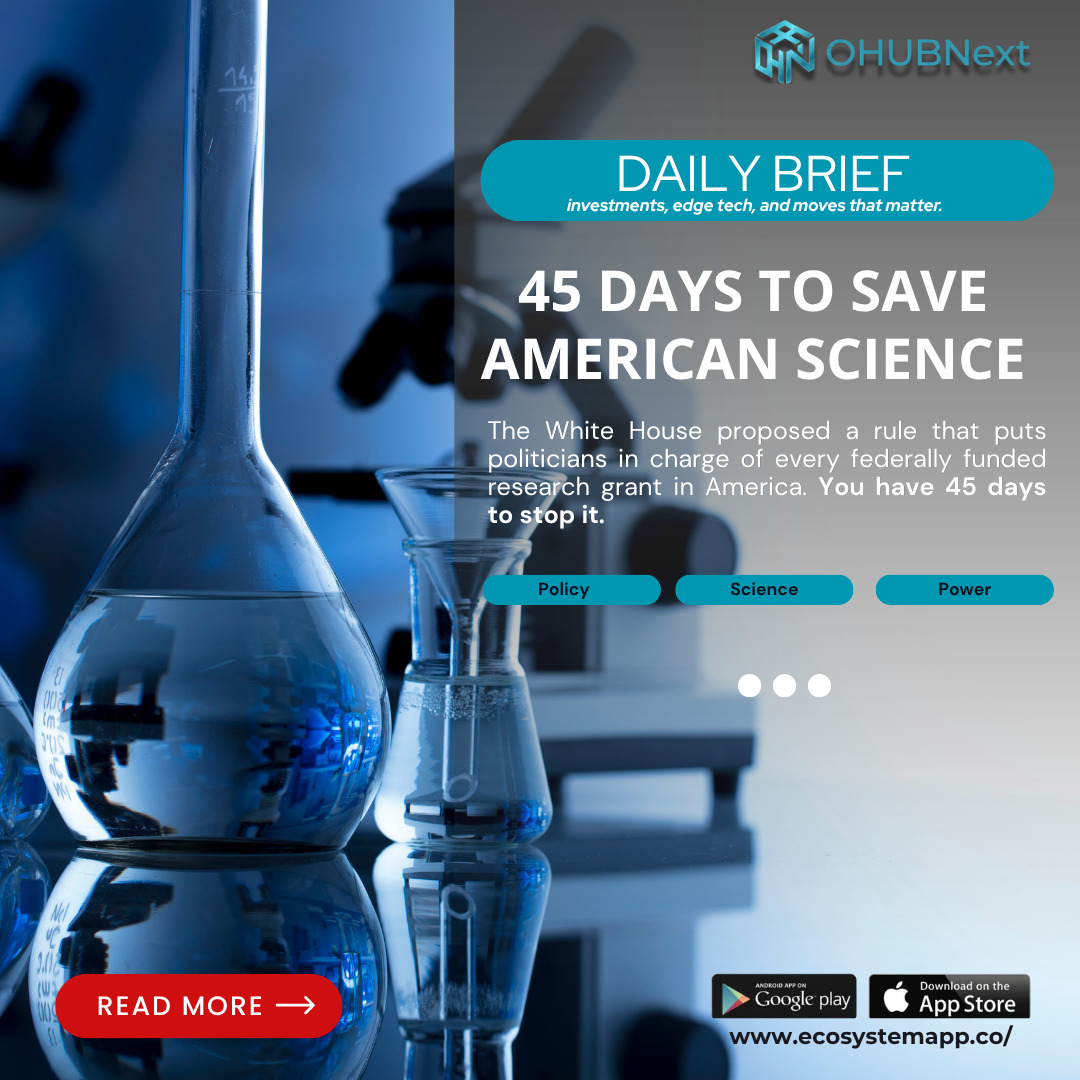
📍 On May 29, 2026, the White House OMB published FR Document 2026-10817 — a proposed rule giving political appointees final authority over every federally funded scientific grant in the U.S., demoting peer review to "advisory" status, and allowing any grant to be canceled at any time for any reason. The comment window is 45 days. After that, it becomes law.
─────
Hey Builders!
Read that again.
A sitting administration has proposed a rule making political loyalty — not scientific merit — the deciding factor in who receives federal research funding. Every NIH grant. Every NSF award. Every EPA study. Every clinical trial. All of it subject to review by political appointees required to assess whether research aligns with "the President's policy priorities."
This is not a funding cut. It is a structural transformation. Since 1945, three protections have kept American science independent: agency-level notice-and-comment rulemaking, career scientist authority over grant decisions, and peer review as a binding standard. This rule strips all three simultaneously. What remains is a system where federally funded science is authorized by the same mechanism as federal contracts: political compliance.
That is what is at stake. Everything else follows from that.
─────
1️⃣ What the Document Actually Says — in Its Own Words
FR Document 2026-10817 covers every major federal grant-making agency — HHS, NSF, EPA, NASA, Defense, and dozens more. Here is what it says, verbatim.
On political control: "Senior appointees must conduct these reviews and apply specific principles when evaluating proposals." Career scientists are out. Political appointees are in.
On peer review: "Peer review remains advisory and does not replace agency discretion." The foundational quality control of American science is now a suggestion an appointee can ignore.
On termination: Agencies may cancel any grant "no longer in the Federal Government's interest." Any grant. Any time. No recourse specified.
On eligibility: Federal funds may not promote "theories of disparate-impact liability," "gender ideology," or what the document calls "neo-Marxist perspectives" — undefined terms applied entirely at political discretion.
💡 For Founders
Every federally funded research partnership, clinical trial, and NSF-backed startup is subject to this rule. If your roadmap depends on basic research — directly or upstream — model what political termination with 45 days' notice does to it.
─────
2️⃣ The Numbers Behind What's at Risk
The U.S. spends $200 billion per year on federally funded R&D — the largest public science investment on earth. NIH alone funds 300,000 projects annually and contributed to all 210 FDA drug approvals between 2010 and 2016, turning $230 billion in public investment into $796 billion in private pharmaceutical value. NSF seeded the internet, GPS, Google's algorithm, and Siri. Its returns run 20:1 to 65:1. The U.S. holds 45% of the world's top-cited scientific publications — a position built entirely on the credibility of independent peer review.
When political loyalty replaces scientific merit as the funding criterion, the consequences are precedented. The Soviet Union's Lysenko affair — a politically favored biologist controlling agricultural research for 30 years — destroyed Soviet genetics, eliminated a generation of scientific talent, and contributed to famine. The structural mechanism being proposed here is identical.
💡 For Founders
Federal R&D is the public subsidy that makes American private innovation possible. Every biotech, health tech, climate tech, and AI company in this network sits downstream of it. Eroding independence doesn't just affect universities. It affects your pipeline, your talent, and your market validation.
─────
🔭 What Happens Next? Three Futures — Depending on What We Do
The outcome is genuinely uncertain. What follows is not meant to alarm or reassure — it is meant to help you think clearly about what you're building into.
🟡 Base Case — The Rule Passes With Minor Modifications
The most extreme provisions are softened by court and congressional pressure. Termination authority remains but is applied inconsistently. DEI-adjacent research is defunded; core basic science mostly continues. Universities restructure applications to comply. Estimated impact: 10–15% of the federal R&D portfolio disrupted, costing $140–280 billion annually in long-run GDP. Survivable — but American scientific scope permanently narrows.
─────
🔴 Worst Case — Finalized and Aggressively Implemented
Political appointees exercise full authority. Grant terminations broaden. Researchers self-censor. International scientists stop applying. Top graduate students choose European and Asian institutions. Within 5 years, China — growing R&D at 10% annually — closes the gap in AI, biotech, and clean energy. Pharmaceutical pipelines thin. Pandemic preparedness erodes. GDP loss: $280 billion per year, compounding. In human terms: delayed cancer therapies, weakened disease surveillance, a generation of talent that leaves and doesn't return.
─────
🟢 Best Case — The Comment Record Holds
A large, substantive public comment record — from founders, researchers, hospitals, universities, and business leaders — forces major revisions before finalization. The Administrative Procedure Act requires agencies to respond to every substantive comment. Courts have struck down rules that failed to engage with the record. The peer review demotion is removed. Termination authority is cabined. Career scientist authority is preserved. The $200 billion R&D pipeline stays intact.
This outcome doesn't happen by default. It happens because enough people showed up.
─────
📋 How to Comment — Exactly What to Do
Comments are due approximately July 13, 2026. Under the Administrative Procedure Act, agencies must respond to every substantive comment before finalizing a rule — making your comment legal evidence, not just civic participation.
▸ Step 1: Go to www.regulations.gov
▸ Step 2: Search docket OMB-2026-0034
▸ Step 3: Click "Comment"
▸ Step 4: Write three focused paragraphs:
▸ Who you are and what's at stake. Founder, researcher, patient, parent — name it. Personal stake is the most compelling evidence.
▸ Cite specific provisions. Name Section 200.205 (political appointee review) and Section 200.340 (termination authority). Agencies must respond to specific citations — vague objections can be dismissed.
▸ Quantify the impact. State the dollar amount federal research represents to your work or institution. Economic impact statements carry more legal weight than general concern.
▸ Step 5: Submit before July 13, 2026
📎 Full document: public-inspection.federalregister.gov/...
📝 Comment portal: www.regulations.gov — Docket OMB-2026-0034
‼️ Do not wait. Do not assume someone else will do it. This is the mechanism the law provides. Use it.
─────
🔧 Three moves to make this week
1️⃣ Submit your comment this week
Cite Section 200.205 and Section 200.340 by name. Three specific paragraphs carry more legal weight than a form letter.
2️⃣ Forward this to three people who don't know it exists
A researcher, a doctor, a founder, a parent. Science is not a partisan issue — it is economic infrastructure. Frame it that way.
3️⃣ Map your federal research dependencies
Which of your products, hires, or market validations trace back to federally funded research? Which of your competitors are foreign companies that benefit from American scientific decline? That answer is your strategic brief for the next 24 months.
─────
💬 Quote of the Day
"The good thing about science is that it's true whether or not you believe in it." — Neil deGrasse Tyson
─────
🎬 Closing Thought
The U.S. did not become the world's leading scientific nation by accident. It happened because of a deliberate decision after World War II to invest public money in independent research — protected by peer review, career scientists, and procedural checks that kept political pressure at arm's length from the laboratory.
That system produced the internet, GPS, the mRNA vaccine, every major cancer therapy of the last 30 years, and the basic research underlying every major American technology company. FR Document 2026-10817 proposes to dismantle it — not by cutting funding, but by cutting independence.
When political loyalty becomes the gating criterion for scientific authorization, science doesn't stop. It just stops being science. Every nation that has tried this has paid for it in human lives and economic stagnation. We have 45 days to put that history into the public record.
The docket is OMB-2026-0034. The deadline is July 13, 2026. The law requires them to read it. Write something worth reading.
─────
⚡️ OHUBNext Daily Brief — investments, edge tech, and moves that matter.
For 12+ years, OHUB has been building pathways and on-ramps to multi-generational wealth --- without reliance on pre-existing wealth. Through exposure, skills, entrepreneurship, capital markets, and inclusive ecosystems, we've helped people create new jobs, new companies, and new wealth.
─────
📎 SOURCE DOCUMENT
▸ Document: FR Document 2026-10817 — "Regulation for Federal Financial Assistance"
▸ Full text: public-inspection.federalregister.gov/...
▸ Comment portal: www.regulations.gov
▸ Docket: OMB-2026-0034
▸ Deadline: July 13, 2026
www.regulations.gov