

OHUB @ohub
🚨 OHUBNext | Most Companies Are Playing the Wrong AI Game — and a New Study Proves It
🚨 OHUBNext | Most Companies Are Playing the Wrong AI Game — and a New Study Proves It
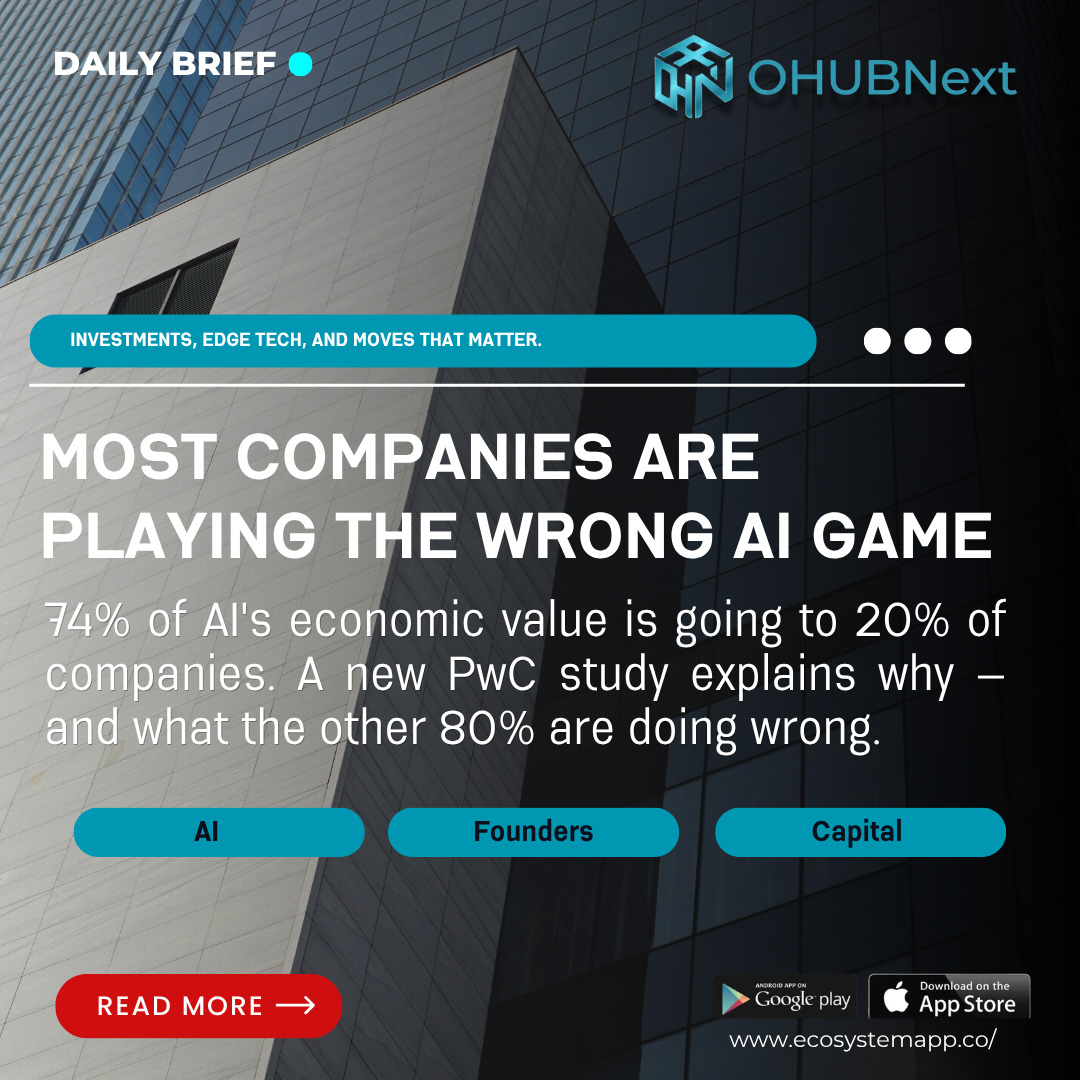
📍 PwC just published the most important number in the AI economy: 74% of AI's economic gains are being captured by just 20% of companies. The other 80% are stuck in pilot mode, sharing 26% of the value. Meanwhile, Ohio just suspended data center tax incentives after residents pushed back, the S&P 500 snapped a nine-week winning streak on Middle East tensions, and job postings requiring AI skills are up 144% year over year. The AI divide is not coming. It is already here.
─────
Hey Builders!
Here is the number that should change how you think about everything this week.
74% of AI's economic value is going to 20% of companies.
That is not a projection. That is a finding from a PwC study of 1,217 senior executives across 25 sectors, published in 2026. The companies in that top 20% are generating 7.2 times more AI-driven revenue and efficiency gains than the average competitor. Their profit margins run 4 percentage points higher. And the gap is not closing — it is widening.
The other 80% of companies are not failing at AI. They are stuck in pilot mode — running experiments, attending conferences, buying licenses, and producing reports. They are doing all the things that look like AI adoption without doing the one thing that generates value: deploying AI as a catalyst for growth and business reinvention, not just a productivity tool.
That distinction — growth versus productivity — is the entire game. The 20% are using AI to open new revenue lines, enter new markets, and reinvent how their businesses operate. The 80% are using it to do the same things slightly faster. One of those strategies compounds. The other one does not.
Today's brief is built around that divide — what is driving it, what is pushing back against it, and exactly what founders need to do to be in the right 20%.
─────
1️⃣ The AI Divide Is Already Here — and It's Wider Than Anyone Admitted
PwC's 2026 AI Performance Study interviewed over 1,200 senior executives at large publicly listed companies across 25 sectors globally. The finding is stark.
Seventy-four percent of AI's economic gains are flowing to just 20% of companies. Those companies generate 7.2 times more value than the average competitor. Their margins are 4 points higher. The difference is not access to better models — every serious company has access to the same foundation models. The difference is strategy.
The top 20% are focused on growth. They are using AI to pursue new revenue opportunities created as industries converge — not just to cut headcount or speed up existing workflows. They have built strong data infrastructure, governance frameworks, and organizational trust around AI before deploying it broadly. They treated AI adoption as a business reinvention problem, not a technology installation problem.
The bottom 80% treated it as a technology installation problem. They are paying for it.
💡 For Founders
The 74/20 split is your market opportunity and your warning at the same time. If you are building a product for the 80% of companies stuck in pilot mode, you have a massive addressable market — but you need to help them cross the threshold from experimentation to deployment, not sell them another experiment. If you are running a company, ask honestly: are you using AI to grow, or just to maintain? The answer tells you which side of the divide you are currently on.
─────
2️⃣ AI Skills Are the New Entry Requirement — and Most Candidates Don't Have Them
Job postings requiring AI skills grew 144% year over year as of April 2026. That is not a trend. That is a structural shift in what employers consider baseline competency.
At the same time, employment for software developers aged 22 to 25 has fallen nearly 20% from 2024. The entry-level technology pipeline is contracting while the demand for AI-fluent workers accelerates. One in three employers expects workforce reductions over the coming year. And 24% of startups say AI adoption will actually increase their headcount — more than double the rate at larger companies — because they are building AI-native operations from the ground up rather than retrofitting legacy ones.
The skills gap is not about AI being too complicated. It is about the speed of the shift outrunning the training infrastructure. The workers who are thriving are the ones who stopped waiting for their employer to train them and started building AI fluency on their own time, in real workflows, for real outputs.
💡 For Founders
The 144% jump in AI skill requirements is a hiring signal and a product signal simultaneously. If you are hiring, the candidates who have self-taught AI fluency — who can show you a workflow they built, a prompt they engineered, a process they automated — are worth more than credentials right now. If you are building workforce tools, the demand for practical AI skills training has never been higher. OHUB's AI Competency Program exists precisely for this moment. The window between "early adopter" and "basic requirement" is closing fast.
─────
3️⃣ The Data Center Backlash Is Real — and Ohio Just Made It Official
Ohio suspended its data center tax incentive after costs ballooned from initial projections to $554 million in 2024 and nearly $1.6 billion in 2025 — more than 11 times the original estimate, per Fortune. Governor DeWine declared a pause on new applicants while the state legislature conducts fresh research. Simultaneously, residents are circulating a ballot measure that would permanently ban hyperscale data centers statewide — potentially the strictest such ban under consideration anywhere in the U.S. — with a July 1 deadline to gather over 400,000 voter signatures.
This is not an isolated story. Across the country, communities are absorbing costs they never agreed to pay — higher electricity rates, strained water systems, converted land, rising housing costs — in the shadow of infrastructure that was never designed with existing residents in mind. Ohio made it a policy fight. Other states are watching.
The pattern is predictable: large capital arrives, promises jobs and tax revenue, skips the question of who bears the infrastructure cost, and then faces a backlash when the bill comes due. Goldman Sachs has warned that crude could stay elevated through year-end even if the Strait of Hormuz reopens, partly because data center energy demand is now a structural driver of power prices — not a temporary spike.
💡 For Founders
The Ohio story is a product opportunity and a strategic warning. The product opportunity: the communities absorbing data center infrastructure costs are underserved markets for energy management tools, community benefit agreement platforms, and local economic development infrastructure. The strategic warning: if your business depends on hyperscale data center expansion, model the regulatory risk. The ribbon-cutting era is ending. The accountability era is beginning.
─────
4️⃣ The Market Snapped — Here Is What Actually Happened
The S&P 500 logged its ninth consecutive weekly advance — the longest winning streak since 2023 — even as Middle East tensions escalated and the 30-year Treasury yield hit its highest level since 2007. Brent crude settled around $92 after dropping more than 16% in May. The Atlanta Fed cut its Q2 GDPNow estimate from 3.8% to 3.0% as the macro picture grew more complicated heading into summer.
For context: nine consecutive winning weeks is a historically rare run. The correction was not a collapse — it was gravity. And the underlying drivers of the AI-led market remain intact. BlackRock's Investment Institute still calls AI the defining theme for equity markets in 2026, with the expectation that it will keep trumping tariffs and traditional macro drivers as a long-term engine of expansion.
The volatility is real. The trajectory is not changing.
💡 For Founders
Do not let a one-week correction reset a nine-week thesis. The capital is still moving toward AI infrastructure, healthcare, and energy. The macro headwinds are real — geopolitical risk, elevated yields, tariff uncertainty — but they are headwinds, not walls. The founders who use market volatility as an excuse to pause are the ones who will look back on June 2026 as the moment they missed. Keep building.
─────
🔧 Three moves to make this week
1️⃣ Run the 74/20 diagnostic on your own business
Pick your three highest-volume workflows. For each one, ask: are we using AI to do this faster, or to do something new we could not do before? The first answer is the 80%. The second answer is the 20%. If all three answers are "faster," you know exactly what to change.
2️⃣ Build one AI skill this week — not a course, a deliverable
The 144% jump in AI skill requirements is not satisfied by certificates. It is satisfied by outputs. Pick one real task — a research report, a financial model, a customer email sequence, a competitive analysis — and build it using AI tools you have not used before. The output is the credential.
3️⃣ Watch Ohio
The data center ballot measure in Ohio is the first major democratic check on AI infrastructure expansion in the United States. If it passes, it sets a template that will spread. Search "Ohio data center ballot measure" and set an alert. The founders who understand the regulatory environment before it crystallizes are the ones who build businesses that survive it.
─────
💬 Quote of the Day
"In the middle of every difficulty lies opportunity." — Albert Einstein
─────
🏁 Build New Skills With OHUB
The OHUBAI Competency Program is a four-week intensive, hands-on training program designed to help you build real AI capability fast — whether you're a founder, a working professional, or a career-switcher ready to future-proof your skill set.
New cohorts open every four weeks. By the end of Week 1, you'll have built your first AI agent.
For $399, here's what you walk away with:
▪️ 4 weeks of live, instructor-led curriculum — not pre-recorded, not self-paced, real instruction with real accountability
▪️ Up to 1 year of access to the Mindstone Dashboard
▪️ Up to 1 year of updated education content
▪️ A seat in one of the fastest-growing AI communities globally
Financing available through Affirm or Klarna — get started for as low as $37/mo.
🚀 Visit opportunityhub.co/ai to learn more.
─────
🎬 Closing Thought
74% of AI's economic value is going to 20% of companies. That number will not improve on its own. The divide between the companies using AI to grow and the ones using it to maintain is not a technology gap — it is a strategy gap. And strategy gaps close when people decide to close them.
Ohio is pushing back on data center expansion because nobody asked who would pay for the power. The S&P snapped a nine-week run because geopolitical risk does not pause for bull markets. AI skill requirements are up 144% because the labor market is already repricing human capital in real time.
None of this is happening to you. All of it is happening around you. The founders who treat this moment as a design problem — who ask what they can build, where they can own, and how they can position on the right side of every divide — are the ones who will look back at June 2026 as the month the picture became clear.
The picture is clear. Move.
─────
⚡️ OHUBNext Daily Brief - investments, edge tech, and moves that matter.
For 12+ years, OHUB has been building pathways and on-ramps to multi-generational wealth without reliance on pre-existing wealth. Through exposure, skills, entrepreneurship, capital markets, and inclusive ecosystems, we've helped people create new jobs, new companies, and new wealth.

OHUBAI Competency Program
Visit the post for more.
opportunityhub.co