

OHUB @ohub
🚨 OHUBNext | Trump Signs AI Order
🚨 OHUBNext | Trump Signs AI Order
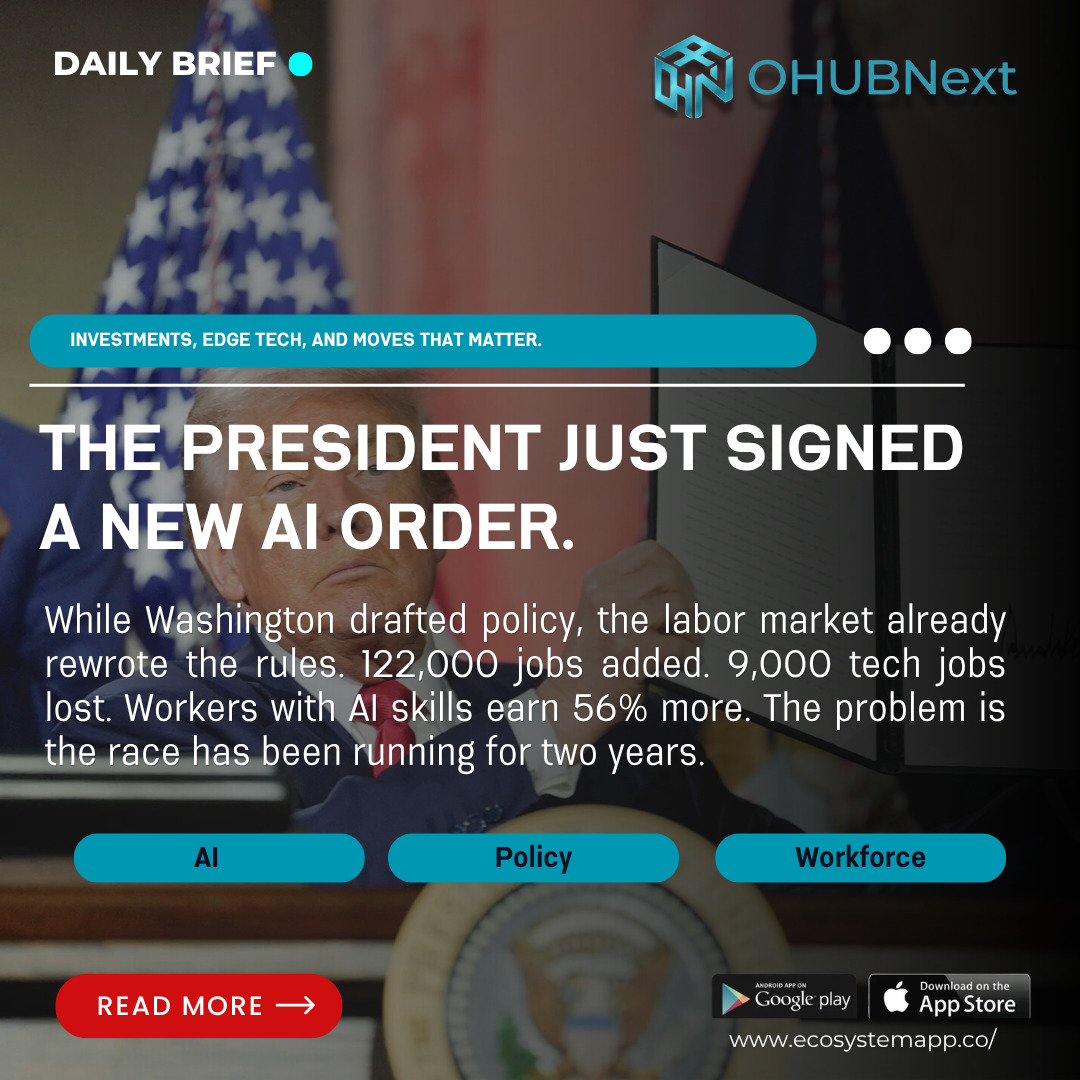
📍 Yesterday, President Trump signed an executive order giving the federal government 30 days of early access to the most powerful AI models before public release. The same morning, ADP reported 122,000 private sector jobs added in May — the strongest month since January 2025 — led by education and health, while information services shed 9,000 jobs. And workers with AI skills now earn 56% more than peers in identical roles without them. The policy, the market, and the money are all pointing in the same direction.
─────
Hey Builders!
Two things happened yesterday that belong in the same sentence.
The White House signed an executive order on AI. And the labor market published its clearest signal yet on what AI is doing to workers in real time.
The executive order — titled "Promoting Advanced Artificial Intelligence Innovation and Security" — asks AI companies to voluntarily submit their most powerful models to the federal government for testing up to 30 days before public release. The government will run structured benchmarks focused on cybersecurity risk and national security implications. It also directs agencies to build an AI cybersecurity clearinghouse — a shared infrastructure for tracking model vulnerabilities across the federal government.
The ADP jobs report, released the same morning, told a parallel story. Private sector employment grew by 122,000 in May — the strongest month since January 2025, led by education and health services at 57,000 new hires. Broad-based gains across eight of ten sectors. But information services lost 9,000 jobs. The sector most exposed to AI automation is already contracting.
And the skills data ties it together: workers with advanced AI skills now earn 56% more than peers in the same roles without them, per PwC's 2025 Global AI Jobs Barometer — a same-role wage comparison across close to a billion job ads on six continents. The premium is not coming. It is here.
Today's brief covers what the executive order actually means for founders, what the jobs data is really telling you, and what the 56% wage premium means for every person building a career or a company right now.
─────
1️⃣ What Trump's AI Executive Order Actually Does — and What It Doesn't
The executive order signed June 2, 2026 has two parts. Understanding both matters.
Part one is a voluntary model review process. Before releasing their most powerful AI models to the public, companies are asked — not required — to submit them to the government for up to 30 days of testing. The government runs benchmarks focused on cybersecurity capabilities and national security risk. The original draft gave the government 90 days; the final order cut it to 30 after concerns that longer timelines would stifle innovation. The process is voluntary. There is no enforcement mechanism for companies that decline.
Part two is infrastructure. The order directs federal agencies to develop AI cybersecurity benchmarks, create a shared clearinghouse for tracking model vulnerabilities, and strengthen federal security defenses against AI-enabled threats.
What the order does not do: it does not regulate AI deployment, it does not address algorithmic discrimination, it does not create liability frameworks for AI outputs, and it does not touch the OMB grants regulation that is simultaneously threatening to put political appointees in charge of all federally funded AI research.
This order is a national security play, not a consumer protection play. It reflects the administration's core AI thesis: American AI dominance is a strategic asset, and the government's job is to ensure it is not weaponized against itself.
💡 For Founders
The voluntary review process creates a new dynamic for frontier AI companies — particularly those with government contracts or ambitions. Early participation in the benchmarking process signals security credibility and opens doors to federal procurement. For founders building in cybersecurity, AI safety, or model evaluation infrastructure, this order just created a government-backed demand signal. The clearinghouse alone will require vendors. Know where your product sits in that ecosystem.
─────
2️⃣ The Jobs Report Buried the Lede — Read It Again
ADP reported 122,000 private sector jobs added in May — above the 110,000 consensus estimate and the strongest monthly gain since January 2025. Eight of ten sectors showed growth. Education and health led with 57,000 new hires. Trade, transportation, and utilities added 36,000. Construction and leisure and hospitality each added 8,000.
Small businesses led the hiring — companies with fewer than 50 employees accounted for 67,000 of the 122,000 new jobs. Annual pay growth held at 4.4%.
Those are the headline numbers. Here is the buried lede: information services lost 9,000 jobs in May. That is the sector that includes software, media, telecommunications, and data processing — the white-collar technology economy. It has now shed jobs in multiple consecutive months. The entry-level software developer employment rate for workers aged 22 to 25 has fallen nearly 20% from 2024.
The jobs that AI is eliminating are not warehouse jobs or factory jobs. They are the jobs that the last generation was told were safe — the analyst roles, the junior developer positions, the content and research functions that were supposed to be the stable floor of the knowledge economy. That floor is shifting.
💡 For Founders
The small business hiring number — 67,000 of 122,000 new jobs — is the most important figure in the report for this community. Small businesses are moving faster than large ones because they have less legacy infrastructure to protect and more urgency to perform. If you are a founder and you are not hiring right now, your competitors likely are. The talent coming out of contracting white-collar sectors — motivated, skilled, and often at lower price points than pre-2025 salary bands — is the best hiring environment for lean, AI-augmented teams in years.
─────
3️⃣ 56% More. That Is What AI Skills Are Worth Right Now.
PwC's 2025 Global AI Jobs Barometer is direct: workers with advanced AI skills earn 56% more than peers in identical roles without those skills — a premium that has more than doubled from 25% the prior year. The demand for AI fluency is growing roughly 20 times faster than the overall job market, with AI-skill job postings rising 7.5% even as total job postings fell 11.3%.
That premium is not evenly distributed. It is highest in finance, legal, and healthcare — sectors where AI-augmented workers can handle higher-complexity tasks that previously required additional headcount. It is lowest in sectors where AI is primarily a productivity tool rather than a capability multiplier.
The World Economic Forum projects that by 2030, AI disruption will affect 22% of all jobs — 170 million new roles created, 92 million displaced, a net gain of 78 million positions. The workers who capture the net gain are not necessarily the most educated or the most experienced. They are the ones who moved earliest to build AI fluency in their specific domain.
The window between "early adopter" and "basic requirement" is closing. Job postings requiring AI skills are up 144% year over year. The employers writing those postings are not looking for AI researchers. They are looking for accountants, marketers, nurses, and project managers who can work with AI tools as a native part of their workflow.
💡 For Founders
The 56% premium is your business case for every AI investment you have been delaying. It applies to your team and to your product. If your product helps workers develop AI fluency in their specific domain — not generic AI training, but applied skills in healthcare, finance, legal, education, or operations — you are building into one of the clearest demand signals in the labor market. And if you are building your own team, the single highest-ROI hire you can make right now is someone who has already closed that gap on their own.
─────
4️⃣ The 2030 Map — What the WEF Numbers Actually Mean for Cities and Communities
The World Economic Forum's 2030 projection deserves more than a headline. 170 million new jobs created. 92 million displaced. Net positive of 78 million.
That net positive obscures the distribution problem. The 170 million new jobs will not appear in the same places, industries, or communities as the 92 million displaced jobs. The cities and regions that are building the workforce infrastructure now — the training pipelines, the apprenticeship programs, the AI fluency curricula — will capture the new jobs. The ones that are not will absorb the displacement without capturing the upside.
Healthcare, education, renewable energy, and infrastructure are the sectors creating the most new roles. Information services, administrative support, and routine cognitive work are where the displacement is concentrated. Those two lists do not overlap geographically. A city that has built its economy around back-office financial services or call center employment faces a fundamentally different 2030 than a city that has invested in healthcare infrastructure and skilled trades.
The mayors at Bloomberg CityLab in Madrid were wrestling with exactly this. The AI interruption scenario is not hypothetical for the cities on the wrong side of that distribution map. It is already running.
💡 For Founders
The WEF map is your market development roadmap. The communities absorbing displacement without capturing new job creation are the most underserved markets for workforce transition infrastructure — retraining platforms, alternative credentialing, AI fluency programs, and community-based economic development tools. OHUB has been building for this market for 12 years. The mainstream is just catching up to the thesis.
─────
🔧 Three moves to make this week
1️⃣ Read the executive order — three pages, 20 minutes
If your business touches federal contracts, government data, AI model development, or cybersecurity — this document directly affects your market. The clearinghouse alone will generate vendor opportunities in the next 12 months. Know what is in it before your competitors do.
Read it here: whitehouse.gov/...
2️⃣ Calculate your AI skills premium gap
Take your three highest-leverage roles. Ask: what would those people be worth if they had advanced AI fluency? The PwC data says 56% more. That delta — between current output and AI-augmented output — is either your competitive advantage or your competitor's. Close it this quarter.
3️⃣ Map your hiring opportunity in the contracting sectors
Information services shed 9,000 jobs in May. White-collar professional services are contracting. The talent coming out of those sectors is skilled, motivated, and available. If you are hiring for research, analysis, writing, customer success, or operations — the market has never been more favorable for lean, AI-augmented team building. Move before the window closes.
─────
💬 Quote of the Day
"The best time to plant a tree was 20 years ago. The second best time is now." — Chinese Proverb
─────
🏁 Build New Skills With OHUB
The OHUBAI Competency Program is a four-week intensive, hands-on training program designed to help you build real AI capability fast — whether you're a founder, a working professional, or a career-switcher ready to future-proof your skill set.
New cohorts open every four weeks. By the end of Week 1, you'll have built your first AI agent.
For $399, here's what you walk away with:
▪️ 4 weeks of live, instructor-led curriculum — not pre-recorded, not self-paced, real instruction with real accountability
▪️ Up to 1 year of access to the Mindstone Dashboard
▪️ Up to 1 year of updated education content
▪️ A seat in one of the fastest-growing AI communities globally
Financing available through Affirm or Klarna — get started for as low as $37/mo.
🚀 Visit opportunityhub.co/ai to learn more.
─────
🎬 Closing Thought
The government just moved on AI. The labor market already did. And the workers who built AI fluency before either of those things happened are earning 56% more than the ones who waited.
That is the pattern this community has been tracking for years. The people who move before the signal is obvious are the ones who capture the premium. The ones who wait for confirmation — for the executive order, for the job posting, for the headline — arrive after the window has narrowed.
The executive order is not the beginning of the AI era. It is the federal government catching up to a race that has been running since 2022. The labor market is not predicting AI displacement. It is reporting it in real time. And the 56% wage premium is not a forecast. It is a current price.
The question is never whether the shift is real. It is whether you moved before it became obvious. For the OHUBNext community, the answer has always been yes.
─────
⚡️ OHUBNext Daily Brief - investments, edge tech, and moves that matter.
For 12+ years, OHUB has been building pathways and on-ramps to multi-generational wealth without reliance on pre-existing wealth. Through exposure, skills, entrepreneurship, capital markets, and inclusive ecosystems, we've helped people create new jobs, new companies, and new wealth.

Promoting Advanced Artificial Intelligence Innovation and Security
By the authority vested in me as President by the Constitution and the laws of the United States of America, it is hereby ordered: Section 1. Purpose.
www.whitehouse.gov