

OHUB @ohub
🚨 OHUBNext | Microsoft Is Already Making $37 Billion From AI
🚨 OHUBNext | Microsoft Is Already Making $37 Billion From AI
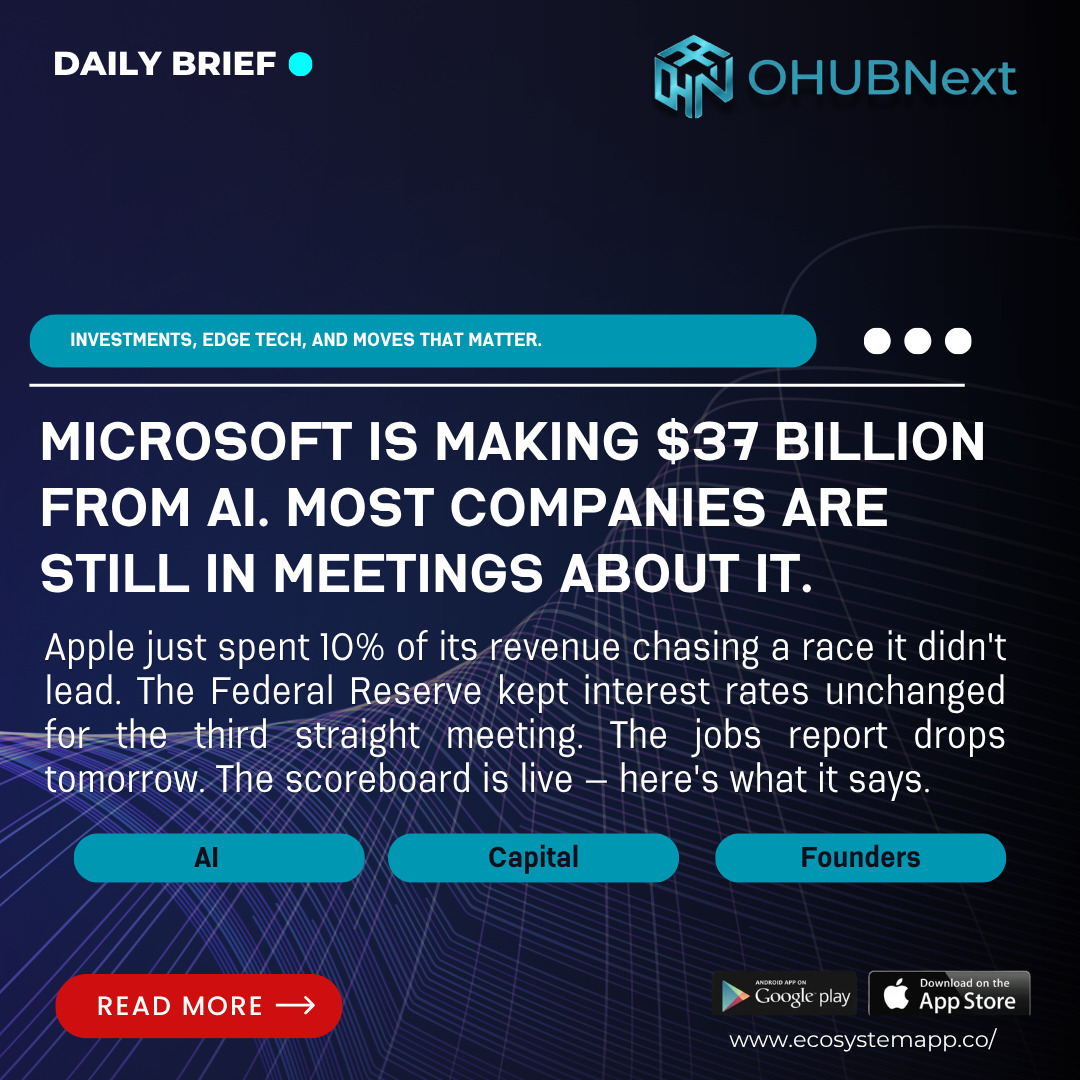
📍 Microsoft's AI business just crossed a $37 billion annual revenue run rate — up 123% year over year. Apple spent 10% of its entire revenue on R&D last quarter for the first time in 30 years, racing to catch up. The Fed held rates steady for the third straight meeting. And tomorrow morning, the BLS drops the May jobs report — the most consequential labor market data point of the quarter. The AI monetization race is no longer theoretical. The scoreboard is live.
─────
Hey Builders!
There is a difference between investing in AI and making money from AI.
Most companies are still doing the first one. Microsoft is doing the second — at $37 billion a year and accelerating.
That number — $37 billion in AI annual recurring revenue, up 123% from a year ago — is the most important data point in the AI economy this week. Not because Microsoft is special, but because of what it proves: AI is not a future revenue story. It is a current one. And the gap between the companies generating AI revenue and the ones still running pilots is not a gap in technology access. It is a gap in execution.
Apple is the mirror image. The most valuable company in the world just spent 10% of its revenue on R&D for the first time in 30 years — a 34% increase in a single year — because it is chasing a race it did not lead. R&D spending that aggressive is not confidence. It is urgency.
Together, those two data points tell you everything about where the AI economy stands right now: the early movers are monetizing, the followers are spending to catch up, and the window between the two is closing faster than most forecasts assumed.
Tomorrow morning at 8:30 a.m., the BLS releases the May jobs report. It will tell us what all of this looks like at the ground level — which industries are hiring, which are contracting, and whether the AI-driven labor market shift is accelerating or plateauing. Today's brief sets the stage.
─────
1️⃣ $37 Billion. That Is What AI Revenue Actually Looks Like.
Microsoft's fiscal Q3 2026 results are a masterclass in AI monetization. AI annual recurring revenue crossed $37 billion — up 123% year over year. Azure cloud growth hit 40%. The company beat Wall Street expectations across the board.
The engine behind those numbers is Copilot — Microsoft's AI assistant embedded across its entire product suite — and Azure AI services, which power a significant share of enterprise AI deployments globally. Microsoft did not build a separate AI business. It wired AI into the products enterprises were already paying for and charged more for the upgrade.
That strategy — integration over separation — is why the revenue is sticky. Enterprises do not cancel Copilot licenses the way they cancel standalone SaaS tools. The switching costs are high and the productivity gains are measurable. Microsoft's AI revenue is not a bet on the future. It is a billing line on a current contract.
For context: $37 billion in AI annual recurring revenue means Microsoft's AI business alone is larger than Salesforce's entire company. It is larger than Adobe. It is larger than most of the Fortune 500.
💡 For Founders
The Microsoft model is the template, not the exception. The companies that will win with AI are not the ones building AI products — they are the ones embedding AI so deeply into existing workflows that removing it becomes unthinkable. If you are building a product, the question is not "does this use AI?" It is "is this product indispensable because of what AI makes it do?" The answer to that second question is the difference between a feature and a business.
─────
2️⃣ Apple's 10% Moment — What It Signals When the World's Most Valuable Company Panics
Apple spent $11.4 billion on R&D in a single quarter — 10.3% of revenue, up from 7.6% the prior quarter, a 34% year-over-year increase. It is the first time in at least 30 years that Apple has crossed the 10% R&D threshold.
Revenue grew 17% in the same quarter — the fastest growth since 2021 — driven by record iPhone 17 demand. Apple is not spending this aggressively because it is struggling. It is spending this aggressively because it is behind.
The AI race has a specific problem for Apple: its primary interface — the smartphone — is not the natural home of the large language model interactions that are reshaping how people use software. Siri is not ChatGPT. Apple Intelligence has not delivered the transformative capability that Copilot and Gemini have in enterprise contexts. And while Apple controls the most profitable hardware platform on earth, the software layer above it is being contested by companies that moved faster.
The 34% R&D increase in one year is Apple's acknowledgment that catching up costs money — a lot of it, quickly.
💡 For Founders
The Apple story is a cautionary tale about the cost of being second. The most resourced, most profitable consumer technology company in the world is now in a spending race to recover ground it ceded by moving too carefully. For founders, the lesson is not "move fast and break things" — it is "understand which races have closing windows and move before the window closes." Apple has the capital to recover. Most companies do not.
─────
3️⃣ The Fed Holds — and What That Means for Founders Raising Right Now
The Federal Reserve held the federal funds rate at 3.5%–3.75% for the third consecutive meeting. The next decision comes June 16–17, with markets pricing a 60% probability of no change and a 40% probability of a 25 basis point cut.
The hold reflects a Fed that is watching two competing signals: inflation that has moderated but not fully resolved, and a labor market that is softening but not breaking. The Atlanta Fed's Q2 GDPNow estimate sits at 3.0% — healthy growth but below the 3.8% projected a month ago.
For the venture and startup ecosystem, three consecutive holds means the cost of capital has stabilized but not declined. Valuations in the private markets have adjusted. The exit environment remains constrained — the IPO window is open for AI companies with real revenue (see: Anthropic's confidential filing) but largely closed for everything else.
The June 16–17 decision is the most consequential Fed meeting of the summer. A cut would unlock capital deployment that has been waiting on the sidelines. A hold extends the current environment into Q3.
💡 For Founders
If you are raising capital in the next 90 days, the rate environment matters less than your revenue story. In a world where Microsoft is printing $37 billion in AI ARR, investors are not rewarding potential — they are rewarding traction. The founders who close rounds in this environment are the ones who can answer "what does your AI monetization look like right now" with a specific number, not a roadmap slide.
─────
4️⃣ Tomorrow's Jobs Report — What to Watch and Why It Matters
The Bureau of Labor Statistics releases the May employment situation report Friday, June 5 at 8:30 a.m. Eastern. This is the most watched economic data point of the month.
Here is what the market is expecting and what to watch beyond the headline:
The consensus estimate for May nonfarm payrolls is approximately 180,000 — slightly above the 122,000 ADP private sector figure reported Wednesday, which typically runs below the BLS number. A print above 200,000 signals a still-resilient labor market and reduces pressure on the Fed to cut. A print below 150,000 increases the probability of a June cut.
Watch the information services sector specifically. ADP showed information services shed 9,000 jobs in May. If the BLS confirms that trend — and extends it to include professional services — it will be the clearest signal yet that AI-driven white-collar displacement is showing up in the official data, not just in surveys and anecdotes.
Watch the healthcare number. Healthcare has been the single most consistent job creator of 2026. If it falters, it changes the story about which sectors are absorbing displaced workers.
Watch wage growth. If wages accelerate above 4.5% year over year, the Fed holds in June regardless of the employment number. Wages are the inflation variable that the Fed watches most closely right now.
💡 For Founders
Set a calendar reminder for 8:30 a.m. tomorrow. The May jobs report will move markets, shape Fed expectations, and tell you whether the labor market tailwinds or headwinds you are operating in are strengthening or easing. If you are hiring, managing a team, or raising capital — this number affects all three. Read it before you start your day.
─────
🔧 Three moves to make this week
1️⃣ Ask one question about your AI revenue
Not your AI cost. Your AI revenue. What are you charging for, or charging more for, because of AI? If the answer is nothing — that is your most important strategic gap. Microsoft did not get to $37 billion by building AI. It got there by billing for it.
2️⃣ Read the BLS report tomorrow at 8:30 a.m.
Go to bls.gov at 8:30 a.m. Eastern on June 5. Read the headline number, the sector breakdown, and the wage growth figure. That sequence — jobs, sectors, wages — tells you everything about the economy you are building in. Five minutes. Do it before the commentary tells you what to think.
3️⃣ Identify your closing window
Apple just spent $11.4 billion in one quarter catching up to a race it could have led. What is the equivalent in your business — the capability, the market, the partnership — that has a closing window you have been treating as open-ended? Name it. Set a deadline. Move.
─────
💬 Quote of the Day
"The secret of getting ahead is getting started." — Mark Twain
─────
🏁 Build New Skills With OHUB
The OHUBAI Competency Program is a four-week intensive, hands-on training program designed to help you build real AI capability fast — whether you're a founder, a working professional, or a career-switcher ready to future-proof your skill set.
New cohorts open every four weeks. By the end of Week 1, you'll have built your first AI agent.
For $399, here's what you walk away with:
▪️ 4 weeks of live, instructor-led curriculum — not pre-recorded, not self-paced, real instruction with real accountability
▪️ Up to 1 year of access to the Mindstone Dashboard
▪️ Up to 1 year of updated education content
▪️ A seat in one of the fastest-growing AI communities globally
Financing available through Affirm or Klarna — get started for as low as $37/mo.
🚀 Visit opportunityhub.co/ai to learn more.
─────
🎬 Closing Thought
Microsoft crossed $37 billion in AI revenue while most companies are still in meetings about their AI strategy. Apple spent $11.4 billion in a single quarter trying to close a gap it created by moving too slowly. The Fed is watching inflation and jobs data to decide whether the economy can handle cheaper money. And tomorrow morning, the BLS will tell us what all of this looks like on the ground — in the actual hiring decisions of actual companies across every sector of the American economy.
The AI monetization race has a scoreboard now. It is updated quarterly. The distance between the leaders and the followers is not closing — it is compounding.
The founders who study that scoreboard, understand what the leaders are doing differently, and apply those principles to their own businesses are the ones who will be on it in three years. The ones who are still in meetings about whether to start will be studying those founders the way everyone is studying Microsoft right now.
The window is open. The score is being kept. Build something worth counting.
─────
⚡️ OHUBNext Daily Brief - investments, edge tech, and moves that matter.
For 12+ years, OHUB has been building pathways and on-ramps to multi-generational wealth without reliance on pre-existing wealth. Through exposure, skills, entrepreneurship, capital markets, and inclusive ecosystems, we've helped people create new jobs, new companies, and new wealth.
bls.gov