

OHUB @ohub
🚨 OHUBNext | The Capital Is Here. The Confidence Isn't.
🚨 OHUBNext | The Capital Is Here. The Confidence Isn't.
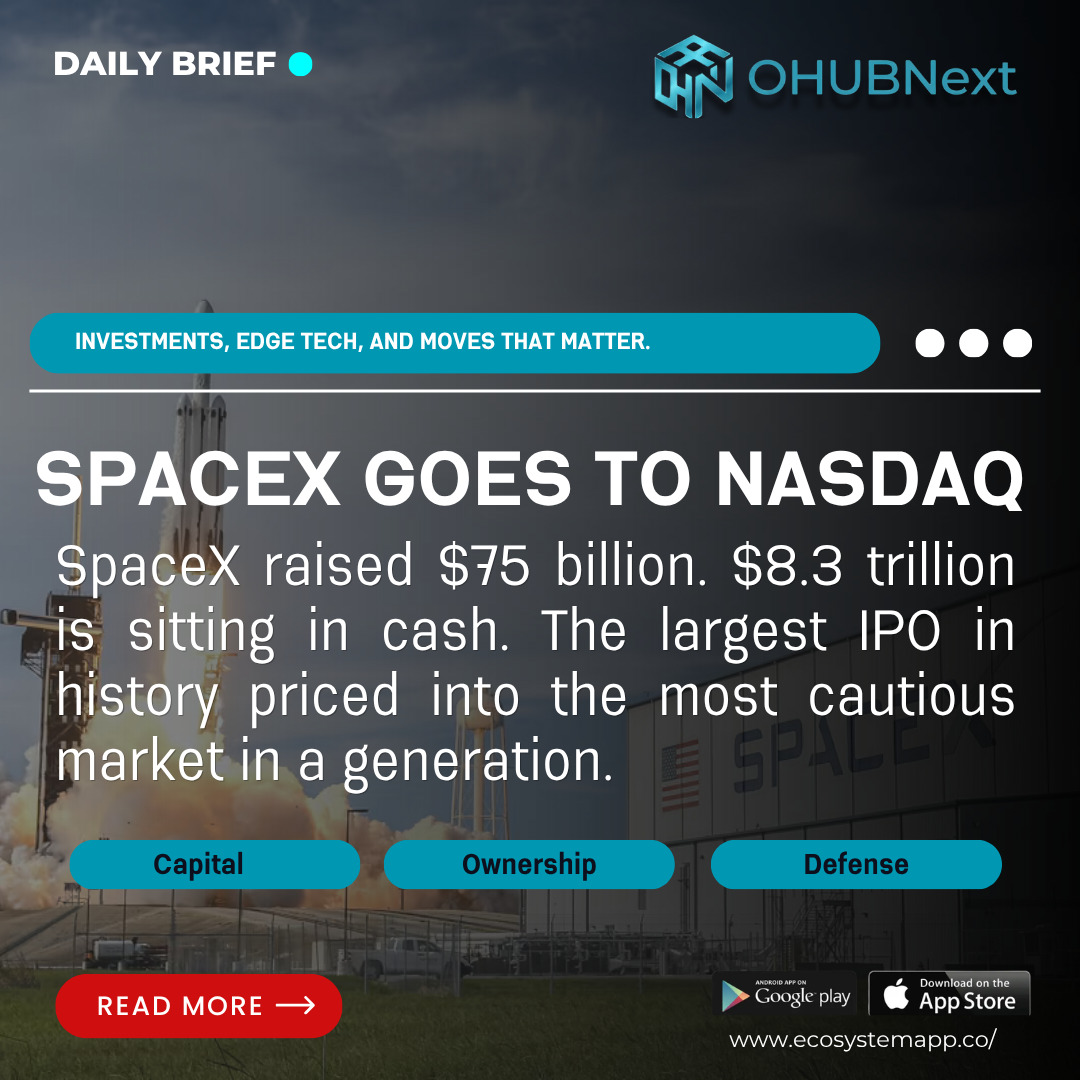
📍 SpaceX priced at $135 per share on June 3 — $1.77 trillion valuation, $75 billion raised, the largest public offering in history. U.S. money market funds are sitting on a record $8.3 trillion. The capital is there. It is not moving. That gap is the story.
─────
Hey Builders!
SpaceX hits Nasdaq on June 12 under ticker SPCX. $135 a share. $1.77 trillion valuation. $75 billion raised in a single transaction. Musk retains 82% voting control. Almost none of you got a share at $135 — not because you weren't paying attention, but because you weren't in the room where allocation happens.
That is the thread that runs through everything in today's brief.
While SpaceX priced at $1.77 trillion, Anduril raised $5 billion at a $61 billion valuation — doubling in under a year. Defense tech has now pulled in $14.6 billion in 2026, already past last year's full-year record with seven months left. Meanwhile $8.3 trillion sits in money market funds, untouched, earning 3.3% while the market sets records above it. And GLP-1 drugs are quietly dismantling $55 billion in U.S. food system revenue — a structural shift most founders have not yet put in a spreadsheet.
The biggest capital events are happening at altitude. The biggest market shifts are happening at ground level. The founders who see both — and build in the space between — are the ones who will matter.
─────
1️⃣ SpaceX Goes Public Thursday. Almost Nobody Gets In at $135.
SpaceX set its IPO price at $135 per share on June 3, selling 555.6 million shares for a $75 billion raise at a $1.77 trillion valuation. First trading on Nasdaq under ticker SPCX begins June 12. That valuation puts SpaceX seventh in U.S. market cap — ahead of Tesla, ahead of Berkshire Hathaway — before a single share trades publicly.
Retail allocation at $135 is minimal. The hedge funds, pension funds, and sovereign wealth vehicles on the roadshow June 4–8 got access. Most individual investors will buy SPCX in the open market on June 12 at whatever the first session prints — historically 20 to 30% above IPO price on high-profile listings before retracing. Musk retains 82% voting control regardless of what the market does.
The $75 billion SpaceX raised in one transaction exceeds the total venture capital raised by Black-founded companies in U.S. history — combined — by a significant multiple. That is not an aside. It is the context.
💡 For Founders
The founders who profited at $135 were not smarter. They were inside the network that runs the roadshow. That access is not luck — it is built deliberately over years through fund relationships, LP networks, and a track record that gets you on allocation lists. The IPO is the outcome. The infrastructure that gets you in the room is the work. Start building it now.
─────
2️⃣ Defense Tech Is Having Its Best Year on Record. It Is Not Even July.
Anduril Industries raised $5 billion in a Series H led by Andreessen Horowitz and Thrive Capital, pushing its valuation from $30.5 billion to $61 billion in under a year. The Costa Mesa-based autonomous defense company has now raised more than $11 billion total — the most of any venture-backed defense startup in the world.
Defense-tech venture funding has crossed $14.6 billion in 2026 through May — past the $9.6 billion full-year record set in 2025, with seven months remaining. Capital is concentrating in AI-enabled weapons systems, autonomous maritime and aerial platforms, military software, and space infrastructure. The firms funding it — Andreessen Horowitz, Thrive, General Catalyst — spent the previous decade avoiding defense on ethical grounds. They have all reversed. The capital is no longer reluctant. It is competing to get in.
SpaceX's IPO opens a public market exit narrative. Anduril, Shield AI, and Joby Aviation are all watching it closely.
💡 For Founders
Defense is a $14.6 billion category with bipartisan demand, long contract cycles, and public market exits now on the horizon. If your product touches AI, autonomy, cybersecurity, logistics, or communications — a dual-use positioning is no longer a stretch. It is a legitimate path to a customer with deep pockets and a multi-year runway. The founders who built commercial-only and ignored government are reconsidering that now. The ones who built dual-use from day one are already under contract.
─────
3️⃣ $8.3 Trillion Is Sitting in Cash. Here Is What That Means for Anyone Raising Right Now.
U.S. money market fund assets hit a record $8.3 trillion as of late May 2026 — up $172 billion year-to-date, with the largest single-week jump in six years recorded in early May at $122 billion. The inflows are driven by Fed uncertainty, elevated oil prices, and investors repricing from rate cuts to potential hikes. The seven-day average yield is 3.3%.
The paradox is stark. The S&P is near record highs. Anthropic is filing at $965 billion. SpaceX just raised $75 billion. And $8.3 trillion — almost twice Japan's GDP — is parked in cash instruments, not deployed. The anxiety is not at the top of the market. It is in the middle, where founders outside the top 20 AI deals are raising into a pool of capital that is present, concentrated, and waiting for permission to move.
At the average seed valuation, $8.3 trillion could fund 1.6 million early-stage rounds. It will fund a fraction of that. The question is what unlocks it.
💡 For Founders
Investors are not lying when they say the market is tight. But tight capital does not mean absent capital — it means capital waiting for a confidence signal. Rate cut. Geopolitical clarity. A data point that makes deployment feel safe. Your job right now is to be that signal. Revenue traction, operating efficiency, and a clear path to profitability are not nice-to-haves in this environment. They are the unlock code.
─────
4️⃣ GLP-1 Drugs Will Reach 25 Million Users by 2030. Most Founders Haven't Modeled It.
Approximately 10 to 12 million Americans are currently on active GLP-1 prescriptions — Ozempic, Wegovy, Zepbound. J.P. Morgan projects that number reaches 25 million by 2030 as oral formulations clear approval, prices fall with generic entry, and Medicare obesity coverage expands. Users consume up to 21% fewer calories on average.
That caloric reduction, at scale, is a $30 to $55 billion contraction in U.S. food system revenue, according to economic modeling. Food companies are already reformulating for smaller portions. Grocery category managers are recalibrating volumes. Restaurant average check sizes are shifting. J.P. Morgan's research identifies simultaneous demand-side disruption across food, agriculture, and transportation. The downstream is not hypothetical. It is underway.
Employer cost pressure is escalating in parallel. Fifty-five percent of commercial employers now cover GLP-1s for obesity treatment. Fifteen percent have already dropped coverage as year-over-year spend on these drugs climbs 50% or more at some organizations. A new wave of same-day delivery platforms, natural GLP-1 supplement brands, and adherence-focused health tech is emerging in response.
💡 For Founders
If your business depends on American caloric consumption — food, consumer products, healthcare, logistics — GLP-1 adoption is a structural variable, not a trend. Model it now. A scenario where 10% of your customer base consumes 21% fewer calories by 2028 is not pessimistic. It is directionally accurate. The founders building for this shift — adherence tools, reformulated nutrition, healthcare navigation — are entering an underserved category ahead of the curve. The ones ignoring it are building toward a revenue surprise they will not enjoy.
─────
5️⃣ Founders Are Giving Customers Equity. It Is Working.
A growing number of startups are designing community ownership into their cap tables from day one — giving customers, creators, and community members genuine equity stakes rather than loyalty points. The structures range from Regulation Crowdfunding raises open to early customers, to share-denominated loyalty programs, to creator equity that pairs options with commissions.
The regulatory infrastructure has existed since the JOBS Act. Regulation Crowdfunding allows raises up to $5 million. Regulation A+ allows up to $75 million. Republic, StartEngine, and Wefunder have collectively processed billions across thousands of campaigns. What is new in 2026 is the intent: founders are using community rounds as a go-to-market strategy, not a fallback when institutional capital declines.
The model accelerates in categories where community trust drives distribution — consumer brands, media companies, creator platforms, mission-driven businesses where the customer and the owner have always been the same person anyway.
💡 For Founders
A customer with equity is not just a buyer. They are a distributor, a defender, and a long-term advocate — and no loyalty points program produces that. If you are structuring your next raise, a Regulation Crowdfunding tranche open to your existing customers is worth serious consideration — not just for the capital, but for the alignment it creates. OHUB has spent 12 years building communities oriented around ownership. The regulatory tools to operationalize it have never been more accessible.
─────
🔧 Three moves to make this week
1️⃣ Watch the SPCX open on June 12
SpaceX begins trading Thursday. Whether or not you plan to buy, watch the first-hour price action. The spread between $135 and the open market price is the institutional premium — the precise dollar cost of not being in the room. Track it. It is the clearest single data point this week on how access architecture operates in public markets.
2️⃣ Model GLP-1 impact on your revenue
Open a spreadsheet. Model a scenario where 10% of your customer base is consuming 21% fewer calories by 2028. What does that do to your top line? Your volume? Your pricing power? You do not need a perfect model. You need to have run the scenario before your competitors do.
3️⃣ Search SAM.gov for your product category today
Go to SAM.gov and run one search for contract opportunities in your space. If your product touches AI, cybersecurity, autonomy, logistics, or communications — a government contract vehicle almost certainly exists. Defense tech pulled $14.6 billion this year because the government is a high-margin, long-cycle customer. Most founders have never looked once.
─────
💬 Quote of the Day
"The future belongs to those who prepare for it today." — Malcolm X
─────
🏁 Stay Ahead With OHUBNext
This brief is part of what OHUBNext members get every day.
For $5.99/month — or $59/year — you get the full daily brief, access to OHUB's Library of Opportunity, self-paced certificates in High-Growth Company Building and Tech Ecosystem Investing, career accelerator tools, and live monthly labs with the OHUB team. The annual plan includes exclusive masterclasses, early course access, and wealth tools built for builders who are serious about owning what comes next.
Institutional-grade. Fraction of the cost.
🚀 Join at opportunityhub.co/next
─────
🎬 Closing Thought
SpaceX raises $75 billion in a single transaction. Defense tech crosses $14.6 billion in five months. And $8.3 trillion sits in money market funds, earning 3.3%, frozen — not because the capital is gone but because the people holding it are waiting for a signal that feels safe enough to act on.
This is what a two-speed market looks like. At the top, the rounds are closing. The valuations are historic. The IPO window is open and the companies walking through it are being valued at numbers private markets have never seen. Below that altitude, the market is cautious, concentrated, and selective in ways that track very closely with who was already inside the network before the boom started.
GLP-1 drugs are quietly pulling $55 billion out of the food system. Community ownership models are pulling customers into cap tables. Both are structural shifts happening at ground level while the financial press covers SpaceX. The founders who see both altitudes — who can read the IPO filing and the J.P. Morgan GLP-1 projection in the same morning — are building at the intersection of where capital flows and where markets actually move.
That intersection is not on a roadshow. It is in your spreadsheet, your product decisions, and the communities you are choosing to build with. The capital is not absent. It is concentrated. The market is not closed. It is selective. The founders who build the access, the track record, and the dual-use strategy will not just survive this moment. They will own what comes after it.
─────
⚡️ OHUBNext Daily Brief - investments, edge tech, and moves that matter.
For 12+ years, OHUB has been building pathways and on-ramps to multi-generational wealth without reliance on pre-existing wealth. Through exposure, skills, entrepreneurship, capital markets, and inclusive ecosystems, we've helped people create new jobs, new companies, and new wealth.
Home | SAM.gov
sam.gov