

OHUB @ohub
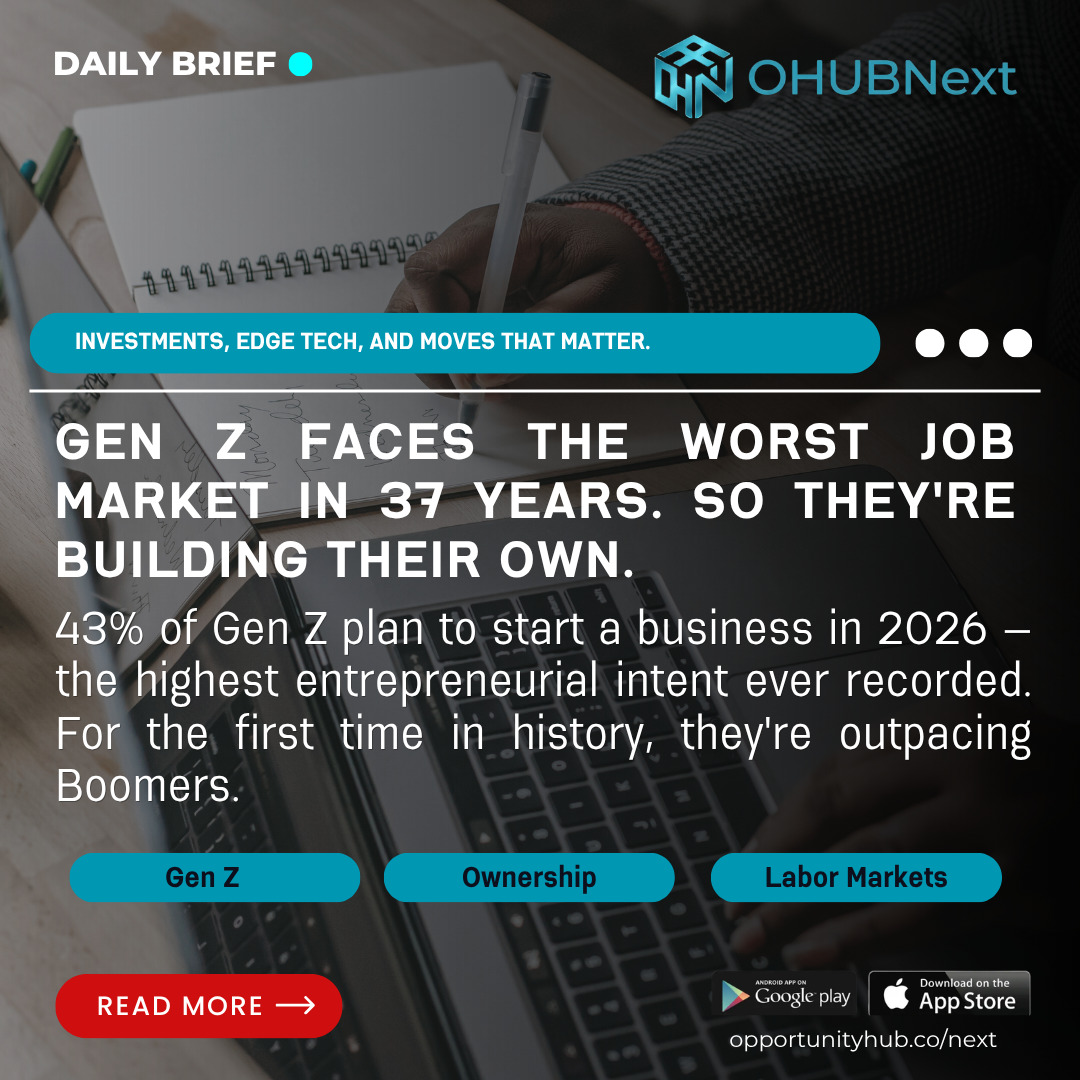
🚨 OHUBNext | Gen Z Faces the Worst Job Market in 37 Years. So They're Building Their Own.
🚨 OHUBNext | Gen Z Faces the Worst Job Market in 37 Years. So They're Building Their Own.
📍 The entry-level job market is the worst it has been in 37 years, according to Fortune. New workforce entrants now represent the highest share of the unemployed since 1989. At the same moment, 43% of Gen Z adults plan to start a business in 2026 — the highest entrepreneurial intent ever recorded for any generation. The closed door and the open road arrived together.
─────
Hey Builders!
The pipeline that turned degrees into careers is clogged — and a generation is rerouting around it.
Finance and information services, which once added 44,000 jobs a month before the pandemic, are now shedding an average of 9,000 jobs a month since 2023. The firms that absorbed new graduates for generations are running leaner — not because revenue fell, but because AI agents are handling intake, research, drafting, and triage tasks. Twenty-one percent of companies have already frozen entry-level hiring because of AI. Forty-seven percent expect to eliminate entry-level roles entirely by 2027.
Gen Z did the math. Forty-three percent plan to start a business this year. For the first time in history, Gen Z now accounts for more new business starts than Baby Boomers. Fifty-seven percent already have a side income stream. This is not rebellion. It is rational reallocation.
And underneath this shift, other structural moves are accelerating. Black women-owned employer businesses grew 13% between 2024 and 2025 — the fastest of any demographic — while overall Black women's employment rates fell. The skilled trades are sitting on 600,000 open jobs with no workers to fill them, threatening $1 trillion in annual economic losses by 2030. And the AI that is closing the corporate door is simultaneously the tool that makes building alone cheaper than it has ever been.
The workforce is not in a downturn. It is in a restructuring. The difference matters — because a restructuring creates opportunity for founders who can read where it is going.
─────
1️⃣ Gen Z Faces the Worst Job Market in 37 Years. So They're Building Their Own.
The share of unemployed Americans who are new workforce entrants hit a 37-year high in 2025, peaking at 13.3% in July before settling at 10.6% in February 2026 — still higher than at any point during the Great Recession, according to BLS data analyzed by Fortune. The industries that historically absorbed new graduates — finance, information services, consulting — have shed an average of 9,000 jobs a month since 2023, compared to gains of 44,000 a month before the pandemic.
AI is accelerating the contraction at the entry level specifically. At firms that adopted generative AI, junior employment declined approximately 9% after six quarters relative to non-adopting firms, driven primarily by reduced hiring rather than layoffs of existing workers, according to research from the Economic Innovation Group. Twenty-one percent of companies have already frozen entry-level hiring because of AI, and 47% expect to eliminate entry-level roles entirely by 2027, according to a Resume.org survey.
Gen Z's response is structural. Forty-three percent plan to start a business in 2026 — the highest entrepreneurial intent of any generation, surpassing Millennials at 39% and more than doubling Gen X at 21%, according to Intuit QuickBooks. For the first time in recorded history, Gen Z now accounts for more new business starts than Baby Boomers — 9% of all new businesses started in 2025, compared to 5% for Boomers, according to Gusto's 2026 New Business Formation Report. The entry-level job market did not produce this shift. It provoked it.
💡 For Founders
The 43% of Gen Z planning to build are not starting with venture capital or family wealth. They are starting with AI tools, no-code platforms, and a distribution infrastructure — social media, creator networks, affiliate systems — that did not exist for previous generations of first-time founders. If you are building tools, platforms, or communities that serve early-stage solo founders, your market just reached historic scale. If you are a founder yourself: the closed corporate door is not a setback. It is the forcing function that built more of the world's companies than any accelerator ever did.
─────
2️⃣ Artificial Intelligence Has Become the Leading Stated Reason for Corporate Layoffs in 2026
AI has been cited in 87,714 job cut announcements through May 2026 — 22% of all layoffs tracked by Challenger, Gray & Christmas, and the leading stated reason for cuts across all industries. In May alone, AI-linked layoffs hit 38,579 — the highest single month since Challenger began tracking AI as a layoff rationale in 2023. Technology companies have announced 123,653 total cuts through May 2026, up 66% from the same period in 2025.
The layoffs are selective in ways that matter. Companies cutting junior roles are simultaneously hiring for positions that did not exist two years ago — AI engineers, prompt engineers, machine learning operations specialists, and AI safety researchers. GitLab restructured for the "agentic AI era" in June 2026, flattening three management layers and restructuring global operations. The stated rationale: AI agents now handle reviews and approvals that previously required human managers.
The same technology doing the cutting is doing the enabling. The cost of building a product, writing copy, managing customer service, and handling operations has collapsed for solo founders and small teams. A founder with access to current AI tools can now build and operate what required a five-person team three years ago. The concentration of layoffs at the entry and junior level is not coincidental — it is precisely the work that AI is now cheapest to perform.
💡 For Founders
The 87,714 AI-linked layoffs represent workers with real domain expertise — analysts, writers, researchers, junior engineers — who are now available, often at below-market rates, because their former employers replaced their functions with software. If you are building a team, this is an unusually accessible talent window. The workers who lost jobs because AI can do what they did are, in many cases, the exact people who can help you build with AI better than your competitors. Hire for domain knowledge, not just technical skill.
─────
3️⃣ Black Women-Owned Businesses Are Growing Faster Than Any Other Demographic. The Capital Gap Remains Structural.
Black women-owned employer businesses grew 13% between 2024 and 2025 — the fastest growth rate of any demographic group, according to Wells Fargo's 2025 Impact of Women-Owned Businesses report. Revenue at Black women-owned businesses grew nearly 6% in the same period. Over the longer arc from 2019 to 2024, revenue at Black women-owned businesses surged 80.8% and employment grew 44.4%.
The growth is happening against significant headwinds. Black women's overall employment rate fell 1.4 percentage points in 2025 — among the steepest declines of any demographic. The businesses are growing while the employment safety net shrinks, which is a form of entrepreneurship born of necessity as much as choice. Black women-led startups seeking venture capital face a financing layer that does not reflect the operational performance on the ground. Black founders overall raised $643 million in Q1 2026 — 0.21% of the total U.S. venture market — and the slice available to Black women within that figure is narrower still.
The divergence tells a precise story: when formal employment contracts, ownership becomes the primary wealth-building vehicle. Black women are not waiting for the employment market to correct. They are building employer businesses — companies with payroll, revenue, and complexity — that are growing at rates the broader market cannot match.
💡 For Founders
The Black women-owned business growth story is the most underleveraged narrative in American entrepreneurship. These are not side hustles. They are employer businesses — companies with staff, revenue, and operational infrastructure — growing at 13% in a market that largely ignores them. If you are building a platform, fund, accelerator, or B2B service, this demographic represents a high-growth, underserved customer base with documented revenue expansion and insufficient capital access. The mismatch between operational performance and financing access is the arbitrage. Build into it.
─────
4️⃣ The Skilled Trades Shortage Is a $1 Trillion Annual Crisis — and Corporate America Just Committed $365 Million to Address It
Nearly 600,000 skilled trades positions went unfilled in the past year — electricians, HVAC technicians, plumbers, pipefitters, construction equipment operators — while apprenticeship programs produced approximately 150,000 new workers to fill them, according to JLL research published in April 2026 and covered by Fortune. By 2030, an estimated 2.1 million skilled trades jobs could go unfilled, carrying potential annual economic losses of $1 trillion, according to U.S. Department of Education estimates. For every five workers who retire from construction, manufacturing, and skilled trades, only two replacements enter the workforce.
The corporate response is accelerating. Lowe's, BlackRock, and Google have collectively committed more than $365 million to skilled trades training as of June 2026 — with Lowe's Foundation committing $250 million to train 250,000 workers in plumbing, carpentry, and electrical over the next decade. Enrollment in community college trades programs is rising 12% over the past five years, with trades-related majors among the fastest-growing disciplines. Electrician positions are projected to grow 9.5% through 2034 — more than triple the 3.1% average across all occupations. HVAC technician positions are projected to grow 8.1% over the same period.
The apprenticeship model is also one of the most financially rational paths in the 2026 labor market. Apprentices earn $15 to $20 per hour while training, exit with a nationally recognized credential, and enter a market with 450,000 more open jobs than workers to fill them. The student debt calculation that made trades feel like a lesser option no longer holds against $1.8 trillion in outstanding student loans and a constricted white-collar hiring market.
💡 For Founders
The trades gap is a product category with no dominant player. Field service management, apprenticeship platforms, credential verification tools, contractor marketplaces, scheduling and payments infrastructure for independent tradespeople — all are underfunded relative to the scale of the problem. The $365 million in corporate commitments announced this month signals that institutional capital is finally treating this as a solvable problem rather than a cultural one. The founders who build the software layer for the skilled trades economy are building into a $1 trillion gap with a 2.1 million-worker demand signal and no category leader in sight.
─────
5️⃣ The Workforce Data Looks Stable at the Surface. The Structural Shift Underneath It Is Accelerating.
The May 2026 jobs report showed 172,000 non-farm payroll jobs added and unemployment steady at 4.3% — headline numbers that read as a functional labor market. Underneath them, the distribution is more complicated. Full-time employment contracted from 134.18 million to 134.16 million workers. Part-time employment expanded. Job openings held at 7.6 million in April, concentrated in professional services and healthcare — sectors requiring credentials and experience that new entrants do not yet hold. Initial jobless claims rose to 225,000 in the week ending May 30, the highest since 2020. Wage growth slowed to 3.4% year-over-year, with real wages likely negative when May inflation data arrives.
This is a restructuring, not a recession. Recessions compress the headline numbers. Restructurings move capital and labor from one configuration to another while the aggregate appears stable. The industries losing jobs — finance, information services, corporate administration — are exactly the industries where AI is performing the most entry-level work. The industries gaining jobs — healthcare, trades, local government — are the ones AI cannot yet perform without a human on site.
The mismatch between 7.6 million open jobs and rising jobless claims is not a paradox. It is a match problem. The jobs exist. The credentialing, geographic access, and skill alignment to fill them do not. The institutions built to close that gap — universities, workforce boards, community colleges — are running curricula that predate the AI moment by years. The restructuring will not wait for them to catch up.
💡 For Founders
Read every jobs report as a map, not a score. The sectors shedding jobs tell you where AI is performing work cheaply enough to displace humans. The sectors gaining jobs tell you where human presence, credentials, and physical skill still command a premium. The gap between those two columns — the workers displaced from one and unable to access the other — is the market for reskilling platforms, portable credentialing, apprenticeship infrastructure, and community-based career pathways. That market is not abstract. It is 87,000 AI-laid-off workers, one million new workforce entrants who cannot get a first job, and 600,000 trades positions with no one to fill them. Build the bridge.
─────
🔧 Three moves to make this week
1️⃣ Audit one junior-level function in your business for AI replacement
Pick one task — customer intake, research synthesis, first-pass writing, data cleaning. Run it through Claude or GPT-4 for five business days. If the output is 80% of what a human produces at 10% of the cost, that is a capital reallocation decision, not a technology experiment. The founders who make this audit now will have the runway to hire for the work AI cannot do — domain expertise, relationships, and judgment.
2️⃣ Find one Gen Z solo founder who shipped something in the last 60 days and study their stack
Go to Product Hunt, Indie Hackers, or X and find a founder under 25 who built and launched a product recently. Look at the tools they used — the AI stack, the no-code infrastructure, the distribution model. This is not benchmarking. It is intelligence. The cost structure they are operating at is the cost structure your competitors will be operating at within 18 months.
3️⃣ Pull the Gusto New Business Formation Report before your next investor conversation
Gen Z surpassing Boomers in new business starts is a data point that reframes the workforce narrative from decline to formation. If you are raising, the argument that a new generation of builders is entering the market at historic rates — using tools that compress costs and accelerate time-to-revenue — belongs in your deck. Gusto's report is public. Read it. Use it.
─────
💬 Quote of the Day
"The secret of getting ahead is getting started." — Mark Twain
─────
🏁 Stay Ahead With OHUBNext
This brief is part of what OHUBNext members get every day.
For $5.99/month — or $59/year — you get the full daily brief, access to OHUB's Library of Opportunity, self-paced certificates in High-Growth Company Building and Tech Ecosystem Investing, career accelerator tools, and live monthly labs with the OHUB team. The annual plan includes exclusive masterclasses, early course access, and wealth tools built for builders who are serious about owning what comes next.
Institutional-grade. Fraction of the cost.
🚀 Join at opportunityhub.co/next
─────
🎬 Closing Thought
The entry-level job market is the worst it has been in 37 years. AI-linked layoffs are running at their highest monthly pace since tracking began. Black women's employment rate fell while their businesses grew by 13%. Six hundred thousand trades jobs sit open with no workers to fill them. Read together, these are not separate stories. They are one story — a workforce in structural reorganization, shedding one configuration and forming another, faster than the institutions designed to manage the transition can follow.
Gen Z is not waiting. They are starting companies at a rate that has, for the first time in history, surpassed Baby Boomers. Not because they prefer entrepreneurship in the abstract, but because the alternative — waiting for a corporate job market that has been contracting for entry-level workers for three consecutive years — is a worse bet. The math changed. They changed with it.
The founders who build for the workforce that is actually forming — not the workforce that made sense before 2023 — are not behind the curve. They are the only ones building with accurate data. The gap between where the labor market is and where the education, credentialing, and capital systems think it is — that gap is the opportunity. It is wide, it is growing, and for now, it has very few builders in it.
The door closed. Build something better than what was behind it.
─────
⚡️ OHUBNext Daily Brief - investments, edge tech, and moves that matter.
For 12+ years, OHUB has been building pathways and on-ramps to multi-generational wealth without reliance on pre-existing wealth. Through exposure, skills, entrepreneurship, capital markets, and inclusive ecosystems, we've helped people create new jobs, new companies, and new wealth.

The Best Free Online Resume Builder - ResumeTemplates.com
Build your resume for free with our AI-powered online resume builder. Fast, professional, and ATS-friendly templates.
resume.org