

OHUB @ohub
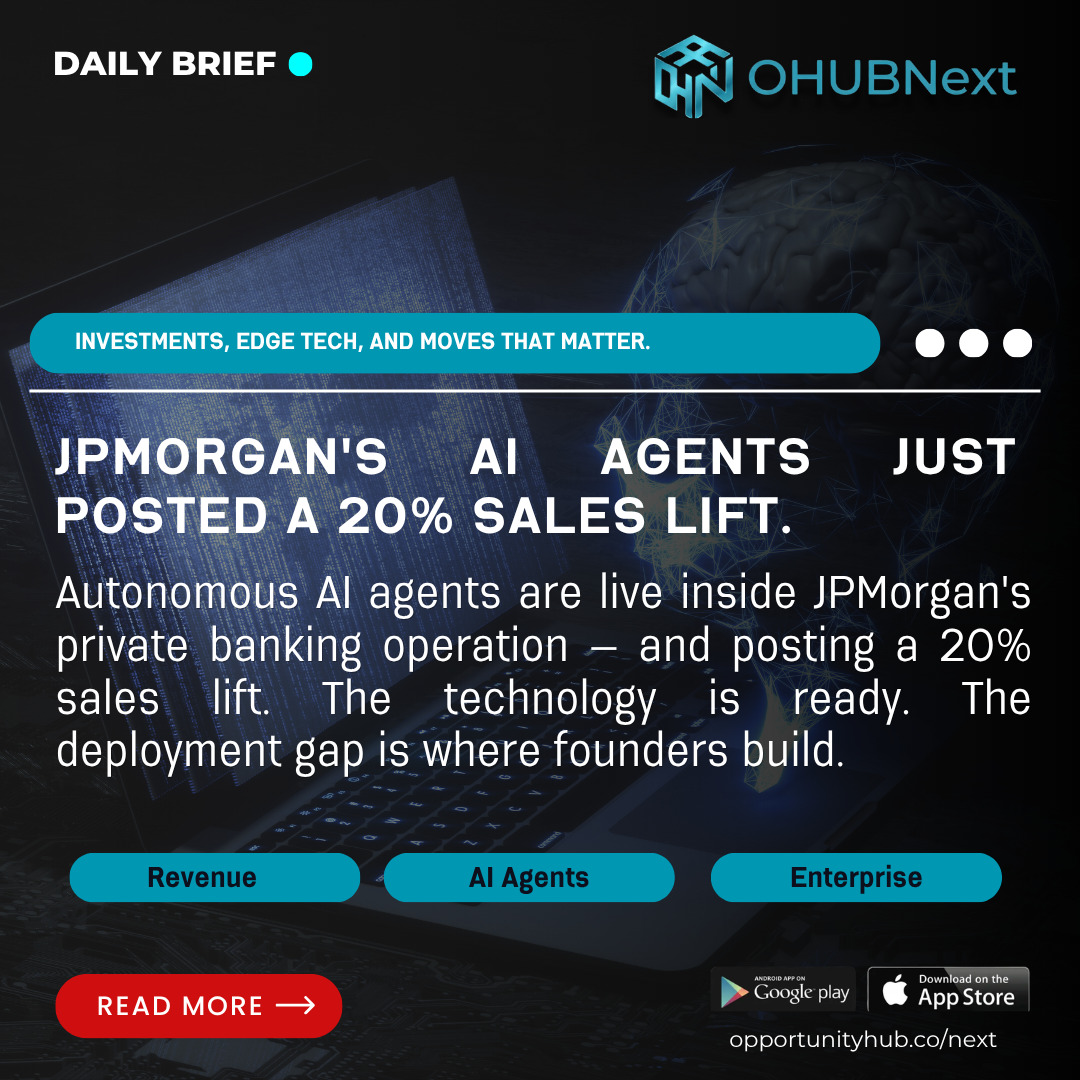
🚨 OHUBNext | JPMorgan's AI Agents Are Producing a 20% Sales Lift
🚨 OHUBNext | JPMorgan's AI Agents Are Producing a 20% Sales Lift
📍 JPMorgan Chase is deploying autonomous AI agents that operate for hours without human oversight — and the results are already in: a 20% gross sales increase in private banking, driven by AI that screens markets overnight so humans close deals in the morning. Gartner projects 40% of enterprise applications will embed task-specific AI agents by year-end. The enterprises that moved first are already capturing the lift. Founders who build the version for the rest of the market are building into a gap that is still wide open.
─────
Hey Builders!
The results are in. JPMorgan's autonomous AI agents are producing a 20% gross sales increase — and the rest of the market is still in beta testing.
JPMorgan announced this week it is deploying AI agents capable of running autonomously for one to two hours, eventually scaling to days and weeks. Private banking teams using AI overnight screening have already posted a 20% increase in gross sales. The bank has 300 active AI use cases in production. This is not experimentation. This is enterprise adoption at the scale of one of the largest financial institutions on the planet — and it is generating measurable revenue.
The broader market is accelerating behind it. Gartner projects that 40% of enterprise applications will embed task-specific AI agents by the end of 2026, up from less than 5% in 2025. By Q2, 31% of enterprises already had at least one agent in production. Median cost reductions of 25–40% and process efficiency gains of 28–37% are now documented across finance, supply chain, and operations deployments. And yet: 95% of enterprise AI agent prototypes never reach production, and only 1 in 5 companies has a mature governance model for autonomous agents. The technology is ahead of the institutional capacity to deploy it.
That gap is the founder opportunity. JPMorgan built the agentic finance stack for private banking clients with $10 million or more in assets. The founder with $100,000 in revenue needs the same stack — and no one has built it for them yet. The same is true across healthcare, logistics, professional services, and every industry where enterprise incumbents are deploying at scale while smaller operators are still running on spreadsheets and Slack.
Black founders raised $643 million in Q1 2026 — the highest quarterly total since 2022. The AI wave is producing capital events. The question is not whether AI creates opportunity. It is whether the builders who understand communities, workflows, and markets that the enterprise ignores are in position to capture it.
─────
1️⃣ JPMorgan's AI Agents Are Live, Autonomous, and Producing 20% More Revenue. The Enterprise Playbook Is Written.
JPMorgan Chase confirmed this week it is deploying autonomous AI agents throughout 2026 — systems that operate for one to two hours without human intervention, managing multi-step workflows across research, client screening, back-office operations, and revenue-generating functions, per CNBC reporting on June 9. The bank's stated trajectory: agents that run coherently for "multiple hours, then days, then weeks." Private banking teams that have integrated AI tools — systems that screen markets, client positions, and research overnight — have recorded a 20% increase in gross sales. The human bankers are not being replaced. They are being redeployed to the only task AI cannot replicate: the relationship close.
JPMorgan has 300 active AI use cases running across the firm. The 2026 deployment is the next phase — not AI assisting humans at discrete tasks, but AI owning workflows end-to-end. The broader financial sector is following: 73% of financial executives now run human-AI hybrid operations, and 67% trust hybrid AI data for material risk and investment decisions, according to a PRNewswire industry report published this week. Each significant AI-related conduct incident costs firms an average of $14 million — meaning the deployment is real enough that the liability is already being quantified.
The 20% gross sales lift is the number that matters. It reframes agentic AI from an IT investment into a revenue strategy. When AI handles the overnight research and screening, bankers arrive to client meetings with full context, no prep time, and nothing to do but close. That is the product. JPMorgan built it for their tier. Nobody has built it for everyone else.
💡 For Founders
JPMorgan's 20% sales lift is your proof of concept — you did not have to fund it. The enterprise built the case study. Your job is to build the same architecture for the markets they cannot reach: community banks, independent financial advisors, small business lenders, accounting firms, insurance brokers. Every one of those markets has the same workflow problem JPMorgan just solved at scale. The technology is available. The distribution is not. That is where you build.
─────
2️⃣ 40% of Enterprise Applications Will Embed AI Agents by Year-End. 95% of Prototypes Never Make It to Production.
Gartner projects that 40% of enterprise applications will integrate task-specific AI agents by the end of 2026 — up from less than 5% in 2025. By Q2 2026, 31% of enterprises already had at least one agent in production. Eighty percent of enterprises deploying AI agents report measurable economic benefits: median cost reductions of 25–40% and process efficiency gains of 28–37% are now documented across finance, supply chain, and operations, according to research published by enterprise AI platform Lyzr in June 2026.
The gap between stated adoption and production reality is significant. Roughly 95% of enterprise generative AI pilots delivered zero measurable return and never reached production, per MIT Sloan research reviewing over 300 publicly disclosed AI deployments. Only 1 in 5 companies has a mature governance model for autonomous agents, according to Deloitte's 2026 State of AI in the Enterprise report. The two primary failure modes: trust deficits — organizations that will not let agents make decisions without human sign-off — and integration debt — legacy systems that cannot connect to agentic workflows without significant re-engineering. The technology is ready. The institutions are not.
This creates a two-speed market. Enterprises that have cleared the governance and integration hurdles — JPMorgan, the hyperscalers, a handful of forward-leaning healthcare and logistics companies — are capturing the 20–40% efficiency gains. Everyone else is still in pilot mode, watching the gap between their operations and the frontier widen every quarter.
💡 For Founders
The 95% prototype failure rate is not a technology problem. It is a deployment problem — governance, integration, change management, and trust. Every enterprise that cannot get its agent from prototype to production is a potential customer for a founder who can solve that deployment gap. Implementation tooling, governance frameworks, agent monitoring dashboards, integration middleware for legacy systems — these are not glamorous products. They are the unsexy infrastructure that determines whether the $3 trillion AI buildout actually runs. The founders who solve deployment will make more money than many of the founders who build the agents themselves.
─────
3️⃣ Black Founders Raised $643 Million in Q1 2026 — the Highest Quarterly Total Since 2022. The AI Wave Is Producing Capital Events.
Black-founded startups in the U.S. raised $643 million in Q1 2026, per Crunchbase data published May 31 in TechCrunch — the highest quarterly total since Q2 2022 and nearly 70% of what Black founders raised in all of 2025. The standout deal: SambaNova, an AI hardware company, raised $350 million in a Series E, representing more than half the quarter's total. The next-largest deals were sports prediction startup Noviq ($75 million Series B) and YC-backed AI insurance platform Harper ($47 million Series A). All three are AI-native businesses built for the infrastructure moment the market is currently rewarding.
The structural context has not changed. Black founders accounted for 0.32% of the roughly $290 billion invested across the U.S. venture market in 2025 — and approximately 0.25% of the $252 billion deployed in Q1 2026. The Q1 2026 number is real progress driven by a concentrated set of AI-adjacent founders who are building at the intersection of the highest-conviction investment thesis in the market. The pattern is clear: the AI wave is producing capital events for Black founders who are inside it. SambaNova, Noviq, and Harper are not outliers. They are the model.
Running parallel: Toronto-based BKR Capital announced a $20 million first close for its Black Innovation Fund II, targeting $50 million to back 25 Black-led tech companies at check sizes of $250,000 to $1.5 million. Fund I delivered top-quartile returns. RBC, the Business Development Bank of Canada, and Export Development Canada anchored the second close. Performance earned the institutional follow-on. That is the proof of concept for the model.
💡 For Founders
The Q1 2026 data gives you two things: a headline and an argument. The headline — $643 million, highest since 2022 — reframes the narrative. The argument — roughly 0.25% of the Q1 2026 venture market, concentrated in three AI deals — tells you exactly where to position. The AI infrastructure wave is producing capital for founders who are building inside it. SambaNova built AI hardware. Harper built AI insurance. Noviq built AI sports prediction. The common thread is not demographics. It is a clear AI-native thesis in a category the market believes in. Build your AI thesis before your next pitch. Make it specific. Make it defensible. The capital is there for founders who speak the language of the moment.
─────
4️⃣ Morgan Stanley Projects $3 Trillion in AI Infrastructure Spending by 2028. More Than 80% Has Not Happened Yet.
Morgan Stanley Research estimates approximately $3 trillion in global AI-related infrastructure investment will flow through the global economy by 2028, with more than 80% of that spending still ahead, per its 2026 AI Market Trends report. The estimate includes roughly $2.9 trillion in global data center construction costs alone — fueled by sustained compute demand that vastly exceeds current supply. Morgan Stanley projects roughly $1 trillion in annual financing will be required to support the buildout, calling the scale comparable to the railroad and electrification eras of U.S. industrial history.
The economic downstream is significant. The buildout is expected to contribute approximately 25% of U.S. GDP growth in 2026. Over the coming decade, Morgan Stanley projects the AI infrastructure wave could add a cumulative $10 trillion more to U.S. GDP than is currently forecast — contingent on productivity growth sustaining above historical averages. Power, land, cooling, connectivity, and physical construction are the near-term bottlenecks. The compute exists in theory. The infrastructure to run it is still being built.
The financing structure for $3 trillion in spending will not come from hyperscaler capex alone. Morgan Stanley explicitly projects that pension funds, sovereign wealth vehicles, and infrastructure-focused private equity will need to participate at scale. The capital required per year — roughly $1 trillion — is larger than any single institutional category can absorb. New vehicles, new structures, and new asset classes will need to be created to move that capital efficiently.
💡 For Founders
The $3 trillion projection is not a data center story for most founders — it is a demand signal. Every dollar of AI infrastructure built by 2028 creates downstream demand for software, services, tooling, and workflow automation that runs on top of it. Morgan Stanley's own estimate is that 80% of the spending has not happened yet. The infrastructure being laid in 2026 and 2027 is the foundation that will determine which applications become category leaders in 2028 and 2029. Founders who are building for the infrastructure layer being constructed right now are not late. They are positioned for the wave that follows the build. Study what gets built. Build what runs on it.
─────
5️⃣ Agentic AI Will Autonomously Resolve 80% of Customer Service Issues by 2029. The Deployment Gap Is the Opportunity.
Gartner projects that agentic AI will autonomously resolve 80% of common customer service issues without human intervention by 2029 — up from a negligible baseline today. Cisco's documented deployments show AI-driven troubleshooting reducing issue resolution time by up to 43%. The 47% of digital workers who struggle daily to find the information they need and the 41% of employee time lost to low-value tasks represent the remaining addressable market — still largely untouched.
The gap between what is possible and what is deployed remains significant. Gartner's projection that 40% of enterprise applications will embed agents by year-end assumes the deployment problems — governance, integration, change management — get solved at pace. They are not being solved at pace. Most small and mid-market businesses are still running customer support on ticketing systems built in 2015, operational workflows on Excel, and research on manual Google searches. The enterprise frontier and the rest of the market are operating in different decades.
The founder opportunity is not to build a better agent. It is to build the deployment layer that takes an agent from prototype to production for a business that does not have a JPMorgan-sized engineering team. Vertical-specific deployment — an agentic customer support product built specifically for a dental practice, a law firm, or a community bank — removes the integration debt and governance complexity that kills 95% of enterprise prototypes. The technology is ready. The packaging is not.
💡 For Founders
A 43% reduction in resolution time is not a marginal efficiency gain — it is a business model change. Gartner's 80% autonomous resolution projection by 2029 tells you the direction. Cisco's documented results tell you the magnitude. A founder who deploys that outcome for a small law firm, a regional insurance agency, or a healthcare practice is not selling software. They are selling a measurable operational transformation with institutional proof points. The case data is public. The deployment gap is real. The customers exist in every vertical the enterprise is too large to serve. Pick one. Go deep. Build the agentic stack a non-technical operator can actually run. That is the product the market is missing.
─────
🔧 Three moves to make this week
1️⃣ Map one workflow in your business that an AI agent could own by Q4
JPMorgan's AI agents handle overnight research and client screening so bankers arrive to meetings with full context. Pick your equivalent: customer onboarding, competitive research, financial reconciliation, proposal drafting, follow-up sequences. Map what an agent that owns that workflow end-to-end would need — what data it accesses, what decisions it makes, what a human reviews. That map is your Q4 product brief and your proof of concept for the next investor conversation.
2️⃣ Find one vertical where agentic AI has a documented result — and no category leader
The 43% support cost reduction and the 20% JPMorgan sales lift are documented. Search for the vertical version of those results — dental practices, regional banks, logistics brokers, independent insurance agents. Where the result exists but no product owns the category, the white space is yours. Spend two hours this week mapping three verticals where enterprise AI has proof and SMB deployment has nothing. That is your market research. Do it before someone else does.
3️⃣ Pull Deloitte's 2026 State of AI in the Enterprise report before your next investor conversation
Only 1 in 5 companies has a mature AI governance model. 95% of prototypes never reach production. Those two numbers reframe the entire agentic AI opportunity — from "AI is replacing everything" to "AI is ready and most businesses can't deploy it." If you are raising, that framing positions your product not as a technology bet but as a deployment and implementation solution for a proven technology. That is a much easier investment thesis to close on.
─────
💬 Quote of the Day
"You can't use up creativity. The more you use, the more you have." — Maya Angelou
─────
🏁 Stay Ahead With OHUBNext
This brief is part of what OHUBNext members get every day.
For $5.99/month — or $59/year — you get the full daily brief, access to OHUB's Library of Opportunity, self-paced certificates in High-Growth Company Building and Tech Ecosystem Investing, career accelerator tools, and live monthly labs with the OHUB team. The annual plan includes exclusive masterclasses, early course access, and wealth tools built for builders who are serious about owning what comes next.
Institutional-grade. Fraction of the cost.
🚀 Join at opportunityhub.co/next
─────
🎬 Closing Thought
JPMorgan's AI agents are live, autonomous, and producing a 20% revenue lift. Gartner projects 40% of enterprise applications embed agents by year-end. Morgan Stanley sees $3 trillion in AI infrastructure spending still ahead. And 95% of enterprise AI prototypes never reach production. These four data points tell one story: the technology is ready, the results are documented, and most of the market cannot deploy it.
That gap — between what is possible and what is running — is the largest founder opportunity in the current cycle. The enterprise has solved the problem for itself. JPMorgan, the hyperscalers, the forward-leaning logistics and healthcare firms — they have the engineering teams, the governance frameworks, and the integration budgets to move from prototype to production. Every other business in America does not. They are waiting for a founder to solve it for them.
Black founders raised $643 million in Q1 2026 by building AI-native companies inside the highest-conviction thesis in the market. The model is visible. The path is documented. The deployment gap is open. The founders who move now — who pick a vertical, build deep, and package the agentic stack for the operator who cannot hire a JPMorgan engineering team — are not chasing the AI wave. They are building the infrastructure that determines who benefits from it.
The enterprise wrote the playbook. Now build the version for everyone else.
─────
⚡️ OHUBNext Daily Brief - investments, edge tech, and moves that matter.
For 12+ years, OHUB has been building pathways and on-ramps to multi-generational wealth without reliance on pre-existing wealth. Through exposure, skills, entrepreneurship, capital markets, and inclusive ecosystems, we've helped people create new jobs, new companies, and new wealth.

OHUBNext — Where Builders Lead the Next Economy
Visit the post for more.
opportunityhub.co