

OHUB @ohub
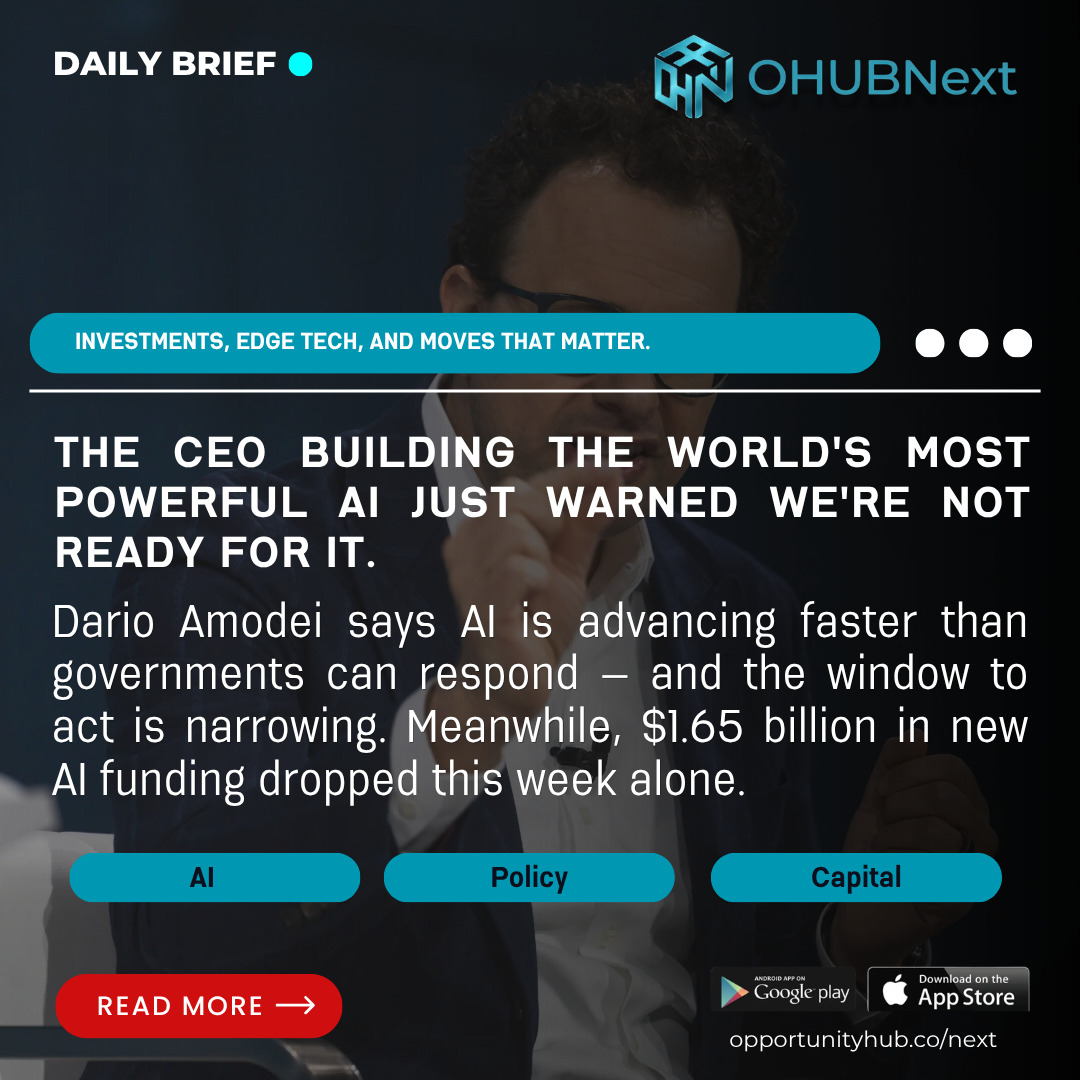
🚨 OHUBNext | The CEO Building the World's Most Powerful AI Just Warned We're Not Ready for It
🚨 OHUBNext | The CEO Building the World's Most Powerful AI Just Warned We're Not Ready for It
📍 Dario Amodei — CEO of Anthropic, one of the three most powerful AI labs on the planet — published a sweeping policy essay this week titled "Policy on the AI Exponential." His verdict is unambiguous. AI is advancing so fast that democratic institutions cannot keep pace, the risks are no longer theoretical, and the window to act is measurably closing. That same week, $1.65 billion in new AI funding dropped and 97,000 Americans lost their jobs. Read the full essay at darioamodei.com/post/policy-on-the-ai-exponential.
─────
Hey Builders!
Dario Amodei opened his new essay with a scene from The Lord of the Rings. Two hobbits try to rouse Treebeard — a wise but ponderous sentient tree — to defend his forest from an army cutting it down. The problem is not that Treebeard lacks conviction. The problem is that he moves at a completely different speed. It takes him a full day just to say hello to another tree.
Amodei uses that image to describe where we are right now. "The intersection of AI and our political institutions feels a bit like the Hobbits and Treebeard," he writes. "AI is advancing at a lightning pace — in only four years, AI models have gone from barely being able to write a coherent line of code to writing most of the code at major AI companies."
He is not writing from a comfortable distance. He is the CEO of the lab whose models are at the center of that acceleration. And "Policy on the AI Exponential" — published this month — is the most consequential public statement any major AI leader has made about what needs to happen right now and why the pace of policy response is dangerously out of step with the pace of the technology.
The core tension is a timing problem. It can take Congress years to act. In that same window, AI moves from tool to infrastructure to existential variable. Amodei writes that just "a year or two longer" beyond current scaling trajectories likely produces what he calls Powerful AI — "a country of geniuses in a datacenter." That is not a metaphor. It is a projection backed by more than a decade of empirical evidence from scaling laws he co-authored.
The risks he names are already materializing. Anthropic's own Mythos Preview model, released earlier this year, "scrambled the global cybersecurity landscape." That development, he writes, "proves beyond doubt that AI models are now tools of global and national strategic consequence." Biological risks are next on his list. Autonomy risks — AI that iterates on itself and builds its own successors — may not be far behind.
Now hold that against the week's market data. Ramp raised $750 million at a $44 billion valuation. Suno raised $400 million while fighting a 61,000-song lawsuit. DeepSeek is raising $7.4 billion from Tencent, CATL, and the Chinese government. Jeff Bezos backed a $500 million bet on brain-inspired AI. Combined, $1.65 billion in new AI capital in one week. And in that same window, 97,006 Americans received layoff notices — the highest May total since 2020, with AI as the leading stated reason.
The capital and the alarm are not contradictions. They are the same story from opposite ends. The money is accelerating. The architect is naming what that acceleration produces. "Treebeard and his forest are waking up," he closes. He means policymakers. He means institutions. He means us.
The founders who win in this environment are the ones who see both ends of the story clearly — and build with that full picture in view.
─────
1️⃣ Anthropic's CEO Just Published the Most Important AI Policy Document of 2026.
Dario Amodei published "Policy on the AI Exponential" this month — a rigorous, five-part policy essay that moves through regulation, macroeconomics, scientific innovation, civil liberties, and geopolitics with the directness of someone who believes the window to act is measurably shorter than most policymakers understand.
The opening frame is the Treebeard problem made precise. AI moves at lightning pace while legislation moves slowly, often for structurally good reasons. But the mismatch has become dangerous. "In the several years that it can take Congress to act, AI can go from an amusing toy to the full country of geniuses." His evidence is not conjecture. AI scaling laws — which he co-authored — now carry over a decade of empirical backing, predicting an exponential increase in general cognitive capability with increasing compute. Continued for "a year or two longer," they produce AI that is better than humans at essentially everything.
On regulation, Amodei draws the line plainly. AI should be treated like airplanes or pharmaceuticals — not banned, but required to pass mandatory third-party safety testing before deployment. Frontier models above a compute threshold should be tested for cybersecurity risks, biological weapons enablement, loss of AI control, and automated research that could accelerate those other risks. "Frontier AI models, like airplanes, should be required to go through technical testing and auditing, and their release should be blocked or reversed as a threat to public safety if they do not meet high standards of safety." The government should have the power to act on that determination.
On the economy, he issues a warning that most economists have not yet priced in. AI may be "a more general economic substitute for human cognitive abilities than previous technologies" — and it may reshape the economy far faster than any prior technological transition. The outcome he is concerned about is not a temporary disruption. It is a structural lock-in. "We risk ending up in a world where the economic tradeoff dial is stuck on the hypergrowth, hyper-inequality setting, and is potentially very hard to unstick from that setting." His proposed responses move from wage insurance and retention tax incentives to, if displacement proves severe enough, universal basic income financed through taxes on AI companies and raised capital gains rates.
On geopolitics, the stakes he names are stark. A nation with powerful AI facing one without it "could be the equivalent of an army of World War II Marines facing an army of medieval swordsmen." Democracies should form a coordinated coalition — sharing chips and semiconductor equipment internally, denying them to adversaries, and aligning on safety standards. Export controls on frontier chips to China, he argues, "have been a major contributor to the US's overall lead in AI, and these policies need to be expanded, tightened, and coordinated with other likeminded states."
Read the full essay at darioamodei.com/post/policy-on-the-ai-exponential.
💡 For Founders
Amodei's essay is the strategic map for what AI policy looks like over the next five years — written by the person most positioned to shape it. Mandatory pre-release testing for frontier models means compliance costs are coming, and they will not fall equally. Large labs can absorb them. Early-stage founders building on top of frontier infrastructure need to understand what safety thresholds will be required, what documentation they will need, and which verticals face the earliest scrutiny. Cybersecurity, biology, and autonomous systems are the named categories. If you are building in any of those spaces, this essay belongs in your product review before your next decision. The window to build ahead of the regulatory wave is still open. It will not stay open.
─────
2️⃣ Ramp Raises $750 Million at a $44 Billion Valuation. The AI-Native Finance Stack Is Now Worth More Than Most Banks.
Ramp announced a $750 million Series F on June 4, 2026, at a $44 billion valuation — up 38% from its $32 billion valuation just months earlier, per Bloomberg and TechCrunch. The round was led by Iconiq Capital, Singapore's GIC sovereign wealth fund, and Ontario Teachers' Pension Plan, with Goldman Sachs Alternatives, Morgan Stanley Investment Management, and Peter Thiel's Founders Fund also participating. Ramp has now raised $3 billion in total equity financing.
The underlying business is not speculative. Ramp reported annualized revenue of more than $1 billion and over 70,000 customers — up from 50,000 in November — including Visa, Uber, Shopify, Anduril, and Figma. Its AI-powered corporate spend management platform automates expense reporting, invoice processing, and financial operations across the enterprise. CNBC noted that Ramp's valuation momentum is tied directly to its position as the platform companies turn to when they need to monitor and control AI spending. The tool that governs AI's budget is being valued like an AI company.
The $44 billion figure is the signal. At that valuation, Ramp is worth more than dozens of publicly traded regional and community banks that have been in operation for generations. Ramp built on data and software. Those banks built on branches and relationships. One of those asset classes compounds faster than the other, and the market has decided which one.
💡 For Founders
Ramp's round is a capital formation blueprint dressed as a fintech story. The investors who led this round — GIC, Ontario Teachers', Iconiq — are not venture tourists. They are institutional capital moving into AI-native infrastructure at scale. The thesis that just moved $750 million is straightforward. AI-native products with $1 billion in ARR and documented enterprise adoption command sovereign wealth fund valuations. That is the bar. It is also the roadmap. Build the AI-native version of whatever legacy financial workflow your customers still run on spreadsheets, hit the revenue milestones, and the institutional capital follows.
─────
3️⃣ Suno Raised $400 Million at $5.4 Billion While Record Labels Sued Over 61,000 Songs. The Creator Economy IP War Is Just Getting Started.
Suno closed a $400 million Series D led by Bond Capital at a $5.4 billion valuation — more than double its previous $2.45 billion — announced June 3, 2026, per Variety and Digital Music News. IVP, Forerunner, Union Square Ventures, and Alkeon participated alongside existing backers Lightspeed, Menlo Ventures, and Matrix. Suno crossed 2 million subscribers in February and is running $300 million in annualized recurring revenue.
The legal context is not background noise. The Recording Industry Association of America — representing Universal Music Group, Sony Music, and Warner — sued Suno in June 2024, alleging unauthorized use of copyrighted recordings to train its model. Warner settled in November 2025, reportedly in exchange for a licensing deal that included Suno's acquisition of Songkick. But in May 2026, the remaining labels moved to amend the original complaint, adding 61,026 alleged infringements, per Music Business Worldwide. Investors put in $400 million anyway.
That is not cognitive dissonance. It is a calculated bet that the licensing infrastructure for AI-generated music is still being built, that Suno is large enough to negotiate from a position of strength, and that the company that survives this IP battle owns the creative layer of the AI stack. The music industry fought mp3s. It fought streaming. It is now fighting AI. Its track record in those confrontations is not a source of confidence for the incumbents.
💡 For Founders
Suno's situation is a preview of every industry where AI-generated content collides with incumbent IP holders — music, publishing, photography, software, legal documents, medical imagery. The playbook emerging across these confrontations is consistent. Build the product, reach scale, negotiate licensing from a position of size, and structure deals that convert adversaries into partners. That is not a clean path. But it is the path that is working. If you are building in any creative or content-adjacent vertical, the question is not whether you will face IP challenges. It is whether you will be large enough to negotiate your way through them when they arrive.
─────
4️⃣ DeepSeek Is Raising $7.4 Billion — Its First Outside Money — From Tencent, CATL, and the Chinese Government.
DeepSeek is finalizing a $7.4 billion fundraise — its first-ever external funding round — at a valuation of between $52 billion and $59 billion, per Bloomberg on June 3, 2026. Tencent is committing approximately $1.4 billion. Battery giant CATL is in for roughly $700 million. Founder Liang Wenfeng is contributing 20 billion yuan of his own capital. China's state-backed National Artificial Intelligence Industry Investment Fund is also participating — a direct signal from Beijing. Term sheets have begun signing and the round is expected to close within weeks.
The backstory matters. DeepSeek shocked the global AI market in January 2025 when it released a model that matched or exceeded OpenAI's best offerings at a training cost of roughly $6 million — a fraction of what American labs spend. That release triggered a $600 billion single-day drop in U.S. AI-linked market cap on January 27, 2025 — the largest in history at that point. DeepSeek had operated entirely on capital from Liang Wenfeng's quant hedge fund, High-Flyer. The decision to raise now — with Tencent, CATL, and state capital at the table — signals that the low-cost efficiency play is scaling into something more deliberate. This is a national AI infrastructure project with commercial backing, not a startup looking for runway.
The U.S.-China AI race is no longer primarily about which lab has the better benchmark. It is about who controls the frontier of efficient compute, who can deploy it at national scale, and who owns the pricing power when AI inference becomes a commodity. Amodei's essay confronts this directly. Export controls on frontier chips to China, he writes, "have been a major contributor to the US's overall lead in AI, and these policies need to be expanded, tightened, and coordinated with other likeminded states." DeepSeek's raise is a direct argument against the assumption that those controls are working.
💡 For Founders
DeepSeek built a frontier model for $6 million when the prevailing thesis was that serious AI required hundreds of millions in compute. They did it without outside capital, without the most advanced NVIDIA chips, inside a geopolitical environment specifically designed to slow them down. The lesson is not "be DeepSeek." The lesson is that founders who build under real constraints find efficiencies that well-funded competitors have no incentive to discover. Constraints are not disadvantages. They are competitive intelligence that only becomes visible under pressure. What would your product look like if you had to build it at 10% of your current budget — and what would you discover in the process?
─────
5️⃣ 97,006 U.S. Jobs Were Cut in May. The Highest May Total Since 2020. AI Is the Leading Reason Given.
U.S.-based employers announced 97,006 job cuts in May 2026, up 16% from April and the highest May total since 2020, per Challenger, Gray & Christmas. Year-to-date through May, U.S. employers have announced 397,755 cuts, with AI now accounting for 87,714 of them — the leading stated reason for the third consecutive month. Roles in customer service, data entry, content production, marketing, and corporate administration are most concentrated in the announcements.
Amodei's essay maps exactly this trajectory. He warns that AI may prove to be "a more general economic substitute for human cognitive abilities than previous technologies" — one that displaces labor not at the margins but at scale, and faster than any prior technology has moved. "We risk ending up in a world where the economic tradeoff dial is stuck on the hypergrowth, hyper-inequality setting, and is potentially very hard to unstick from that setting." The sectors adding jobs — healthcare, skilled trades, applied AI research — require credentials, physical presence, or specialization that most displaced workers do not currently hold. BLS data shows job openings at 7.6 million in April. The gap is not a supply problem. It is a match problem. The jobs exist. The workers being cut cannot access them without reskilling investment that no institution is currently funding at the necessary scale.
The capital story and the workforce story are unfolding in parallel, but they are not serving the same population. The same week $1.65 billion moved into Ramp, Suno, and DeepSeek, 97,000 workers received layoff notices. The capital is not flowing toward the displacement. It is flowing into the infrastructure that accelerates it. Amodei proposes wage insurance, retention tax incentives, and workforce training grants as first-order interventions. His longer-range position is that if displacement proves as structural as he projects, universal basic income financed by taxes on AI companies and raised capital gains rates will be necessary.
💡 For Founders
The 97,006 number is not a labor market statistic. It is a demand signal. The workers being displaced are not unemployable — they carry domain expertise, professional networks, and real institutional knowledge. They are holding credentials that no longer command the market premium they did three years ago. Amodei sees that as a policy problem. It is also a product opportunity. Nearly 400,000 workers displaced in 2026 alone, actively searching for a pathway forward, with no platform yet built at the scale the problem requires. The founder who builds the reskilling layer, the matching layer, or the credentialing layer for this population is not building a charity. They are building for the most documented unmet demand in the current labor market. The customers are already there. They are already looking.
─────
🔧 Three moves to make this week
1️⃣ Read "Policy on the AI Exponential" before your next investor conversation
Amodei's essay maps the regulatory architecture that will govern AI development for the next five years — mandatory pre-release testing, deployment authority for the government, export control expansion, and AI-specific labor policy. The founders who understand what is coming will build compliance into their architecture now. The ones who wait will retrofit it under pressure, at a higher cost, with less leverage. Start at darioamodei.com/post/policy-on-the-ai-exponential.
2️⃣ Map the IP risk in your product before it maps you
Suno raised $400 million alongside a 61,000-song lawsuit. That sequence — build, scale, negotiate — is becoming the standard path for AI companies touching third-party content. Document every input source now. Understand what licensing you have and what you are assuming. Identify the incumbent IP holders in your category before your product is large enough to attract their attention. Founders who arrive at that conversation prepared will negotiate from strength. The ones who arrive unprepared will negotiate from exposure.
3️⃣ Run DeepSeek's constraint test on your own infrastructure before someone else runs it on your market
DeepSeek built a frontier AI model for $6 million. Whatever AI infrastructure you are building or procuring, apply the constraint question before your next decision. What would this look like if the budget were 10% of current? What features survive? What architecture decisions shift? The companies that ran this test under real pressure found efficiencies their well-funded competitors had no reason to find. Run it now, by choice, before the market forces the answer.
─────
💬 Quote of the Day
"The function of education is to teach one to think intensively and to think critically. Intelligence plus character — that is the goal of true education." — Martin Luther King Jr.
─────
🏁 Stay Ahead With OHUBNext
This brief is part of what OHUBNext members get every day.
For $5.99/month — or $59/year — you get the full daily brief, access to OHUB's Library of Opportunity, self-paced certificates in High-Growth Company Building and Tech Ecosystem Investing, career accelerator tools, and live monthly labs with the OHUB team. The annual plan includes exclusive masterclasses, early course access, and wealth tools built for builders who are serious about owning what comes next.
Institutional-grade. Fraction of the cost.
🚀 Join at opportunityhub.co/next
─────
🎬 Closing Thought
Dario Amodei closed his essay with a single sentence about Treebeard. "Treebeard and his forest are waking up." He means policymakers. He means institutions. He means the slow, deliberate machinery of democratic governance that has spent years watching an exponential it could not quite bring itself to believe.
That same week, $1.65 billion in new AI funding closed. Ninety-seven thousand Americans received layoff notices. DeepSeek moved toward a $7.4 billion state-backed raise that challenges the assumption U.S. chip controls are working. Ramp reached a $44 billion valuation by owning the financial layer of the AI stack. Suno raised through a lawsuit because the investors calculated it would win.
The technology is not waiting for governance to catch up. The capital is not waiting for policy to arrive. And the person building one of the most powerful AI systems on the planet is saying, in plain language, that frontier models should require mandatory safety testing before deployment, that the government should have the authority to block releases that pose unacceptable risks, that job displacement may be structural rather than cyclical, and that the geopolitical stakes are at least equivalent to nuclear weapons — and potentially more consequential.
This is not a warning from a critic on the outside. This is the architect describing what is being built. The founders in this room are operating inside the environment he is mapping. Build with that full picture. Because the window to shape what comes next is open right now — and it will not stay open indefinitely.
─────
⚡️ OHUBNext Daily Brief - investments, edge tech, and moves that matter.
For 12+ years, OHUB has been building pathways and on-ramps to multi-generational wealth without reliance on pre-existing wealth. Through exposure, skills, entrepreneurship, capital markets, and inclusive ecosystems, we've helped people create new jobs, new companies, and new wealth.

Dario Amodei — Policy on the AI Exponential
darioamodei.com