


OHUB @ohub
🚨 OHUBNext | 3 Things to Run Through Claude Fable Before July 7
🚨 OHUBNext | 3 Things to Run Through Claude Fable Before July 7
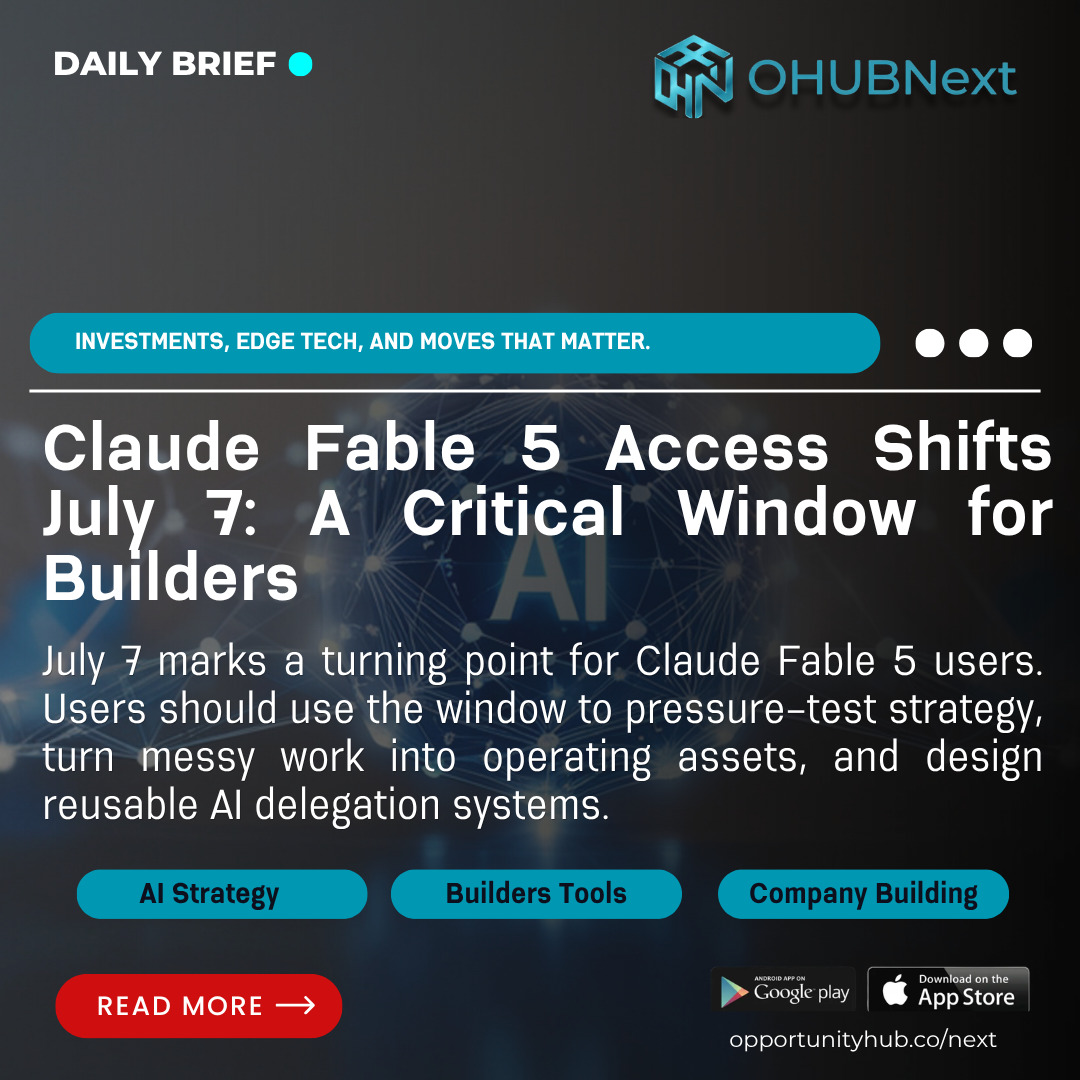
📍 Claude Fable 5 is included for eligible Pro, Max, Team, and select Enterprise users only through July 7 before shifting to usage credits. The move is a short-window opportunity for builders to turn a premium reasoning model into durable strategy, operating, and delegation assets before the meter changes.
─────
Hey Builders!
This is not a post about chasing the newest model.
It is about using a temporary access window with discipline. Anthropic says Fable 5 is available globally on the Claude Platform, Claude.ai, Claude Code, and Claude Cowork. For Pro, Max, Team, and select Enterprise plans, the model is included for up to 50 percent of weekly usage limits through July 7. After that, continued use moves to usage credits.
That makes today a practical business moment. If you have access, the question is not whether Fable is impressive. The question is what high-value work you should put through it before the pricing structure changes.
The wrong move is to burn the window on generic questions, novelty prompts, or another round of "what can this model do?" The right move is to give it the problems that usually take hours of judgment, synthesis, and revision. Strategy that needs pressure. Documents that need structure. Workflows that need delegation logic. Decisions that need a second brain willing to challenge the premise.
Anthropic's redeployment note also matters because Fable's return comes with safeguards. The company says some benign coding and debugging requests may be flagged more often, and blocked Fable requests can be routed to Opus 4.8. Builders should read that as an operating reality, not a complaint. Powerful models are moving into a world where access, capacity, policy, safety, and cost are all part of the product.
So use the window like a founder. Do not ask Fable to impress you. Ask it to produce assets you can still use after July 7.
─────
1️⃣ Pressure-Test the Business Before the Meter Changes
The highest-value first use is strategic pressure. Give Fable the business model, offer, customer segment, pricing logic, partnership pitch, investor narrative, or go-to-market plan you have been carrying in your head and ask it to find the weak points.
This is where stronger reasoning matters. A weaker assistant may polish the language and agree with the direction. A better reasoning model should interrogate the assumptions, name missing evidence, separate customer pain from founder belief, and show where the strategy breaks under real market pressure.
Sample problem to run today:
"I am building [company/product] for [customer]. The problem is [problem], the current alternative is [alternative], and the offer is [offer]. Act like a skeptical investor and operating executive. Identify the five assumptions most likely to fail, the evidence I need to validate each one, and the fastest test I can run in seven days."
Sample problem to run if you are raising:
"Here is my current investor narrative. Rewrite it into a sharper seed-stage fundraising argument, then critique it like a partner who wants to pass. Separate market risk, product risk, distribution risk, team risk, and capital risk. End with the three questions I must be ready to answer in diligence."
Sample problem to run if you sell services:
"Here is my service offer, target buyer, pricing, and sales process. Diagnose why a buyer would hesitate. Rebuild the offer into a clearer outcome, a tighter scope, a stronger proof point, and a price ladder that protects margin."
💡 For Founders
Use Fable on judgment-heavy work first. The goal is not a cleaner paragraph. The goal is a better decision, a stronger test, and a clearer view of what your customer or investor will challenge.
─────
2️⃣ Turn Messy Work Into Operating Assets
The second move is to feed Fable the messy material that is slowing your company down. Meeting notes, voice memos, emails, sales objections, customer calls, curriculum outlines, hiring notes, product feedback, grant language, board updates, and half-built SOPs all have hidden structure inside them.
This is where many builders waste time. They keep asking AI for new ideas while ignoring the raw material already sitting in their inbox, notes app, and shared drives. Fable's value is higher when it has context and a concrete output to produce.
Sample problem to run from scattered notes:
"Turn these rough notes into a one-page operating memo. Extract the decision, the context, the options, the risks, the owner, the deadline, and the next three actions. If any information is missing, list the exact questions I need to answer before sending it to my team."
Sample problem to run from customer feedback:
"Here are ten pieces of customer feedback. Group them by underlying job-to-be-done, urgency, willingness to pay, and product implication. Tell me what to build next, what to ignore, and what to ask in the next customer interview."
Sample problem to run from a recurring task:
"Convert this recurring task into an SOP a new teammate could follow. Include the trigger, required inputs, step-by-step process, quality bar, common failure points, escalation rules, and a final checklist."
💡 For Founders
Do not use the temporary window only to think. Use it to operationalize. Every founder should leave July 7 with at least one memo, one SOP, one customer-insight brief, or one decision framework that makes the company easier to run.
─────
3️⃣ Build Your AI Delegation Stack Before Access Gets More Expensive
The third move is to design the repeatable system you will keep using after Fable shifts to credits. If a premium model helps you produce a better prompt, workflow, rubric, or agent instruction set, that asset can keep paying off with cheaper models or later paid usage.
This is the founder leverage point. Most teams are still treating AI like a chat box. The better teams are building delegation systems. They define the task, the context, the output format, the quality bar, the failure modes, and the review process.
Sample problem to run for prompt architecture:
"Design a reusable prompt system for [workflow]. Include the role, context fields, required inputs, output structure, quality criteria, self-check steps, and examples of strong and weak outputs. Make it usable by a teammate who is not technical."
Sample problem to run for an agent workflow:
"Map this workflow into an AI-assisted operating process. Identify which steps should be automated, which require human judgment, what data the AI needs, where errors are most likely, and what approval gates should stay with a person."
Sample problem to run for quality control:
"Create an evaluation rubric for this recurring output. Define excellent, acceptable, and unacceptable work. Include scoring criteria, red flags, revision instructions, and a final pass checklist."
💡 For Founders
The asset is not only the answer Fable gives you today. The asset is the delegation pattern you can reuse tomorrow. Before July 7, use the model to build the operating language your team will use with AI all year.
─────
🔧 Three moves to make this week
1️⃣ Pick one expensive problem
Choose one problem that normally costs you time, money, or executive attention. Do not start with low-value prompts. Start with the work you would pay a strategist, operator, analyst, or senior writer to help you solve.
2️⃣ Give the model real context
Paste the messy inputs. Include the buyer, constraints, numbers, objections, deadlines, and what you have already tried. Premium reasoning performs better when it has the raw material needed to make tradeoffs.
3️⃣ Save the reusable asset
Do not leave the output trapped in a chat. Turn it into a memo, SOP, rubric, sales asset, investor-prep document, or internal prompt template. The point is to keep the value after the access window changes.
─────
💬 Quote of the Day
"After July 7, your team can continue using Fable 5 by enabling usage credits." — Anthropic, Redeploying Fable 5
─────
🏁 Stay Ahead With OHUBNext
This brief is part of what OHUBNext members get every day.
For $5.99/month — or $59/year — you get the full daily brief, access to OHUB's Library of Opportunity, self-paced certificates in High-Growth Company Building and Tech Ecosystem Investing, career accelerator tools, and live monthly labs with the OHUB team. The annual plan includes exclusive masterclasses, early course access, and wealth tools built for builders who are serious about owning what comes next.
Institutional-grade. Fraction of the cost.
🚀 Join at opportunityhub.co/next
─────
🎬 Closing Thought
The July 7 change is bigger than one product setting.
It is a reminder that advanced AI access will increasingly be shaped by capacity, credits, safeguards, enterprise policy, and usage economics. Builders should expect that pattern. The best models will not always be sitting inside a flat subscription at the exact moment you need them.
That means the winning habit is not model tourism. It is disciplined extraction. When a powerful model is available, use it to clarify the strategy, codify the work, and build the delegation systems that compound after the session ends.
Use the window. Save the asset. Own the workflow.
─────
⚡️ OHUBNext Daily Brief - investments, edge tech, and moves that matter.
For 12+ years, OHUB has been building pathways and on-ramps to multi-generational wealth without reliance on pre-existing wealth. Through exposure, skills, entrepreneurship, capital markets, and inclusive ecosystems, we've helped people create new jobs, new companies, and new wealth.

OHUBNext
One simple plan. $5.99/month or billed annually.
opportunityhub.co