


OHUB @ohub
🚨 OHUBNext | 100 Autonomous Vehicles Move Physical AI From Demo to Deployment
🚨 OHUBNext | 100 Autonomous Vehicles Move Physical AI From Demo to Deployment
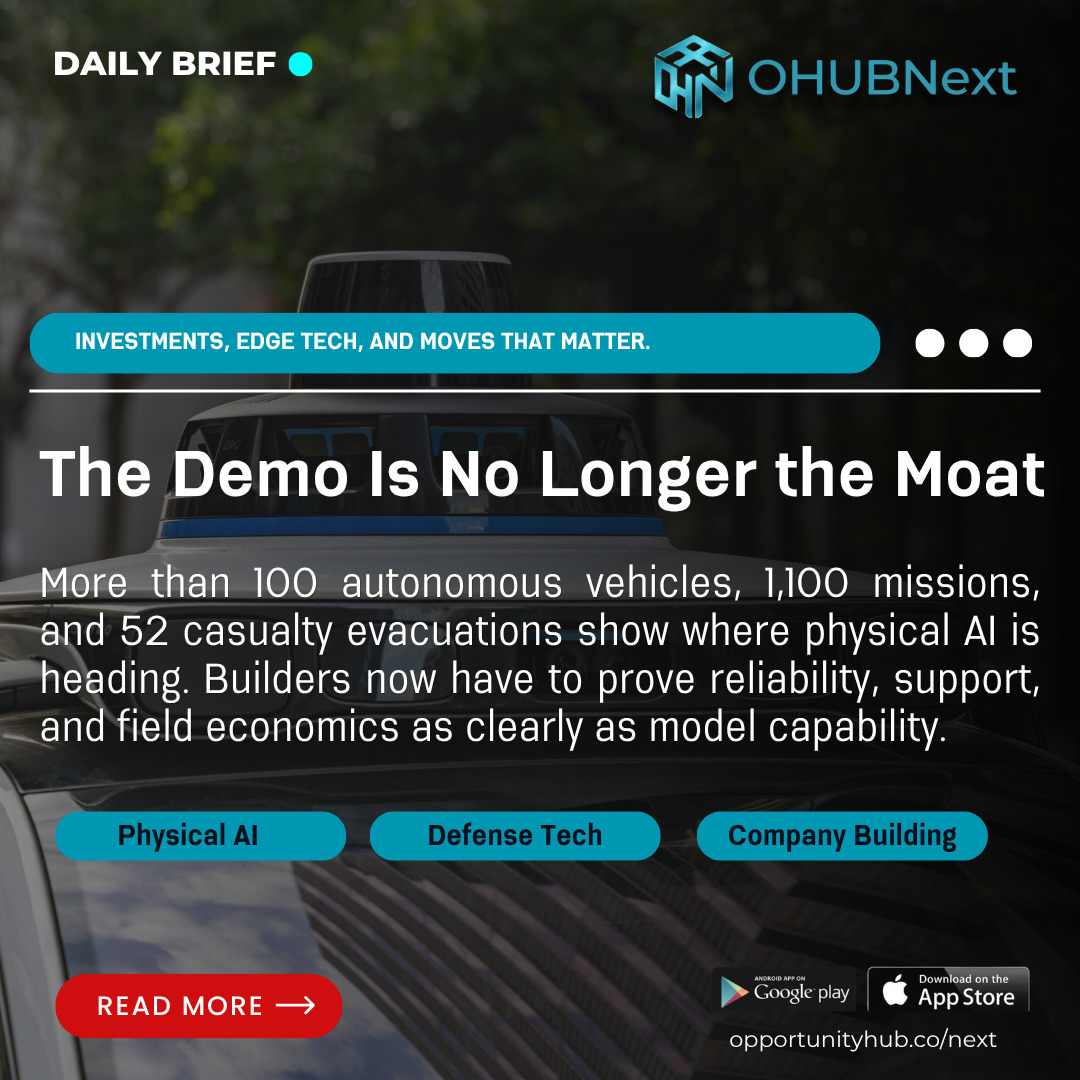
📍 Forterra disclosed that more than 100 self-driving Lancer vehicles have been deployed in Ukraine for the past nine months, completing more than 1,100 missions, driving more than 2,500 miles, carrying 777,440 pounds of weight, and supporting 52 casualty evacuations. The signal for builders is bigger than defense. Physical AI is entering a harsher market test, where autonomy has to survive mud, jamming, procurement, maintenance, and real users who cannot afford theater.
─────
Hey Builders!
The most important AI story today is not another chatbot, model benchmark, or app-layer launch.
It is a ground vehicle moving supplies and wounded soldiers through contested terrain. Forterra, a Maryland-based autonomous-mission-systems company, has put more than 100 Lancer vehicles into Ukraine, according to TechCrunch reporting published today. The vehicles have been used across more than 1,100 missions since last October, and the data now looks less like a pilot and more like an operating record.
That matters because physical AI has a different burden of proof. Software can be iterated in production with graceful failure. Battlefield autonomy cannot. The system has to move weight, survive terrain, connect through degraded communications, update remotely, and stay useful under pressure from drones, artillery, electronic warfare, and exhausted operators.
Forterra’s own contract language points to the same shift. In June, the company and Oshkosh Defense announced a U.S. Marine Corps ROGUE-Fires Block 2 production award totaling $92 million, describing it as the U.S. military’s first large-scale production contract for ground vehicle autonomy. Forterra Vice President of Defense Pat Acox said the current fight demands systems that “increase force effectiveness, extend operational reach, and preserve combat power.”
This is the investor and operator signal. Physical AI is moving from model capability into deployment capability. The scarce asset is not only better perception or better planning. It is the full stack around the machine. Hardware, edge compute, comms, production, field support, procurement trust, data feedback, and mission fit are all part of the product.
For founders outside defense, the lesson still travels. Robotics, logistics, construction, manufacturing, field service, energy, agriculture, and health care all face the same transition. The demo is no longer the moat. The operating environment is.
─────
1️⃣ 100 Vehicles Put Ground Autonomy Into a Real Deployment Record
Forterra’s Lancer deployment in Ukraine gives the market a rare operating snapshot for autonomous ground systems. TechCrunch reported that more than 100 vehicles have been deployed in conflict zones for nine months, in what the company believes is the largest combat deployment of autonomous ground vehicles by a U.S. defense technology company.
The mission numbers are material. The vehicles have driven more than 2,500 miles across more than 1,100 missions, carried 777,440 pounds of total weight, and completed 52 casualty evacuations. Those figures turn autonomy from a technical claim into a logistics, reliability, and utilization story.
The Lancer vehicles are based on Polaris ATVs and equipped with a custom sensor and compute stack. TechCrunch reported that they can carry 750 kilograms of cargo, compared with the 250-kilogram carrying capacity typical of some Ukrainian battery-powered UGVs cited by a Ukrainian soldier in the article.
💡 For Founders
If you build physical AI, lead with operating proof. Customers and investors need to know what the system carried, how long it ran, where it failed, how often humans intervened, and what economics changed after deployment.
─────
2️⃣ $92 Million Shows Procurement Is Moving Beyond Experimentation
Forterra’s Ukraine experience sits next to a formal U.S. procurement signal. On June 1, Forterra and prime contractor Oshkosh Defense announced the U.S. Marine Corps ROGUE-Fires Block 2 production award, consisting of two delivery orders totaling $92 million.
Forterra said the award is the U.S. military’s first large-scale production contract for ground vehicle autonomy. The company has been integrating its AutoDrive platform onto the Oshkosh Family of Carriers since winning the initial ROGUE-Fires contract in 2022, and said AutoDrive became the first system fielded by the U.S. military to enable autonomous maneuver of ground vehicles.
The production timeline matters. Forterra and Oshkosh said they will deliver vehicles under the contract through 2031. That is not a hackathon cycle. It is a multi-year industrialization cycle that rewards reliability, supply-chain discipline, software maintainability, and the ability to work inside government acquisition systems.
💡 For Founders
Treat procurement as part of product strategy. If your buyer is government, infrastructure, health care, industrial, or enterprise, the winning product is not only what works in a controlled demo. It is what can be bought, supported, audited, and improved over years.
─────
3️⃣ 25,000 Ground Robots Make Ukraine the Fastest Feedback Loop
Ukraine is not treating ground robots as side experiments. Defense News reported in April that Ukraine planned to contract 25,000 unmanned ground vehicles in the first half of 2026, more than double its 2025 total, as the Defense Ministry works to move frontline logistics from soldiers to robotic systems.
That target gives the Forterra deployment a larger context. Ukraine’s defense ecosystem is using wartime demand to compress the distance between prototype, field use, user feedback, and procurement. Defense News also reported that Ukraine had around 300 ground-drone companies in the Brave1 ecosystem, up from zero in 2022.
For builders, this is what a brutal feedback loop looks like. The product either helps operators move supplies, evacuate wounded soldiers, lay equipment, cross terrain, and stay alive, or it becomes another costly object on the field. That kind of market does not reward slideware.
💡 For Founders
Find the customer environment that tells the truth fastest. The right test is not always the biggest pilot. It is the test where the user’s constraints are real enough to expose what your roadmap is avoiding.
─────
4️⃣ $1.2 Billion for Quantum Systems Shows Autonomy Capital Is Globalizing
The capital stack around autonomous defense systems is widening beyond the United States. The Wall Street Journal reported that German drone maker Quantum Systems raised $1.2 billion at a valuation of roughly $8 billion, with Airbus, Blackstone, Advent, and Noteus Partners co-leading the round.
The stated use of proceeds matters. Quantum Systems said the capital will help expand drone production and support software investments for AI-powered autonomous systems. That connects capital formation directly to production capacity, software depth, and allied defense demand.
This is no longer a narrow venture category. Defense autonomy is becoming a sovereign industrial-policy market, a late-stage private-capital market, and a procurement modernization market at the same time. The buyers want capability. The investors want scale. The companies have to prove they can manufacture and support systems under geopolitical pressure.
💡 For Founders
If you operate in dual-use technology, know which capital story you are telling. Venture dollars may fund speed, but strategic buyers, industrial partners, and government customers will judge whether the company can scale production and survive policy risk.
─────
5️⃣ $100 Million for Dominion Shows Sovereignty Is Becoming a Startup Thesis
Axios reported last week that Ottawa-based Dominion Dynamics raised a $100 million Series A led by Georgian, with participation from Valor Equity Partners, Lakestar, JDY Capital, Bessemer Venture Partners, and Silent Ventures. Dominion says the round is the largest in Canadian defense history.
The company is building AuraNet, a command-and-control suite, and Scout, a robotic wingman system. Axios also reported that Dominion moved into a 25,000-square-foot manufacturing facility in June and had raised $119 million since launching last year.
The larger signal is that allied autonomy markets are being shaped by sovereignty, not only efficiency. Canada, Europe, Ukraine, and the United States are all asking a version of the same question. Who can build the intelligent systems, industrial base, and operational software needed when old security assumptions no longer feel durable?
💡 For Founders
Sovereignty is becoming a buyer requirement in more markets than defense. If your product touches critical infrastructure, data, compute, logistics, or public-sector workflows, be ready to explain where it is built, who controls it, and how resilient it is under stress.
─────
🔧 Three moves to make this week
1️⃣ Replace demo metrics with field metrics
Audit your current proof points. If they only describe features, pilots, or model capability, add evidence about uptime, recovery, human intervention, deployment cost, support burden, and customer behavior under real constraints.
2️⃣ Map the full operating stack
Write down every dependency that has to work for your product to deliver value. Include hardware, software, data, integrations, communications, procurement, compliance, maintenance, training, and support. The weak link is part of the product.
3️⃣ Build for the buyer’s risk model
Enterprise, government, and industrial buyers do not only ask whether the technology works. They ask what happens when it fails, who fixes it, where the data goes, how it is governed, and whether the vendor will still be around in year three.
─────
💬 Quote of the Day
“Increase force effectiveness, extend operational reach, and preserve combat power.” — Pat Acox, Vice President of Defense, Forterra
─────
🏁 Stay Ahead With OHUBNext
This brief is part of what OHUBNext members get every day.
For $5.99/month — or $59/year — you get the full daily brief, access to OHUB's Library of Opportunity, self-paced certificates in High-Growth Company Building and Tech Ecosystem Investing, career accelerator tools, and live monthly labs with the OHUB team. The annual plan includes exclusive masterclasses, early course access, and wealth tools built for builders who are serious about owning what comes next.
Institutional-grade. Fraction of the cost.
🚀 Join at opportunityhub.co/next
─────
🎬 Closing Thought
The next phase of AI will be judged outside the browser.
That does not mean software stops mattering. It means software has to prove itself through systems that touch roads, fields, factories, ports, clinics, substations, warehouses, and, in the harshest cases, battlefields. Physical AI raises the standard because the world does not reset when the model gets confused.
Forterra’s Ukraine deployment is a defense story, but the founder lesson is broader. The companies that win this cycle will not be the ones with the cleanest demos. They will be the ones that can turn intelligence into dependable operations under messy, expensive, high-stakes conditions.
Build for the field. The market is heading there.
─────
⚡️ OHUBNext Daily Brief - investments, edge tech, and moves that matter.
For 12+ years, OHUB has been building pathways and on-ramps to multi-generational wealth without reliance on pre-existing wealth. Through exposure, skills, entrepreneurship, capital markets, and inclusive ecosystems, we've helped people create new jobs, new companies, and new wealth.

OHUBNext
One simple plan. $5.99/month or billed annually.
opportunityhub.co