


OHUB @ohub
🚨 OHUBNext | $1 Billion Reprices the Inference Layer of Enterprise AI
🚨 OHUBNext | $1 Billion Reprices the Inference Layer of Enterprise AI
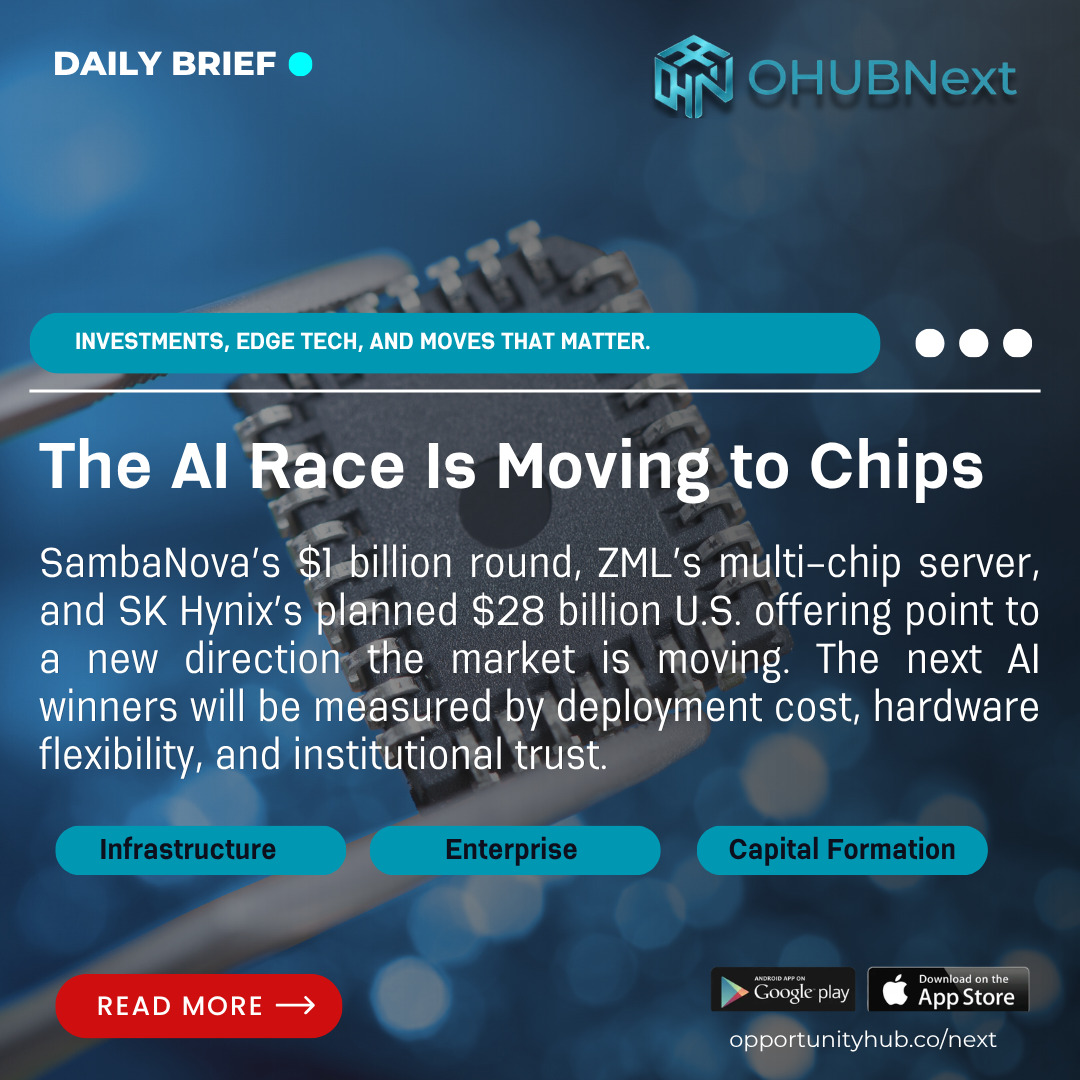
📍 SambaNova completed the first close of a $1 billion Series F at an $11 billion post-money valuation, led by General Atlantic, on July 8. The round puts a hard number on the shift from training models to running them cheaply, privately, and reliably inside enterprise workflows. Today’s brief shows why inference, not the next chatbot demo, is where capital, chip strategy, labor demand, and regulated work are converging.
─────
Hey Builders!
The AI market is moving from spectacle to operating cost. For the past three years, the headline question was who could train the largest model. This week’s better question is who can run the model at scale, at lower cost, with hardware flexibility, regulatory comfort, and enterprise uptime.
SambaNova’s $1 billion financing is the cleanest signal. The company is not selling another application layer. It is selling a vertically integrated inference stack built around its reconfigurable dataflow units, or RDUs, at a moment when enterprises want AI systems that can run close to their data and outside the public cloud default. JPMorganChase is the release’s named enterprise proof point.
Rodrigo Liang, SambaNova’s co-founder and CEO, framed the market directly. “SambaNova’s $11 billion valuation highlights the central role that fast inference now plays in the enterprise AI stack,” he said in the company announcement. That line matters because valuation is no longer just following model scale. It is following deployment economics.
The rest of today’s tape tells the same story from different angles. ZML, a Paris startup, released a universal LLM server that runs across Nvidia CUDA, AMD ROCm, Google TPU, Intel oneAPI, and Apple Metal. SK Hynix is preparing a $28 billion U.S. stock offering as memory-chip demand becomes the financial plumbing of AI. Norm Ai raised $120 million at a $1.2 billion valuation by wrapping legal work in supervised AI agents. Crunchbase reports that North American venture funding hit $392 billion in the first half of 2026, with huge AI rounds driving record totals while deal count stayed below prior highs.
This is not a broad boom. It is a concentrated repricing of the infrastructure and workflow layers that make AI usable in production. The builders who understand that distinction will make sharper decisions about where to raise, where to hire, and where to sell.
─────
1️⃣ SambaNova raises $1 billion at an $11 billion valuation as inference becomes the enterprise AI bottleneck
SambaNova announced on July 8 that it completed the first close of $1 billion in strategic financing as part of its Series F, valuing the company at $11 billion post money. General Atlantic led the round, with significant investment from Seligman Ventures, T. Rowe Price Associates, and Capital Group. New and existing investors also include funds and accounts managed by BlackRock, Intel Capital, Qatar Investment Authority, Vista Equity Partners, Battery Ventures, and others.
The company said JPMorganChase is the latest customer to select SambaNova RDUs for fast, on-prem AI inference. That detail is the commercial signal. Financial institutions do not simply need model access. They need control over latency, data boundaries, auditability, and cost per token when AI moves from pilots into core operating workflows.
SambaNova said it will use the proceeds to expand capacity, accelerate product innovation, and scale deployments for enterprises, neo-clouds, sovereign AI customers, and service providers. Earlier this year, it unveiled its SN50 chip and announced a $350 million-plus raise alongside a strategic collaboration with Intel.
💡 For Founders
If your AI product depends on third-party inference pricing, treat that dependency like gross margin exposure. Build a clear view of cost per task, latency requirements, and data residency before customers ask for it. Enterprise buyers will increasingly evaluate AI vendors by deployment economics, not demo quality.
─────
2️⃣ ZML releases a universal LLM server as chip choice becomes a software problem
ZML released ZML/LLMD, a self-contained inference server for LLaMa, Gemma, Qwen, and Mistral models that runs across Nvidia CUDA, AMD ROCm, Google TPU, Intel oneAPI, and Apple Metal. The company says LLMD supports five accelerator targets, includes modern serving primitives such as continuous batching, paged attention, tensor parallel sharding, prefix caching, tool calling, and Prometheus metrics, and ships a 1.7 GB CUDA image.
The product matters because it attacks one of the biggest hidden costs in AI deployment. Hardware diversity is useful only if the software stack can move across chips without forcing teams to rewrite serving infrastructure. ZML’s broader positioning is explicit. The company says its production inference stack is designed to decouple AI workloads from proprietary hardware.
TechCrunch reported that ZML’s founder, Steeve Morin, sees the software as a way to help enterprises and clouds use a mix of chips, including lower-cost or lower-energy options. The point is not that Nvidia’s lead disappears. The point is that the market now has real demand for software that makes non-Nvidia capacity usable.
💡 For Founders
Do not build your AI roadmap around a single accelerator assumption. Even if you rent rather than buy compute, ask your providers which workloads can move across Nvidia, AMD, TPU, Intel, and Apple targets. Portability is becoming a procurement advantage.
─────
3️⃣ SK Hynix prepares a $28 billion U.S. stock offering as memory becomes AI’s public-market test
Axios reported on July 8 that SK Hynix plans to sell $28 billion in stock in the U.S. later this week through American depositary receipts. The offering is expected to price Thursday night before U.S. trading begins Friday. Each ADR will represent one-tenth of a common share, and Bloomberg reported that the allocation process is drawing heavy investor demand.
The market signal is larger than one listing. Axios notes that SK Hynix, Samsung Electronics, Micron Technology, and Kioxia have seen valuations surge with AI-related demand for memory. SK Hynix’s stock is up more than 700% over the last year in Korean currency terms, and its dollar market value is above $1 trillion.
Memory has become one of the cleanest public-market proxies for AI demand because inference and training workloads both need enormous throughput. If investors absorb a $28 billion offering after a sharp run-up and amid chip volatility, it will show that the AI infrastructure bid remains deeper than day-to-day semiconductor selloffs.
💡 For Founders
Watch memory markets as closely as model releases. GPU access gets the headlines, but high-bandwidth memory supply, pricing, and public-market appetite shape the real cost curve underneath AI products. If your business plan assumes falling inference costs, track the components that make those costs fall.
─────
4️⃣ Norm Ai raises $120 million at a $1.2 billion valuation by turning regulated work into supervised AI
Norm Ai announced a $120 million Series C at a $1.2 billion valuation on July 7, led by Khosla Ventures. Blackstone, Bain Capital Ventures, Craft Ventures, Coatue, Vanguard, New York Life, TIAA, Tony James, Jeff Hammes, and Fenwick LLP also participated. The company says it has raised more than $260 million since being founded less than three years ago.
Norm’s model is not generic legal search. The company brings AI engineers and attorneys together to build legal AI agents for high-stakes work. Its affiliated AI-native law firm, Norm Law, uses those agents as outside counsel with senior attorneys supervising, calibrating, and improving the systems. Norm says clients representing more than $30 trillion in assets under management use its technology.
The pricing model is the deeper disruption. Norm says Norm Law prices based on outcomes rather than hours, shifting the economic logic away from both token usage and traditional law-firm billing. That is the template investors are rewarding. AI becomes valuable when it can be paired with domain authority, institutional trust, and a commercial model buyers understand.
💡 For Founders
The next wave of vertical AI will not be won by wrappers alone. Pick a regulated workflow, bring credentialed oversight into the product, and price around the outcome the buyer already budgets for. Trust is now part of the technology stack.
─────
5️⃣ $392 billion in North American venture funding shows AI capital is concentrated, not evenly distributed
Crunchbase reported on July 7 that U.S. and Canadian startups raised $392 billion in the first half of 2026, a record level driven by late-stage AI megarounds. Q2 investment totaled $137.2 billion, second only to Q1, while deal count remained below prior high marks.
The composition matters more than the total. Crunchbase reported that Q2 late-stage and technology growth funding reached about $101 billion, the second-highest total of all time. Early-stage funding rose to just over $31 billion, nearly double year-ago levels and up about 15% from Q1, even as early-stage deal count hit the lowest point in five quarters.
This is a capital concentration story. The market is writing enormous checks to companies that look like category infrastructure, frontier platforms, or vertical systems with a path to institutional demand. Everyone else is competing in a tighter funnel.
💡 For Founders
Fundraising decks need sharper proof of why your company belongs in the concentrated capital lane. Show a specific wedge, a measurable deployment advantage, and a path to durable gross margin. In this market, “AI-enabled” is not a category. It is table stakes.
─────
🔧 Three moves to make this week
1️⃣ Audit inference economics
Calculate the real cost per customer action, not the average cost per token. Include model calls, retries, latency penalties, context windows, hosting, observability, compliance review, and human escalation. The companies raising the biggest rounds are selling relief from those costs.
2️⃣ Build a hardware-portability answer
Ask your engineering team what would break if your preferred GPU supply tightened or your cloud provider repriced inference. You do not need to run everywhere tomorrow, but you do need to know which workloads can move and which ones are locked in.
3️⃣ Turn trust into product scope
Norm’s round shows that regulated AI buyers want supervision, accountability, and outcomes. Add the review loops, audit trails, and human escalation paths that make your product easier to approve inside large institutions.
─────
💬 Quote of the Day
“SambaNova’s $11 billion valuation highlights the central role that fast inference now plays in the enterprise AI stack.” — Rodrigo Liang, co-founder and CEO, SambaNova
─────
🏁 Stay Ahead With OHUBNext
This brief is part of what OHUBNext members get every day.
For $5.99/month — or $59/year — you get the full daily brief, access to OHUB's Library of Opportunity, self-paced certificates in High-Growth Company Building and Tech Ecosystem Investing, career accelerator tools, and live monthly labs with the OHUB team. The annual plan includes exclusive masterclasses, early course access, and wealth tools built for builders who are serious about owning what comes next.
Institutional-grade. Fraction of the cost.
🚀 Join at opportunityhub.co/next
─────
🎬 Closing Thought
SambaNova’s round is a reminder that the AI economy is becoming less abstract. It is no longer just research labs, benchmark charts, and dramatic model releases. It is chips, memory, servers, procurement committees, legal supervision, and line-item operating costs.
That makes the opportunity more concrete. The market needs cheaper inference, more flexible hardware, trusted vertical workflows, and talent that can turn technical capability into institutional deployment. Those are buildable businesses.
It also makes the labor challenge sharper. Challenger, Gray & Christmas reported that AI led all stated reasons for job cuts in June, with 14,029 announced cuts, and has been cited in 101,743 job cut announcements so far this year. The same transition that creates new infrastructure demand is forcing companies to restructure around fewer, more leveraged roles.
Builders should not read today’s market as a generic AI boom. Read it as a narrowing. Capital is moving toward the parts of the stack that reduce cost, increase trust, and make AI operational at scale. Build there, sell there, and train people for the jobs that sit closest to deployment.
─────
⚡️ OHUBNext Daily Brief - investments, edge tech, and moves that matter.
For 12+ years, OHUB has been building pathways and on-ramps to multi-generational wealth without reliance on pre-existing wealth. Through exposure, skills, entrepreneurship, capital markets, and inclusive ecosystems, we've helped people create new jobs, new companies, and new wealth.

OHUBNext
One simple plan. $5.99/month or billed annually.
opportunityhub.co