


OHUB @ohub
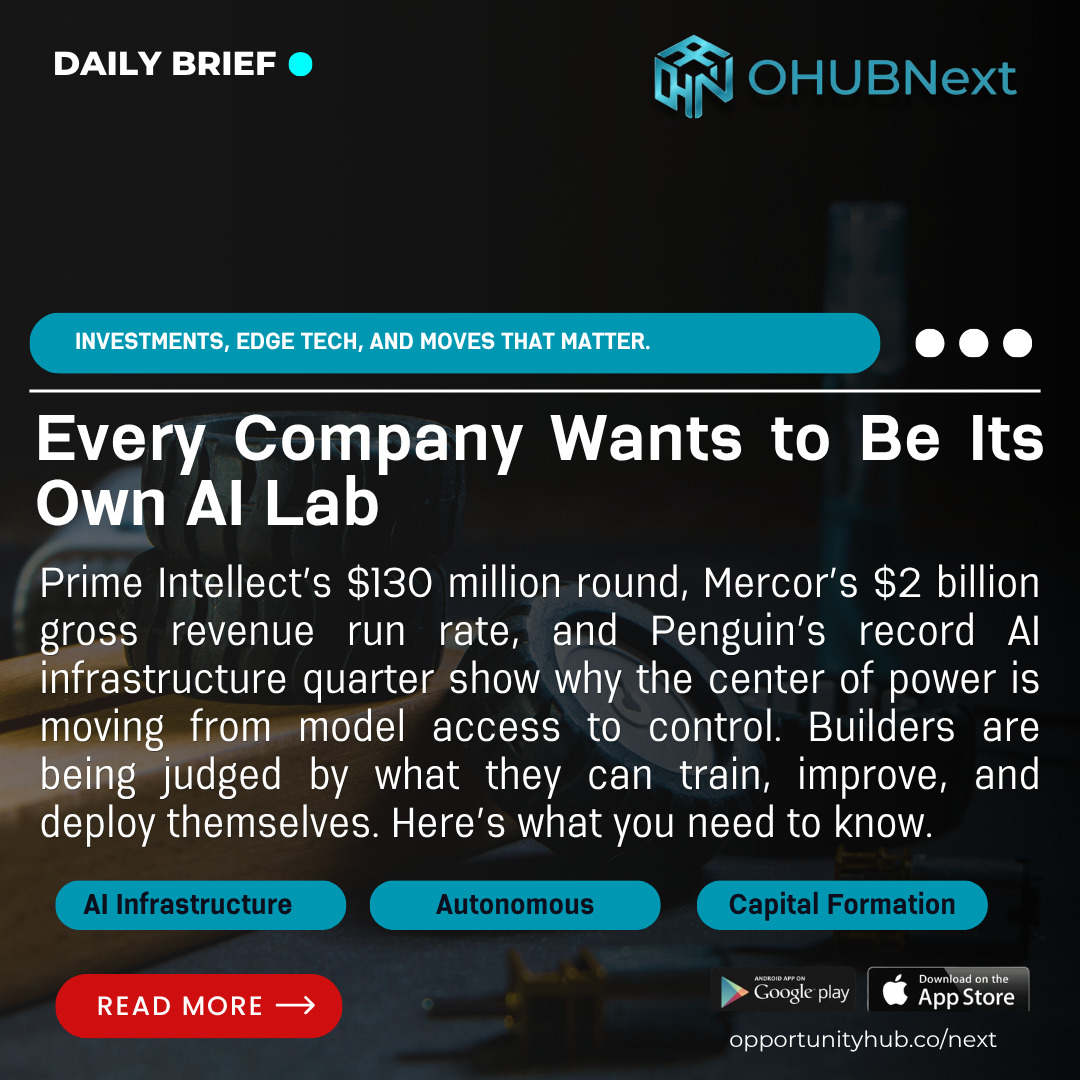
🚨 OHUBNext | $130 Million Turns Enterprise AI Into an Ownership Race
🚨 OHUBNext | $130 Million Turns Enterprise AI Into an Ownership Race
📍 Prime Intellect raised a $130 million Series A led by Radical Ventures, with NVIDIA Ventures, Intel Capital, Dell Technologies Capital, and existing investors participating. The round is not just another agent-infrastructure deal. It is a signal that companies want to own the systems, data loops, and deployment economics behind their AI instead of renting intelligence from a small set of frontier labs.
─────
Hey Builders!
The AI market is entering its ownership phase.
For the last two years, the central question was which model could reason better, code faster, or talk more naturally. This week’s better question is who controls the loop after the model enters the business. The loop includes compute, reinforcement learning, evaluation, proprietary data, workflow-specific agents, production inference, regulatory trust, and the operating team responsible when the system fails.
Prime Intellect put a fresh number on that shift. The company says it has raised $130 million and now serves more than 6,000 customers across compute, reinforcement learning, post-training, sandboxes, inference, environments, and evaluations. It also says demand has scaled to more than $100 million in annualized revenue in under a year. That matters because the company is selling a path for enterprises and AI startups to train and improve agents on their own workflows, not just consume a closed model through an API.
The same operating thesis shows up across the rest of today’s tape. Mercor crossed $2 billion in gross annualized revenue as AI labs and enterprise customers buy access to expert human judgment. Penguin Solutions delivered record quarterly net sales of $479 million as memory and AI infrastructure demand moved through public-market financials. Paradigm raised a $1.2 billion fund and explicitly widened its frontier from crypto into AI, robotics, autonomous drone delivery, rapid manufacturing, and space defense. Manna Aero is moving capital and manufacturing toward the United States while NHTSA is warning automated-vehicle developers that safety around first responders is now a trust requirement, not a feature request.
The connective tissue is simple. AI is no longer judged only by model quality. It is being judged by ownership, margin, safety, infrastructure, deployment speed, and whether the system can survive contact with real customers.
For builders, that changes the work. It is no longer enough to say which model powers the product. You need to know what your team can improve, what data you can own, what infrastructure you depend on, what regulation can stop you, and what customer evidence proves the product is more than a demo.
─────
1️⃣ $130 Million Puts Enterprise AI Ownership on the Cap Table
Prime Intellect announced on July 8 that it raised $130 million in Series A financing led by Radical Ventures, with participation from NVIDIA Ventures, Intel Capital, Dell Technologies Capital, and existing investors. The company says the round brings total funding to more than $150 million.
TechCrunch reported that the financing values Prime Intellect at $1 billion. The same report said the company has reached a $100 million annualized revenue run rate, with customers including Ramp, Zapier, and Flapping Airplanes using hosted versions of its tools.
Prime Intellect’s own framing is the stronger market signal. The company says reinforcement learning lets organizations own their model optimization loop by training directly on their own products and workflows. Its stack spans compute, large-scale reinforcement learning, environments, sandboxes, evaluations, inference, and deployment. In plain terms, the company is packaging pieces of the frontier-lab operating model for customers that do not want to wait for OpenAI, Anthropic, Google, or Meta to generalize their exact use case.
💡 For Founders
If AI is central to your business, map what you truly own. The model may be rented, but your evaluation data, workflow feedback, user behavior, domain rubrics, and cost-performance benchmarks can become the company’s moat.
─────
2️⃣ $2 Billion Shows Expert Data Is Becoming an AI Revenue Engine
TechCrunch reported that Mercor crossed $2 billion in gross annualized revenue as of June, just four months after reaching the $1 billion milestone. The company is less than three years old and hires domain experts to train and refine AI models.
The important distinction is that Mercor’s reported figure is gross annualized revenue, not necessarily net revenue retained after paying experts. TechCrunch also noted that AI companies use different revenue definitions, including annualized recurring revenue, annualized run-rate revenue, committed ARR, and trailing twelve-month revenue. That caveat matters because the AI market is moving fast enough for metrics to become marketing if founders do not inspect the underlying economics.
Still, the signal is hard to ignore. Human expertise did not disappear when model capability improved. It became part of the production system. Labs, agent companies, and enterprises need experts in coding, law, finance, medicine, math, engineering, and operations to create rubrics, evaluate outputs, and generate the kind of specialized data that improves model performance.
💡 For Founders
Do not treat domain judgment as a soft layer around the product. If your AI system depends on expert feedback, make that feedback measurable, repeatable, and defensible. Your data supply chain may become as important as your software architecture.
─────
3️⃣ $479 Million Turns Memory Into an AI Factory Bottleneck
Penguin Solutions reported record fiscal third-quarter net sales of $479 million, up 48% from the year-ago quarter. The company also reported record Q3 GAAP operating income of $51 million and non-GAAP diluted EPS of $0.84, up 79% from the year-ago quarter.
The company’s explanation was direct. CEO Kash Shaikh said integrated memory net sales more than doubled year over year and that the AI infrastructure business continued to build momentum. Penguin also said it became an NVIDIA AI Factory Specialized Partner and added four new AI infrastructure customer logos during the quarter.
The guidance change is the bigger tell. Penguin raised its fiscal 2026 outlook to 22% net sales growth, plus or minus two percentage points, from a previous outlook of 12% growth, plus or minus five percentage points. The company tied the update to strong agentic AI-driven customer demand across Integrated Memory and AI Infrastructure.
💡 For Founders
Watch the infrastructure suppliers that sit below your favorite AI tools. Memory, cluster software, deployment services, and specialized partners are where the real cost curve shows up before it reaches your gross margin.
─────
4️⃣ $1.2 Billion Pushes Frontier Capital Beyond One Category
Paradigm announced a $1.2 billion fourth fund on July 8 to back builders at the frontier of technology. The firm started as a crypto-focused investor, but its new fund explicitly reaches across AI, robotics, autonomous drone delivery, rapid manufacturing, orbital space defense, and other technical frontiers.
The shift is commercially important because it shows how frontier investing is becoming less category-bound. Paradigm said it continues to invest in crypto and financial-market reinvention, but it also named Zipline, SendCutSend, True Anomaly, and Nous Research as examples of the broader kind of builder it wants to back.
For founders, this is another sign that capital is following systems-level technical leverage. Investors are not only looking for a better app. They are looking for companies that can use software, hardware, autonomy, market infrastructure, or open AI systems to change a cost structure or create a new operating layer.
💡 For Founders
Tell investors which frontier you are actually moving. A strong AI story is not enough by itself. Show the technical bottleneck, the customer budget, the deployment path, and the reason your company can own the category instead of merely participate in it.
─────
5️⃣ 1,000 Tulsa Jobs Put Autonomy Back Into the Real World
TechCrunch reported that Manna Aero is setting up a U.S. operations and manufacturing center in Tulsa, Oklahoma, expected to employ about 1,000 people over the next several years. The Ireland-based autonomous drone delivery company raised a $50 million Series B in April, bringing total funding to $110 million, according to the company.
Manna’s operating history is the reason the expansion matters. The company says it has completed more than 250,000 regulated commercial flights, that orders arrive in under three minutes, that CO2 emissions run 85% lower than road delivery, and that its Net Promoter Score is 86. Those are company-reported metrics, but they show the kind of proof autonomy companies increasingly need to bring into new markets.
The regulatory contrast is also sharp. On the same day, NHTSA issued a public call to action warning automated-vehicle developers about driverless vehicles interfering with law enforcement and first responders. The agency said it has documented vehicles entering active emergency scenes, blocking ambulances and firefighters, or failing to respond to flashing lights, flares, smoke, fire, and traffic cones.
💡 For Founders
Autonomy is not a model-release business. It is a real-world reliability business. If your product moves through streets, airspace, warehouses, hospitals, factories, or campuses, your roadmap must include safety, response protocols, local trust, and human escalation from the beginning.
─────
🔧 Three moves to make this week
1️⃣ Audit what your AI product owns
Separate the parts you rent from the parts you control. Put models, compute, data, feedback, evaluation, deployment, pricing, security, and customer evidence on one page so you can see where dependence becomes strategic risk.
2️⃣ Build one proprietary evaluation loop
Pick a workflow that matters to customers and define how your system gets better every week. The loop should include real examples, expert review, failure labels, success metrics, and a way to test whether a cheaper or smaller model can outperform a frontier default on your exact task.
3️⃣ Turn operational proof into sales material
Do not only show the demo. Show uptime, cost per task, customer adoption, incident response, manual fallback, time saved, margin impact, and the buyer’s risk reduction. The market is starting to reward proof that survives outside the controlled environment.
─────
💬 Quote of the Day
"Pre-training concentrated frontier AI in a handful of labs. RL breaks that open." — Prime Intellect
─────
🏁 Stay Ahead With OHUBNext
This brief is part of what OHUBNext members get every day.
For $5.99/month — or $59/year — you get the full daily brief, access to OHUB's Library of Opportunity, self-paced certificates in High-Growth Company Building and Tech Ecosystem Investing, career accelerator tools, and live monthly labs with the OHUB team. The annual plan includes exclusive masterclasses, early course access, and wealth tools built for builders who are serious about owning what comes next.
Institutional-grade. Fraction of the cost.
🚀 Join at opportunityhub.co/next
─────
🎬 Closing Thought
The next AI winners will not be defined only by access to the best model.
They will be defined by the parts of the system they can own and improve. Prime Intellect is selling ownership of the training and optimization loop. Mercor is monetizing expert judgment at scale. Penguin is showing how memory and infrastructure demand flow into public-company results. Paradigm is moving capital toward builders who can operate at technical frontiers. Manna and NHTSA show the same lesson from opposite sides of autonomy. Real deployment creates value, but it also creates obligations.
That is the line for founders this week. If your AI strategy is only a wrapper around someone else’s intelligence, the market will eventually see through it. If your strategy creates a stronger data loop, better economics, sharper evaluation, safer deployment, and deeper customer trust, you are building something harder to copy.
The demo gets attention. The owned loop is what builds the company.
─────
⚡️ OHUBNext Daily Brief - investments, edge tech, and moves that matter.
For 12+ years, OHUB has been building pathways and on-ramps to multi-generational wealth without reliance on pre-existing wealth. Through exposure, skills, entrepreneurship, capital markets, and inclusive ecosystems, we've helped people create new jobs, new companies, and new wealth.

OHUBNext
One simple plan. $5.99/month or billed annually.
opportunityhub.co