


OHUB @ohub
🚨 OHUBNext | Black-Owned Employers Are Building America’s Next Job Engine
🚨 OHUBNext | Black-Owned Employers Are Building America’s Next Job Engine
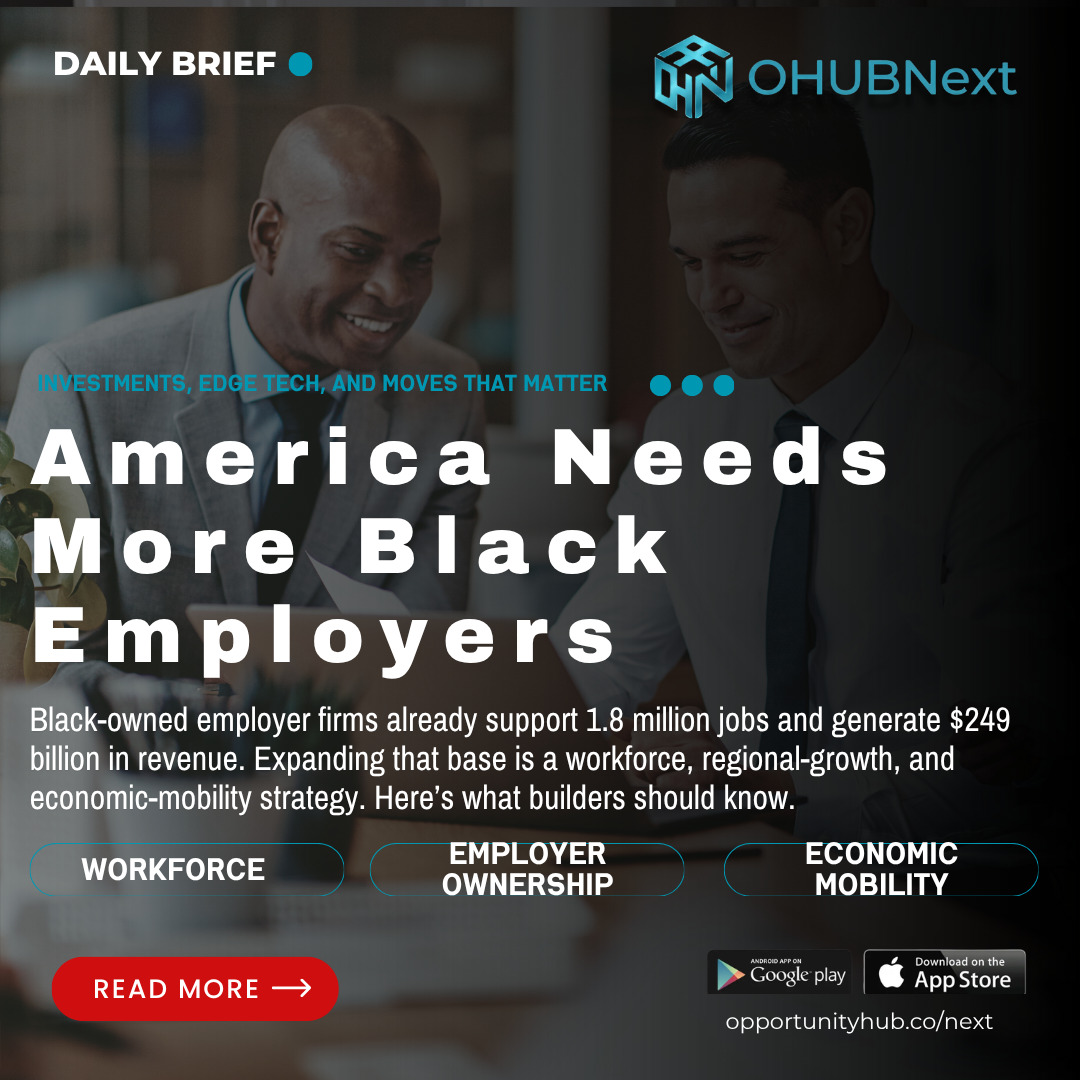
📍 Black-owned employer businesses generated $249 billion in revenue, supported more than 1.8 million jobs, and paid $69.8 billion in salaries in 2023. That is already a major economic engine. Expanding it could create millions of additional jobs while giving more communities a direct stake in regional growth. Here is what builders should know about turning business ownership into employer capacity.
─────
Hey Builders!
Black-owned businesses are usually discussed as a story of individual entrepreneurship. The larger story is employment. More than 200,000 Black-owned employer firms are already hiring people, paying salaries, purchasing from suppliers, and anchoring local economies.
That changes the strategic question. America does not simply need more people starting businesses. It needs more businesses crossing the line from founder-supported operations into durable employers.
The growth opportunity is substantial. Black people represent 14.4% of the U.S. population but only 3.4% of employer-business owners. Brookings estimates that closing the employer-ownership gap across Southern metropolitan areas alone could create more than 2 million jobs, $70 billion in additional payroll wages, and more than $263 billion in revenue.
That upside arrives when the labor market is still producing unequal outcomes. Black unemployment was 6.6% in June, compared with 3.6% for White workers. Black women’s unemployment rose to 5.7%. Expanding the Black employer base will not replace the need for fair hiring and pay, but it can widen the number of institutions positioned to create jobs, train talent, and circulate opportunity.
The constraint is not ambition. It is the operating system around ambition. Capital, customers, contracts, working capital, and management capacity determine which founders can become employers and which businesses remain permanently small.
As Global Black Economic Forum President and CEO Alphonso David put it, “Our goal is not simply to identify problems. It is to convene leaders, elevate solutions, and connect people with the information, resources, and opportunities they need to thrive.”
That is the standard. Recognize the economic engine that already exists, then build the system that lets it grow.
─────
1️⃣ Black-owned employers already support 1.8 million jobs
The number of Black-owned employer businesses grew 62% between 2017 and 2023, surpassing 200,000 firms, according to Brookings’ latest Black Business Parity Dashboard update.
Those businesses generated a combined $249 billion in revenue, supplied more than 1.8 million jobs, and paid $69.8 billion in salaries in 2023. That scale changes the entrepreneurship conversation. Black-owned businesses are not merely vehicles for individual income. They are employers, buyers, suppliers, trainers, and anchors inside regional economies.
The distinction between self-employment and employer ownership matters. Starting a business creates an opportunity for its founder. Building a company capable of hiring, training, and retaining people creates a platform for economic mobility beyond the founder.
💡 For Founders
Design for the first hire before you need the first hire. Document the work, separate recurring revenue from one-time projects, build cash controls, and identify the role that would most increase capacity. Growth becomes employable when the business can consistently convert demand into payroll.
─────
2️⃣ 3.4% employer ownership leaves a multibillion-dollar growth opportunity
Black people represented 14.4% of the U.S. population but only 3.4% of employer-business owners in the latest Brookings analysis. That is not only an equity gap. It is unused economic capacity.
Brookings estimates that bringing Black employer ownership in Southern metropolitan areas into parity with the Black share of the population could create more than 2 million jobs, $70 billion in additional payroll wages, and more than $263 billion in revenue.
The opportunity is visible at the city level. Houston gained 902 Black-owned employer businesses between 2022 and 2023. In Baton Rouge, the increase in Black employers helped offset a broader decline in employer businesses. Black-business growth was not separate from regional economic performance. It strengthened it.
💡 For Founders
Translate the parity gap into a local market map. Identify anchor institutions, major procurement categories, growing industries, workforce partners, and financing sources in your metro. The strongest ecosystem strategy connects companies to real demand, not only to entrepreneurship programming.
─────
3️⃣ 7.2% of SBA approvals delivered only 4.5% of loan dollars to Black borrowers
Business formation receives attention. Business capitalization determines what can scale.
Brookings’ review of 2024 SBA 7(a) approvals found that Black borrowers received 5,068 approvals, representing 7.2% of approvals with reported demographic data, but only $1.41 billion, or 4.5% of approved dollars. The gap between approval share and dollar share matters because smaller financing packages can constrain inventory, hiring, bonding, equipment purchases, and the working capital required to perform larger contracts.
Procurement presents a parallel challenge. Government and corporate contracts can transform a small business, but certification, compliance, bidding, insurance, bonding, and payment delays create operational barriers. A contract is only an opportunity when the company can finance delivery.
This is why workforce development and entrepreneurship belong in the same economic system. Training prepares people for work. Procurement creates demand for companies. Capital allows those companies to deliver. Employer growth turns that demand into jobs.
💡 For Founders
Build a contract-readiness file before the opportunity appears. Include registrations, certifications, insurance, financial statements, past performance, standard pricing, capability language, and a working-capital plan. The goal is not to become procurement-adjacent. It is to become contract-ready.
─────
4️⃣ 6.6% Black unemployment shows why employer growth matters
The national unemployment rate was 4.2% in June, according to the Bureau of Labor Statistics. Black unemployment was 6.6%. White unemployment was 3.6%. The gap remained close to two to one.
The headline rate also misses some of the pressure underneath the labor market. Labor-force participation fell by 0.3 percentage point to 61.5%. Six million people outside the labor force said they wanted a job but were not counted as unemployed because they were not actively searching or were unavailable to begin work during the survey period.
The sector mix offers a map for employer strategy. Professional and business services added 36,000 jobs, social assistance added 25,000, and health care added 22,000. Leisure and hospitality lost 61,000 jobs. Growing firms can use these signals to decide where demand, talent, and transition needs are emerging.
💡 For Founders
Do not treat the labor market as a generic talent pool. Identify the occupations, locations, and communities where capable workers are being displaced or overlooked. Build recruiting channels around verified skills, paid work trials, apprenticeships, and advancement paths rather than relying only on conventional networks.
─────
5️⃣ 5.7% unemployment keeps Black women at the center of the employer test
The Institute for Women’s Policy Research reported that Black women’s unemployment rose from 5.6% in May to 5.7% in June. The ratio relative to White women’s unemployment widened from 1.6 to 1.8.
That movement comes alongside persistent wage gaps and occupational segregation. It also arrives after reductions in federal employment and broader pressure on diversity and inclusion programs. The result is a volatile environment for a group that has historically maintained high labor-force participation while remaining more exposed to unemployment and pay inequity.
Black Women’s Equal Pay Day brought that frustration into the open this week. The strongest community reaction was not a request for another inspirational panel. It was a demand for direct compensation and institutional accountability. More employers matter only if those employers build fairer systems of work.
💡 For Founders
Audit pay, promotion velocity, responsibility, and retention together. A company can hire Black women and still underprice their work or narrow their path to leadership. If the data shows a gap, fix the operating decision that created it.
─────
🔧 Three moves to make this week
1️⃣ Map your employer pathway
Write down what must become repeatable before your company can hire. Identify the revenue threshold, documented process, manager, and cash reserve required for the next role. Treat job creation as an operating milestone, not an inspirational outcome.
2️⃣ Find demand before programming
Search current corporate, city, state, university, hospital, and federal procurement opportunities in your category. Then work backward from the actual requirements. A live buyer specification is more valuable than generic advice about becoming contract-ready.
3️⃣ Measure mobility, not participation
If you run a workforce or entrepreneurship program, track what happens after completion. Measure wages, contracts, repeat revenue, promotions, capital secured, and jobs created. Participation is activity. Mobility is the outcome.
─────
💬 Quote of the Day
“Our goal is not simply to identify problems. It is to convene leaders, elevate solutions, and connect people with the information, resources, and opportunities they need to thrive.” — Alphonso David, President and CEO, Global Black Economic Forum
─────
🏁 Stay Ahead With OHUBNext
This brief is part of what OHUBNext members get every day.
For $5.99/month — or $59/year — you get the full daily brief, access to OHUB's Library of Opportunity, self-paced certificates in High-Growth Company Building and Tech Ecosystem Investing, career accelerator tools, and live monthly labs with the OHUB team. The annual plan includes exclusive masterclasses, early course access, and wealth tools built for builders who are serious about owning what comes next.
Institutional-grade. Fraction of the cost.
🚀 Join at opportunityhub.co/next
─────
🎬 Closing Thought
Black-owned employers are not a future theory. They are a $249 billion economic engine supporting more than 1.8 million jobs today.
The next opportunity is to increase the number of firms capable of hiring. That means moving beyond business-start counts and measuring survival, repeat customers, contracts, affordable capital, management depth, payroll, and jobs created.
This is not a call for every worker to become an entrepreneur. It is a call to strengthen the companies already positioned to become employers and to build clearer paths for the founders ready to make that transition.
Fair work and ownership reinforce each other. Protect the worker. Capitalize the builder. Open the contract. Grow the employer. That is how more income, opportunity, and wealth move through an entire community.
─────
⚡️ OHUBNext Daily Brief - investments, edge tech, and moves that matter.
For 12+ years, OHUB has been building pathways and on-ramps to multi-generational wealth without reliance on pre-existing wealth. Through exposure, skills, entrepreneurship, capital markets, and inclusive ecosystems, we've helped people create new jobs, new companies, and new wealth.

OHUBNext
One simple plan. $5.99/month or billed annually.
opportunityhub.co