


OHUB @ohub
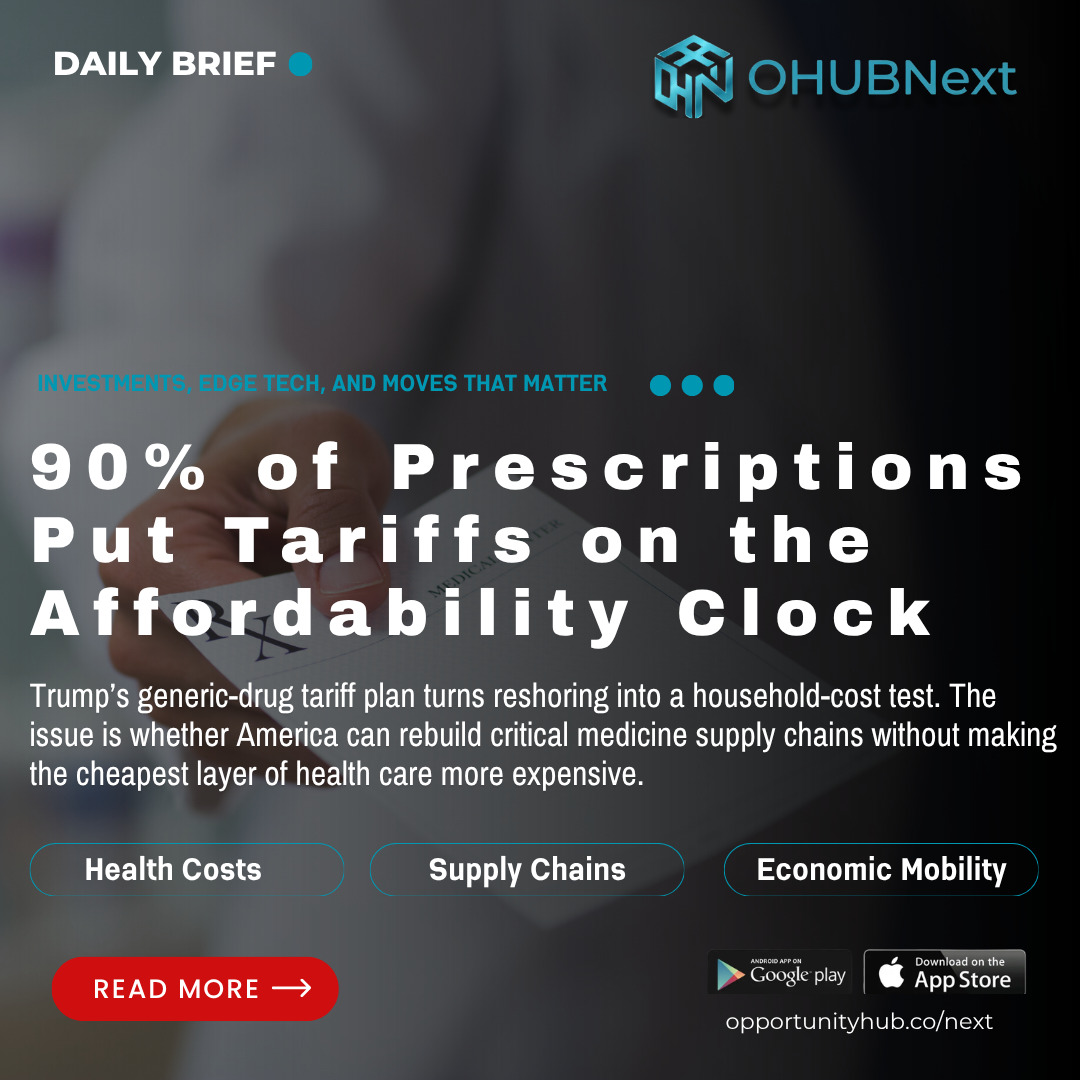
🚨 OHUBNext | 90% of Prescriptions Put Tariffs on the Affordability Clock
🚨 OHUBNext | 90% of Prescriptions Put Tariffs on the Affordability Clock
📍 President Trump’s planned tariff schedule for imported generic drugs would keep duties at zero until August 2028, then impose a 100 percent tariff for one year before rising to 200 percent. The stakes are bigger than a trade fight because generics fill roughly 9 out of 10 U.S. prescriptions. If reshoring policy raises the price of low-cost medicine, the cost lands directly on households, employers, insurers, hospitals, and the builders trying to serve them.
─────
Hey Builders!
Today’s defining AI story isn’t the buildout—it’s what happens when industrial ambition collides with household affordability.
Let's unpack.
Axios framed the issue cleanly this morning. The administration wants to reduce dependence on overseas generic-drug manufacturing while still keeping prescriptions cheap. That is a hard promise to keep because the generic-drug model works precisely because scale, competition, global supply chains, and thin margins have pushed prices down.
The FDA says "9 out of 10 prescriptions filled are for generic drugs." The agency’s Office of Generic Drugs says generics account for more than 90 percent of prescriptions filled in the United States. The Association for Accessible Medicines reports that in 2024, generics made up 90 percent of prescriptions but only 12 percent of total prescription-drug spending.
That is the economic mobility frame. Generic drugs are not a niche product. They are part of the invisible infrastructure that keeps millions of families, employers, and public programs from paying brand-level prices for routine care.
The tariff plan may also expose a deeper company-building lesson. It is easier to announce a domestic-production goal than to finance, permit, staff, qualify, and inspect a resilient pharmaceutical manufacturing base. A policy that pushes production home without enough transition capital could create a gap between national-security ambition and patient access.
For founders and operators, this is not only a health care story. It is a reminder that affordability is a system, not a slogan. When policy rewires supply chains, the winners are the companies that can make cost, quality, resilience, and trust work at the same time.
─────
1️⃣ 100 Percent Tariffs Put Generic Drugs on a Two-Year Clock
Bloomberg Government reported that generic drug manufacturers must move production to the United States or face a 100 percent import duty from August 2028. The reported plan gives manufacturers two years before the first major tariff step.
Axios reported the same core timeline, with generic-drug tariffs set to begin in August 2028 as a test of the administration’s promise to increase domestic drug manufacturing while keeping prescription costs low. Financial Times reporting said the plan would rise from 100 percent in 2028 to 200 percent a year later.
The timeline matters because pharmaceutical manufacturing cannot be reshored like a simple consumer good. Facilities require capital, regulatory clearance, quality systems, supplier qualification, and workforce capacity. A two-year clock is long in politics and short in drug manufacturing.
💡 For Founders
Watch the transition layer. If you build in health care, logistics, compliance, finance, workforce training, or manufacturing analytics, this kind of policy shock creates demand for tools that lower reshoring friction without raising patient cost.
─────
2️⃣ 9 Out of 10 Prescriptions Make This an Economic Mobility Story
The FDA says 9 out of 10 prescriptions filled in the United States are generic drugs. FDA’s Office of Generic Drugs separately says generics account for more than 90 percent of prescriptions filled in the country.
The spending split is what makes the story sharper. The Association for Accessible Medicines says generics comprised 90 percent of all prescriptions filled in 2024 but only 12 percent of total U.S. prescription-drug spending.
That means generic drugs carry the volume of the system without carrying the spending share. Any policy that raises the cost of generic production, importation, distribution, or reimbursement touches the lowest-cost part of the medicine market.
💡 For Founders
Affordability markets reward precision. If your company serves households, employers, or public systems, show exactly where cost is absorbed, passed through, avoided, or reduced.
─────
3️⃣ $467 Billion Shows Why Low-Cost Medicine Is Infrastructure
The Association for Accessible Medicines and the Biosimilars Council reported that generic and biosimilar medicines saved the U.S. health care system $467 billion in 2024. The same report said generics and biosimilars represented 90 percent of prescriptions filled while accounting for 12 percent of prescription-drug spending.
Those savings do not show up as a ribbon-cutting. They show up as avoided costs for patients, employers, plans, Medicare, Medicaid, hospitals, and state budgets. That is why the policy tradeoff is so consequential.
Resilience has value. Domestic production has value. But if the mechanism weakens the low-cost layer that makes medication adherence possible, the policy can improve supply-chain optics while worsening affordability.
💡 For Founders
Do not separate access from economics. The strongest health care companies will prove that reliability and affordability can move together, especially in categories where patients cannot simply opt out.
─────
4️⃣ Tariffs May Reshore the Headline Before They Reshore the Supply Chain
Brookings scholar Marta Wosinska has warned that pharmaceutical tariffs may not automatically produce the intended reshoring outcome. Her analysis argues that sector-wide tariffs can be counterproductive if they raise costs without solving the deeper active-ingredient and supply-chain dependencies.
The Association for Accessible Medicines is more direct in its trade-policy posture. Its trade page says tariffs on generic medicines and ingredients can have disastrous impacts on a U.S. market where manufacturers already face reimbursement pressure.
This is the operating challenge. If reimbursement, quality oversight, input sourcing, workforce availability, and capital cost do not line up, tariffs may shift incentives without creating enough durable domestic capacity.
💡 For Founders
Build for the bottleneck, not the announcement. The investable opportunities are in supplier visibility, quality assurance, regulatory workflow, production planning, financing, and workforce pipelines.
─────
5️⃣ 90.8 Consumer Confidence Shows the Timing Is Politically Fragile
The Conference Board’s July Consumer Confidence Index came in at 90.8, according to AP reporting, down from 92.2 in June. The expectations index was 74.7, below the level that often signals recession risk when sustained.
That matters because prescription-drug costs sit inside a household budget already under pressure from housing, energy, food, insurance, and borrowing costs. A tariff policy can be defensible on national-security grounds and still be hard to execute if consumers experience it as another affordability shock.
This is the broader market signal. Companies and policymakers are being forced to solve resilience and cost at the same time. The old tradeoff between cheap global supply and domestic control is becoming more expensive to manage.
💡 For Founders
Price sensitivity is not a consumer segment. It is the operating environment. Build products, benefits, and financing models that assume households and employers will scrutinize every recurring cost.
─────
🔧 Three moves to make this week
1️⃣ Map your affordability exposure
Identify where your product touches household costs, employer costs, or public-program budgets. If policy or supply-chain changes raise input costs, know whether your customer can absorb them.
2️⃣ Build a resilience case with numbers
Do not sell domestic supply, trust, or compliance as abstract virtues. Show the cost of disruption, the cost of delay, and the return on better visibility.
3️⃣ Watch regulated supply chains for openings
Health care, food, energy, logistics, and critical manufacturing are all being repriced through resilience policy. The best opportunities will sit where compliance, capital, and operating execution meet.
─────
💬 Quote of the Day
"9 out of 10 prescriptions filled are for generic drugs." — U.S. Food and Drug Administration
─────
🏁 Stay Ahead With OHUBNext
This brief is part of what OHUBNext members get every day.
For $5.99/month — or $59/year — you get the full daily brief, access to OHUB's Library of Opportunity, self-paced certificates in High-Growth Company Building and Tech Ecosystem Investing, career accelerator tools, and live monthly labs with the OHUB team. The annual plan includes exclusive masterclasses, early course access, and wealth tools built for builders who are serious about owning what comes next.
Institutional-grade. Fraction of the cost.
🚀 Join at opportunityhub.co/next
─────
🎬 Closing Thought
The generic-drug tariff story is powerful because it refuses to stay inside one category. It is trade policy, health care policy, manufacturing policy, workforce policy, and household economics at once.
That is exactly why it belongs in OHUBNext. Builders need to understand where public policy changes the cost structure of everyday life. Investors need to understand which supply chains can actually be rebuilt. Operators need to understand that resilience without affordability is an incomplete strategy.
The next generation of opportunity will not come only from inventing new products. It will come from rebuilding essential systems so they are cheaper, more trusted, and less fragile.
If you are building now, look for the pressure points where families feel cost, institutions feel risk, and incumbents move too slowly. That is where serious company building starts.
─────
⚡️ OHUBNext Daily Brief - investments, edge tech, and moves that matter.
For 12+ years, OHUB has been building pathways and on-ramps to multi-generational wealth without reliance on pre-existing wealth. Through exposure, skills, entrepreneurship, capital markets, and inclusive ecosystems, we've helped people create new jobs, new companies, and new wealth.

OHUBNext
One simple plan. $5.99/month or billed annually.
opportunityhub.co