

OHUB @ohub
🚨 OHUBNext | The Confidence Correction
🚨 OHUBNext | The Confidence Correction
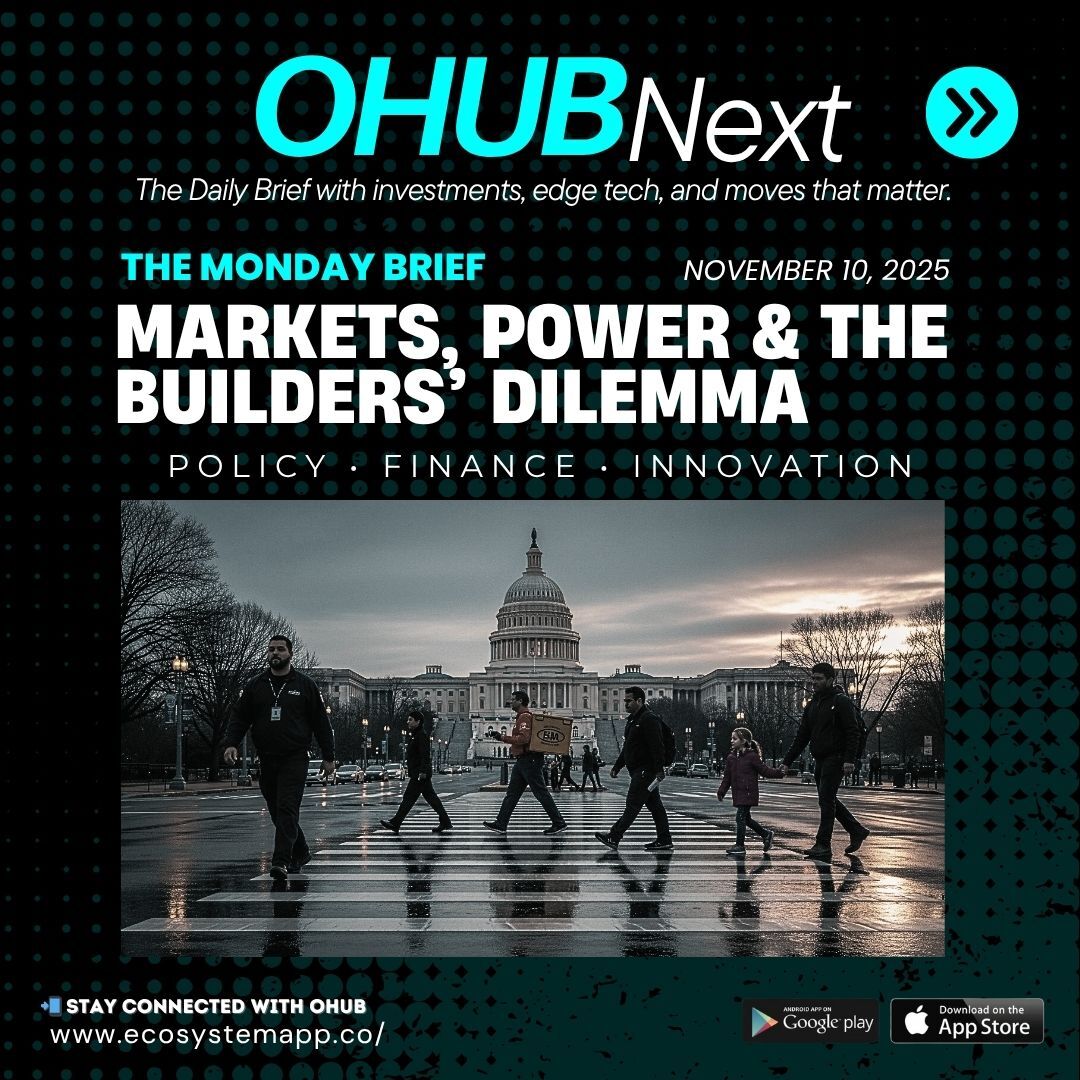
📍 Consumer confidence is falling, markets are rising, and the government may finally reopen. The contradiction tells us something deeper about how trust, governance, and behavior now shape the real economy.
⸻
Hey Builders!
The Senate’s weekend deal to end the nation’s longest shutdown offers more than overdue paychecks. It measures how a government repairs faith after fracture, and whether leadership can still translate power into trust.
As the University of Michigan’s sentiment index fell to 50.3 in November—its lowest in three years—consumer caution spread even as markets climbed. Households pulled back on discretionary spending, investors bought the dip, and policymakers scrambled to turn process into proof. The government shutdown has been not just an economic event but a behavioral referendum on what Americans still trust to work.
When public institutions jam, the private sector becomes the emotional backstop. Yet even that resilience has limits. The shutdown’s impact on SNAP benefits, air travel, and payrolls exposed the fragility of systems designed to operate without interruption. Every modern economy depends as much on procedural continuity as it does on productivity.
⸻
🗞️ Top Story — The Shutdown Deal and the Economics of Trust
The Senate’s weekend deal would restore funding through January 30, temporarily ending a standoff that has cost billions in lost output and shaken public faith in governance (Reuters 2025).
▪️ Roughly 800 thousand federal employees have gone unpaid for over a month, and 42 million Americans dependent on food subsidies have faced uncertainty in accessing benefits.
▪️ Air travel disruptions and suspended inspections have already cost the aviation industry hundreds of millions in lost productivity.
▪️ Economists at the Penn Wharton Budget Model estimate that every two weeks of shutdown shaved 0.1 percent from quarterly GDP.
▪️ While equity markets rallied on the news of progress, polling still shows half of Americans blame Republican leadership for the standoff, a reminder that trust and growth often move in opposite directions.
The temporary resolution offers a pause, not a reset. It funds the government, but it does not yet restore confidence. True recovery will depend on whether institutions can act with predictability in a political environment that thrives on spectacle.
As Stanford’s Caroline Hoxby notes, “Economic stability is not just about balance sheets, but about belief in continuity.”
⸻
⚡ Quick Briefs
▪️ Consumer sentiment has fallen more than 18 percent since August (University of Michigan 2025).
▪️ Markets rose 1.2 percent on news of the Senate breakthrough (S&P Global 2025).
▪️ Household savings are rising again as families hedge against future shocks (Federal Reserve 2025).
▪️ Debt service payments are up 20 percent year-over-year, pressuring middle-income households (CBO 2025).
▪️ Economic advisers warn that even brief interruptions in federal spending ripple through housing, transportation, and small-business lending (PIIE 2025).
⸻
🧱 Builder Insights
1️⃣ Confidence is currency. Trust moves faster than capital and determines how long systems endure under strain.
2️⃣ Predictability is power. Markets and citizens reward governance that functions, not rhetoric that fluctuates.
3️⃣ Recovery begins with credibility. Every reopened agency and restored payment is an act of economic repair.
4️⃣ Behavior is the new balance sheet. Policy is now read less in budgets and more in household psychology.
5️⃣ The next crisis will test what we rebuilt. Systems that restore faith today must be designed to withstand tomorrow’s volatility.
⸻
💬 Quote of the Day
“Confidence is the cheapest stimulus a government can provide and the hardest to sustain.”
— Mohamed El-Erian, Chief Economic Advisor, Allianz (2025)
⸻
🎬 Closing Thought
The shutdown’s near-end is not a story of political victory but of economic endurance. Institutions survived another test, though at the cost of public patience. The deeper work now lies in restoring what no bill can legislate—trust.
Confidence is not optimism. It is continuity.
⸻
⚡ OHUBNext Daily Brief — investments, edge tech, and moves that matter.
For 12+ years, OHUB has been building pathways to multi-generational wealth through exposure, skills, entrepreneurship, capital markets, and inclusive ecosystems.